
Close Menu
    Facebook X (Twitter) Instagram
    SciTechDaily
    • Biology
    • Chemistry
    • Earth
    • Health
    • Physics
    • Science
    • Space
    • Technology
    Facebook X (Twitter) Pinterest YouTube RSS
    SciTechDaily
    Home»Space»First Mars Observations from NASA’s MAVEN Spacecraft
    Space

    First Mars Observations from NASA’s MAVEN Spacecraft

    By NASASeptember 25, 2014No Comments2 Mins Read
    Facebook Twitter Pinterest Telegram LinkedIn WhatsApp Email Reddit
    Share
    Facebook Twitter LinkedIn Pinterest Telegram Email Reddit
    MAVEN Spacecraft Returns First Mars Observations
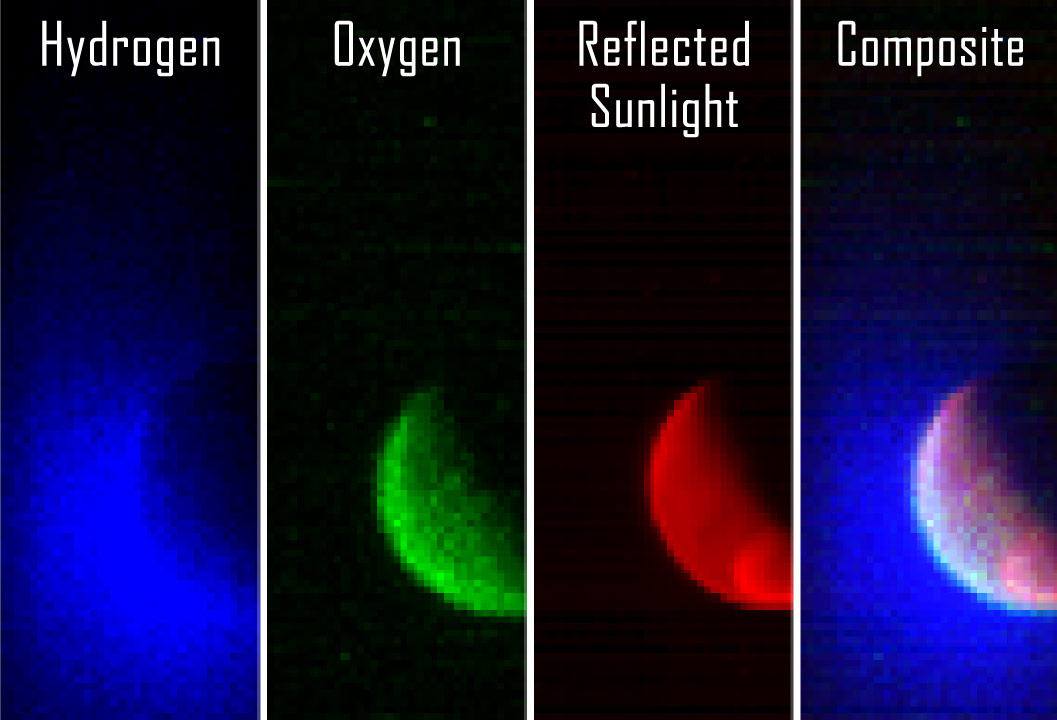
    Captured from 36,500 km (22,700 mi) altitude, the image reveals the planet in three ultraviolet bands. Blue depicts scattered sunlight from atomic hydrogen gas in an extended cloud above the surface. Green showcases sunlight reflected off atomic oxygen, highlighting the smaller oxygen cloud. Red displays ultraviolet sunlight reflected by the planet’s surface; the bright spot in the lower right emanates from polar ice or clouds. Credit: Laboratory for Atmospheric and Space Physics, University of Colorado; NASA

    The above images are the first observations of the extended upper atmosphere from NASA’s MAVEN spacecraft.

    NASA’s Mars Atmosphere and Volatile Evolution (MAVEN) spacecraft has obtained its first observations of the extended upper atmosphere surrounding Mars.

    The Imaging Ultraviolet Spectrograph (IUVS) instrument obtained these false-color images eight hours after the successful completion of Mars orbit insertion by the spacecraft at 10:24 p.m. EDT Sunday, September 21, after a 10-month journey.

    The image shows the planet from an altitude of 36,500 km (22,700 mi) in three ultraviolet wavelength bands. Blue shows the ultraviolet light from the sun scattered from atomic hydrogen gas in an extended cloud that goes to thousands of kilometers above the planet’s surface. Green shows a different wavelength of ultraviolet light that is primarily sunlight reflected off of atomic oxygen, showing the smaller oxygen cloud. Red shows ultraviolet sunlight reflected from the planet’s surface; the bright spot in the lower right is light reflected either from polar ice or clouds.

    The oxygen gas is held close to the planet by Mars’ gravity, while lighter hydrogen gas is present to higher altitudes and extends past the edges of the image. These gases derive from the breakdown of water and carbon dioxide in Mars’ atmosphere. Over the course of its one-Earth-year primary science mission, MAVEN observations like these will be used to determine the loss rate of hydrogen and oxygen from the Martian atmosphere. These observations will allow us to determine the amount of water that has escaped from the planet over time.

    MAVEN is the first spacecraft dedicated to exploring the tenuous upper atmosphere of Mars.


    Never miss a breakthrough: Join the SciTechDaily newsletter.
    Follow us on Google and Google News.

    Astronomy Mars MAVEN Planetary Science
    Share. Facebook Twitter Pinterest LinkedIn Email Reddit

    Related Articles

    MAVEN Spacecraft Detects Aurora and Mysterious Dust Cloud around Mars

    MAVEN Spacecraft Completes First Deep Dip Campaign of Martian Atmosphere

    MAVEN Identifies Links to Atmospheric Loss on Mars

    MAVEN Spacecraft Set to Continue Mars Exploration

    MAVEN Provides First Look at the Upper Atmosphere of Mars

    MAVEN Spacecraft Successfully Enters Mars’ Orbit

    NASA MAVEN Spacecraft Prepares for Mars Orbit-Insertion Maneuver

    MAVEN Spacecraft Makes Final Preparations for Mars Orbit-Insertion Maneuver

    New ScienceCast Video Explores the Mystery of Mars

    Leave A Reply Cancel Reply

    • Facebook
    • Twitter
    • Pinterest
    • YouTube

    Don't Miss a Discovery

    Subscribe for the Latest in Science & Tech!

    Trending News

    Your Blood Pressure Reading Could Be Wrong Because of One Simple Mistake

    Astronomers Stunned by Ancient Galaxy With No Spin

    Physicists May Be on the Verge of Discovering “New Physics” at CERN

    Scientists Solve 320-Million-Year Mystery of Reptile Skin Armor

    Scientists Say This Daily Walking Habit May Be the Secret to Keeping Weight Off After Dieting

    New Therapy Rewires the Brain To Restore Joy in Depression Patients

    Giant Squid Detected off Western Australia in Stunning Deep-Sea Discovery

    Popular Sugar-Free Sweetener Linked to Liver Disease, Study Warns

    Follow SciTechDaily
    • Facebook
    • Twitter
    • YouTube
    • Pinterest
    • Newsletter
    • RSS
    SciTech News
    • Biology News
    • Chemistry News
    • Earth News
    • Health News
    • Physics News
    • Science News
    • Space News
    • Technology News
    Recent Posts
    • Hidden Warm Water Beneath Antarctica Could Rapidly Raise Global Sea Levels
    • Scientists Revive Ancient Chemistry Trick To Engineer Next-Generation Glass
    • Scientists Use AI To Supercharge Ultrafast Laser Simulations by More Than 250x
    • Scientists Just Found a Surprising Way To Destroy “Forever Chemicals”
    • Popular Supplement Ingredient Linked to Shorter Lifespan in Men
    Copyright © 1998 - 2026 SciTechDaily. All Rights Reserved.
    • Science News
    • About
    • Contact
    • Editorial Board
    • Privacy Policy
    • Terms of Use

    Type above and press Enter to search. Press Esc to cancel.