
Close Menu
    Facebook X (Twitter) Instagram
    SciTechDaily
    • Biology
    • Chemistry
    • Earth
    • Health
    • Physics
    • Science
    • Space
    • Technology
    Facebook X (Twitter) Pinterest YouTube RSS
    SciTechDaily
    Home»Space»Hubble Reveals Actual Visible-Light Color of Exoplanet HD 189733b
    Space

    Hubble Reveals Actual Visible-Light Color of Exoplanet HD 189733b

    By NASAJuly 11, 20134 Comments4 Mins Read
    Facebook Twitter Pinterest Telegram LinkedIn WhatsApp Email Reddit
    Share
    Facebook Twitter LinkedIn Pinterest Telegram Email Reddit
    Hubble Discovers a Blue Planet HD 189733b
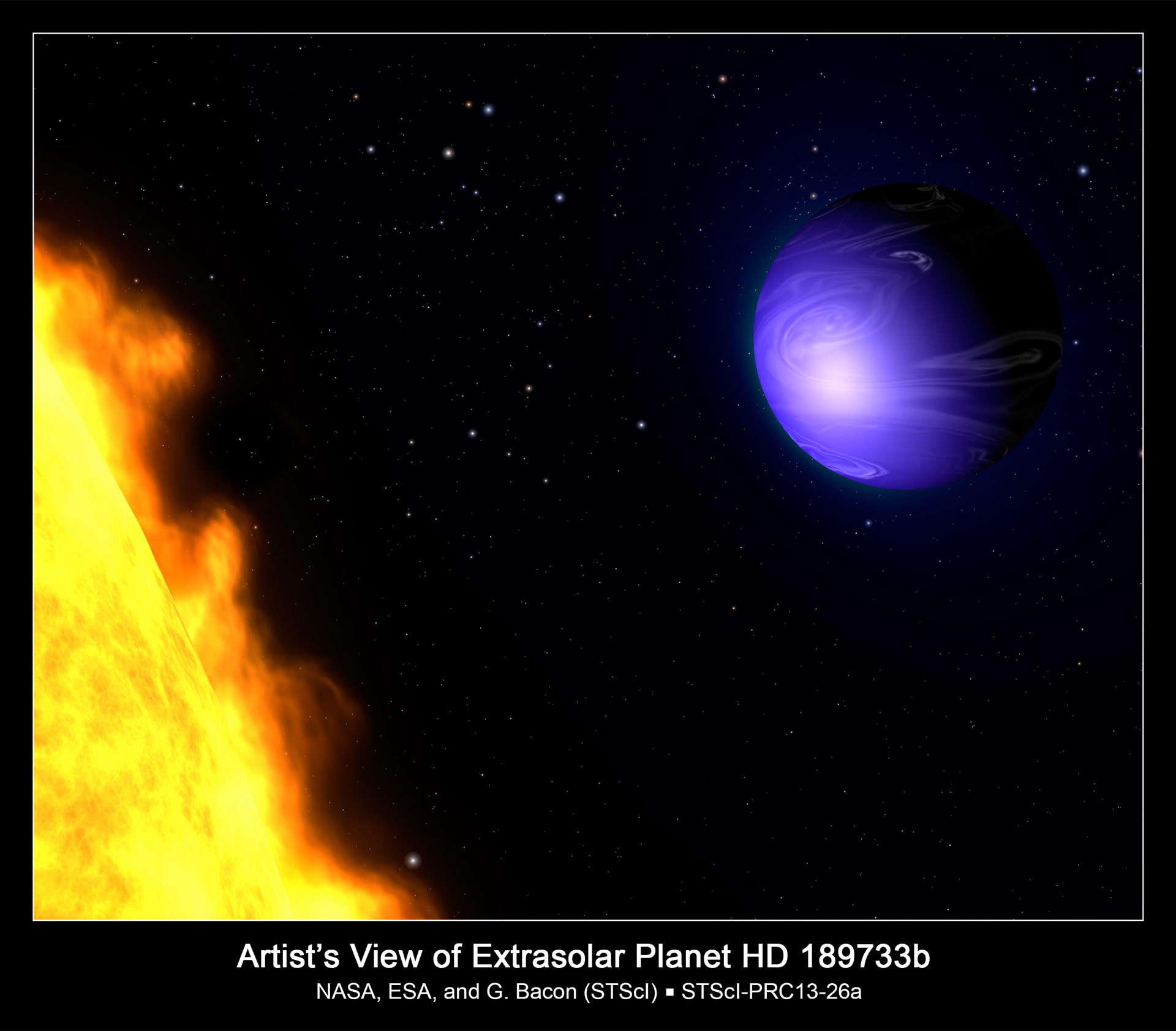
    This artist’s concept shows exoplanet HD 189733b orbiting its yellow-orange star, HD 189733. NASA’s Hubble Space Telescope measured the actual visible-light color of the planet, which is deep blue. Credit: NASA, ESA, and G. Bacon (STScI)

    Using data from NASA’s Hubble Space Telescope, astronomers have revealed that the actual visible-light color of exoplanet HD 189733b is deep blue.

    Astronomers making visible-light observations with NASA’s Hubble Space Telescope have deduced the actual color of a planet orbiting another star 63 light-years away.

    The planet is HD 189733b, one of the closest exoplanets that can be seen crossing the face of its star.


    This illustration shows HD 189733b, a huge gas giant that orbits very close to its host star HD 189733.

    Hubble’s Space Telescope Imaging Spectrograph measured changes in the color of light from the planet before, during and after a pass behind its star. There was a small drop in light and a slight change in the color of the light. “We saw the light becoming less bright in the blue but not in the green or red. Light was missing in the blue but not in the red when it was hidden,” said research team member Frederic Pont of the University of Exeter in South West England. “This means that the object that disappeared was blue.”

    Earlier observations have reported evidence for the scattering of blue light on the planet. The latest Hubble observation confirms the evidence.

    If seen directly, this planet would look like a deep blue dot, reminiscent of Earth’s color as seen from space. That is where the comparison ends.

    On this turbulent alien world, the daytime temperature is nearly 2,000 degrees Fahrenheit, and it possibly rains glass — sideways — in howling, 4,500-mph winds. The cobalt blue color comes not from the reflection of a tropical ocean as it does on Earth, but rather a hazy, blow-torched atmosphere containing high clouds laced with silicate particles. Silicates condensing in the heat could form very small drops of glass that scatter blue light more than red light.

    Hubble and other observatories have made intensive studies of HD 189733b and found its atmosphere to be changeable and exotic.

    HD 189733b is among a bizarre class of planets called hot Jupiters, which orbit precariously close to their parent stars. The observations yield new insights into the chemical composition and cloud structure of the entire class.
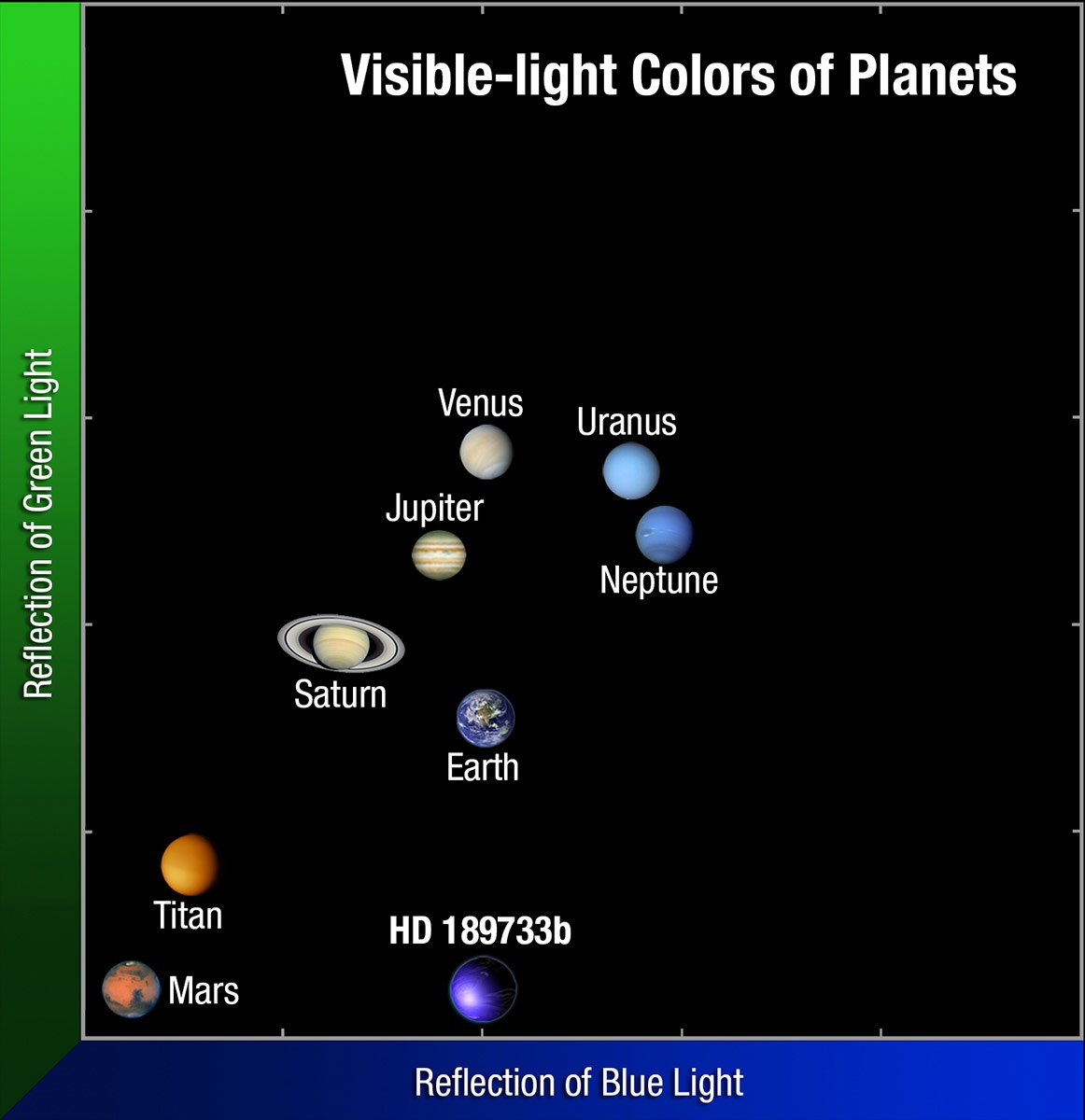
    Colors of Planets in Our Solar System Compared to Exoplanet HD 189733b
    This plot compares the colors of planets in our solar system to exoplanet HD 189733b. The exoplanet’s deep blue color is produced by silicate droplets, which scatter blue light in its atmosphere. Credit: NASA, ESA, and A. Feild (STScI)

    Clouds often play key roles in planetary atmospheres. Detecting the presence and importance of clouds in hot Jupiters is crucial to astronomers’ understanding of the physics and climatology of other planets.

    HD 189733b was discovered in 2005. It is only 2.9 million miles (4.7 million kilometers) from its parent star, so close that it is gravitationally locked. One side always faces the star and the other side is always dark.

    In 2007, NASA’s Spitzer Space Telescope measured the infrared light, or heat, from the planet, leading to one of the first temperature maps for an exoplanet. The map shows day side and night side temperatures on HD 189733b differ by about 500 degrees Fahrenheit (260 degrees Celsius). This should cause fierce winds to roar from the day side to the night side.

    Publication: Thomas M. Evans, et al., “The Deep Blue Color of HD 189733b: Albedo Measurements with Hubble Space Telescope/Space Telescope Imaging Spectrograph at Visible Wavelengths,” 2013, ApJ, 772, L16; doi:10.1088/2041-8205/772/2/L16

    PDF Copy of the Study: The deep blue color of HD189733b: albedo measurements with HST/STIS at visible wavelengths

    Never miss a breakthrough: Join the SciTechDaily newsletter.
    Follow us on Google and Google News.

    Astronomy Exoplanet Hubble Space Telescope NASA Planetary Science
    Share. Facebook Twitter Pinterest LinkedIn Email Reddit

    Related Articles

    Hubble Finds a Planet Orbiting Pair of Stars in System OGLE-2007-BLG-349

    Hubble Measures Rotation of ‘Super-Jupiter’ Exoplanet 2M1207b

    Hubble Reveals a Dry Atmosphere Around Super-Earth 55 Cancri e

    Hubble Finds Signatures of Water on Distant Exoplanets

    Asteroid Belts and Their Potential Significance for Life

    New Study Revives Doubted Exoplanet Fomalhaut b

    Volunteer Scientists Aid in Discovery of Four-Star Planet PH1

    “Habitable Zone” Might Help Extreme Life Forms Survive on Exoplanets

    NASA Data Reveals Significant Changes in Exoplanet’s Atmosphere

    4 Comments

    1. Jayme Blaschke on July 11, 2013 8:43 am

      “The cobalt blue color comes not from the reflection of a tropical ocean as it does on Earth” Really? REALLY? Blown credibility, much?

      Reply
    2. Jayme Blaschke on July 11, 2013 8:46 am

      Look up John Tyndall when you get a chance.

      Reply
      • George Strain on July 11, 2013 11:51 am

        Try looking down sometime!

        http://eoimages.gsfc.nasa.gov/images/imagerecords/57000/57723/globe_east_2048.jpg

        Reply
    3. CftxP on July 12, 2013 5:39 am

      Exactly George! 😀

      Ever wondered why the sky is blue? The atmosphere sure as hell can’t reflect the lush green of the forests or the peachy color of the deserts. We might be carbon-based lifeforms here on Earth, but we all need water or we die. 😮

      Reply
    Leave A Reply Cancel Reply

    • Facebook
    • Twitter
    • Pinterest
    • YouTube

    Don't Miss a Discovery

    Subscribe for the Latest in Science & Tech!

    Trending News

    Breakthrough Bowel Cancer Trial Leaves Patients Cancer-Free for Nearly 3 Years

    Natural Compound Shows Powerful Potential Against Rheumatoid Arthritis

    100,000-Year-Old Neanderthal Fossils in Poland Reveal Unexpected Genetic Connections

    Simple “Gut Reset” May Prevent Weight Gain After Ozempic or Wegovy

    2.8 Days to Disaster: Scientists Warn Low Earth Orbit Could Suddenly Collapse

    Common Food Compound Shows Surprising Power Against Superbugs

    5 Simple Ways To Remember More and Forget Less

    The Atomic Gap That Could Cost the Semiconductor Industry Billions

    Follow SciTechDaily
    • Facebook
    • Twitter
    • YouTube
    • Pinterest
    • Newsletter
    • RSS
    SciTech News
    • Biology News
    • Chemistry News
    • Earth News
    • Health News
    • Physics News
    • Science News
    • Space News
    • Technology News
    Recent Posts
    • After 37 Years, the World’s Longest-Running Soil Warming Experiment Uncovers a Startling Climate Secret
    • NASA Satellite Captures First-Ever High-Res View of Massive Pacific Tsunami
    • ADHD Isn’t Just a Deficit: Study Reveals Powerful Hidden Strengths
    • Scientists Uncover “Astonishing” Hidden Property of Light
    • Scientists Discover Stem Cells That Could Regrow Teeth and Bone
    Copyright © 1998 - 2026 SciTechDaily. All Rights Reserved.
    • Science News
    • About
    • Contact
    • Editorial Board
    • Privacy Policy
    • Terms of Use

    Type above and press Enter to search. Press Esc to cancel.