
Close Menu
    Facebook X (Twitter) Instagram
    SciTechDaily
    • Biology
    • Chemistry
    • Earth
    • Health
    • Physics
    • Science
    • Space
    • Technology
    Facebook X (Twitter) Pinterest YouTube RSS
    SciTechDaily
    Home»Biology»Hyperparasite Fungus Limits the Effects of ‘Zombie-Ant’ Fungus
    Biology

    Hyperparasite Fungus Limits the Effects of ‘Zombie-Ant’ Fungus

    By Penn State UniversityMay 3, 2012No Comments4 Mins Read
    Facebook Twitter Pinterest Telegram LinkedIn WhatsApp Email Reddit
    Share
    Facebook Twitter LinkedIn Pinterest Telegram Email Reddit
    parasite that fights the zombie-ant fungus
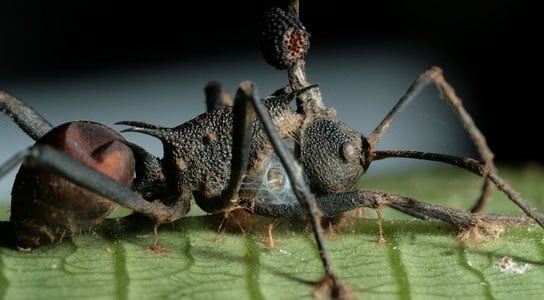
    A parasite that fights the zombie-ant fungus has yielded some of its secrets to an international research team led by David Hughes of Penn State University. The research reveals, for the first time, how an entire ant colony is able to survive infestations by the zombie-ant fungus, which invades an ant’s brain and causes it to march to its death at a mass grave near the ant colony, where the fungus spores erupt out of the ant’s head. This photo shows a zombie ant with the brain-manipulating fungus (Ophiocordyceps unilateralis s.l.) having been castrated by an hyperparasite fungus (white with yellow material). This is no longer a threat to the ants. Credit: David Hughes

    New research on a parasite that fights zombie-ant fungus, an infestation that takes over the brain and then ejects its spores out of the ant’s head, reveals how an ant colony is able to survive this infestation. While it is well known that ants protect themselves from fungi by grooming each other, research by scientists at Penn State revealed that the hyperparasite fungi also had castrating effects that significantly limited the spread of the zombie-ant fungus.

    A parasite that fights the zombie-ant fungus has yielded some of its secrets to an international research team led by Penn State’s David Hughes. The research reveals, for the first time, how an entire ant colony is able to survive infestations by the zombie-ant fungus, which invades an ant’s brain and causes it to march to its death at a mass grave near the ant colony, where the fungus spores erupt out of the ant’s head.

    “In a case where biology is stranger than fiction, the parasite of the zombie-ant fungus is itself a fungus — a hyperparasitic fungus that specializes in attacking the parasite that turns the ants into zombies,” Hughes said. The research was published on May 2 in the journal PLoS ONE.

    “The hyperparasitic fungus effectively castrates the zombie-ant fungus so it cannot spread its spores,” said Hughes, who is an assistant professor of entomology and biology, and a member of the Center for Infectious Disease Dynamics at Penn State. “Because the hyperparasitic fungi prevents the infected zombie-ant fungus from spreading spores, fewer of the ants will become zombies.”

    As part of their research, the scientists created a detailed model that revealed previously unknown details of the interactions between the fungus-infected ants and the parasite-infected zombie-ant fungus. Scientists previously had known that ants defend their colonies against microscopic enemies such as fungal spores by efficiently grooming each other. In this study, the researchers also modeled the effect of ant behavior on limiting infection. “Interestingly, beyond the well-known effect of defensive ant behavior, our new research reveals the added effect of the castrating actions of the hyperparasite fungi, which may result in significantly limiting the spread of the zombie-ant fungus,” Hughes said.
    'Zombie-ant' fungus
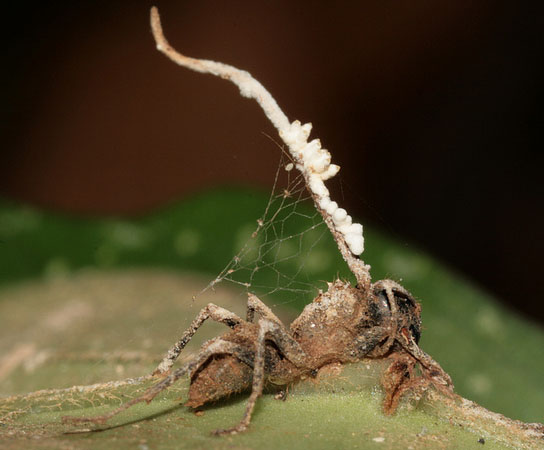
    A parasite that fights the zombie-ant fungus has yielded some of its secrets to an international research team led by David Hughes of Penn State. The research reveals, for the first time, how an entire ant colony is able to survive infestations by the zombie-ant fungus, which takes over the brain and then ejects its spores out of the ant’s head. Credit: David Hughes

    The scientists report that only about 6.5 percent of the spore-producing organs of the zombie-ant fungus were viable. “Even though there are a lot of dead and infected zombie ants in the neighborhood, only a few of the spores of the zombie-ant fungus will become mature and able to infect healthy ants,” Hughes said.

    “Our research indicates that the danger to the ant colony is much smaller than the high density of zombie-ant cadavers in the graveyard might suggest. This complex interaction between ant colonies, their brain-manipulating parasites, and other fungi capable of lending assistance to the colony underscores the need to study social insects under natural conditions.”

    Hughes said his team is expanding its efforts and “remains focused on following the exciting theater played out on the rainforest floor.”

    Reference: “Disease Dynamics in a Specialized Parasite of Ant Societies” by Sandra B. Andersen, Matthew Ferrari, Harry C. Evans, Simon L. Elliot, Jacobus J. Boomsma and David P. Hughes, 2 May 2012, PLoS ONE.
    DOI: 10.1371/journal.pone.0036352

    The research was performed by an international group of scientists from University of Copenhagen, Denmark, Federal University of Vicosa, Brazil, and Penn State in the United States. The research is funded by a Marie Curie OIF Fellowship (PIOF-GA-2008-221041), Danish National Research Foundation and Brazilian National Council for Research (CNPq, grant no. 401610/2009-8) and Penn State.

    Never miss a breakthrough: Join the SciTechDaily newsletter.
    Follow us on Google and Google News.

    Ants Brain Activity Entomology Fungus Parasite Penn State University Popular
    Share. Facebook Twitter Pinterest LinkedIn Email Reddit

    Related Articles

    Mushroom Growing Out of 50-Million-Year-Old Fossilized Ant Reveals New Species of Fungal Parasite

    Ant Responses to Social Isolation Surprisingly Resemble Those of Humans

    Stunning 99-Million-Year-Old Fossil Reveals “Hell Ants” in Detail: Hunted With Bizarre, Deadly Mandibles

    In a Twist of Fate, Ant Expert Discovers Distinct New Species in His Own Backyard

    Invasion of Zombie Ants in Florida – Fungal Infection Takes Over the Ants’ Brains

    Cannibal Wood Ants Were Stuck in a Polish Nuclear Weapons Bunker – Here’s What Happened

    Ants vs. Humans: Solving the Mystery of How Ants Manage Traffic So Well

    Recording Breaking Speed: World’s Fastest Ant Clocked at 855mm/s, an Incredible 47 Strides/s

    Zombie-Ant Fungus Faces Its Own Deadly, Specialized Parasites

    Leave A Reply Cancel Reply

    • Facebook
    • Twitter
    • Pinterest
    • YouTube

    Don't Miss a Discovery

    Subscribe for the Latest in Science & Tech!

    Trending News

    Popular Sugar-Free Sweetener Linked to Liver Disease, Study Warns

    What Is Hantavirus? The Deadly Disease Raising Alarm Worldwide

    Scientists Just Discovered How the Universe Builds Monster Black Holes

    Scientists Unveil New Treatment Strategy That Could Outsmart Cancer

    A Simple Vitamin May Hold the Key to Treating Rare Genetic Diseases

    Scientists Think the Real Fountain of Youth May Be Hiding in Your Gut

    Ravens Don’t Follow Wolves, They Predict Them

    This Common Knee Surgery May Be Doing More Harm Than Good

    Follow SciTechDaily
    • Facebook
    • Twitter
    • YouTube
    • Pinterest
    • Newsletter
    • RSS
    SciTech News
    • Biology News
    • Chemistry News
    • Earth News
    • Health News
    • Physics News
    • Science News
    • Space News
    • Technology News
    Recent Posts
    • Why Are So Many New Fathers Dying? Scientists Say the U.S. Has a Dangerous Blind Spot
    • Scientists Identify Simple Supplement That Greatly Reduces Alzheimer’s Damage
    • You May Have a Dangerous Type of Cholesterol Even if Your Tests Look Normal
    • Study Reveals Dangerous Flaw in AI Symptom Checkers
    • New MRI Breakthrough Captures Stunningly Clear Images of the Eye and Brain
    Copyright © 1998 - 2026 SciTechDaily. All Rights Reserved.
    • Science News
    • About
    • Contact
    • Editorial Board
    • Privacy Policy
    • Terms of Use

    Type above and press Enter to search. Press Esc to cancel.