
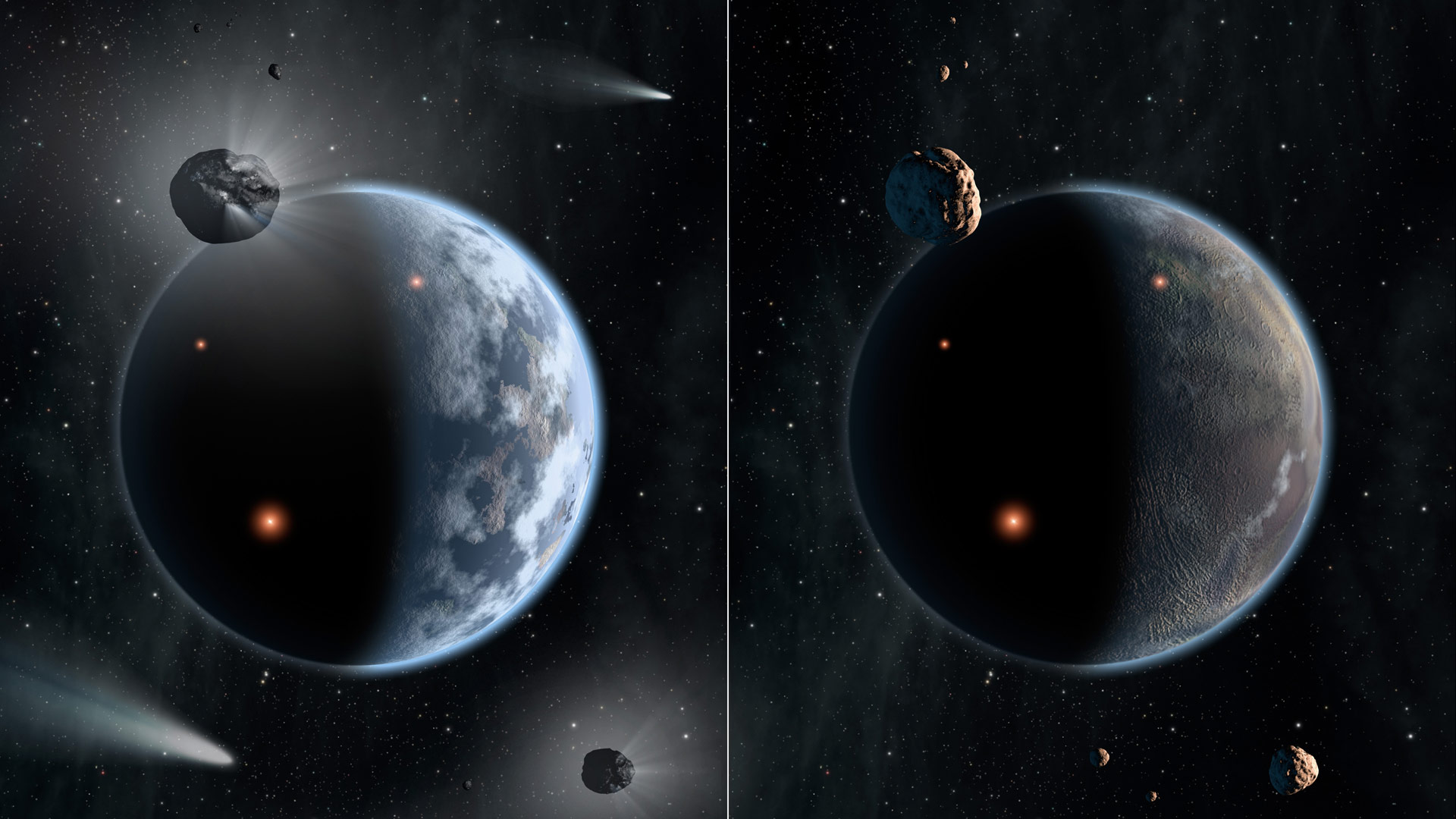
Using planetary models based on measurements of our sun’s carbon-to-oxygen ratio, researchers found that planets rich in carbon, including so-called diamond planets, may lack oceans.
Planets rich in carbon, including so-called diamond planets, may lack oceans, according to NASA-funded theoretical research.
Our sun is a carbon-poor star, and as result, our planet Earth is made up largely of silicates, not carbon. Stars with much more carbon than the sun, on the other hand, are predicted to make planets chock full of carbon, and perhaps even layers of diamond.
By modeling the ingredients in these carbon-based planetary systems, the scientists determined they lack icy water reservoirs thought to supply planets with oceans.
“The building blocks that went into making our oceans are the icy asteroids and comets,” said Torrence Johnson of NASA’s Jet Propulsion Laboratory in Pasadena, California, who presented the results October 7 at the American Astronomical Society Division of Planetary Sciences meeting in Denver. Johnson, a team member of several NASA planetary missions, including Galileo, Voyager, and Cassini, has spent decades studying the planets in our own solar system.
“If we keep track of these building blocks, we find that planets around carbon-rich stars come up dry,” he said.
Johnson and his colleagues say the extra carbon in developing star systems would snag the oxygen, preventing it from forming water.
“It’s ironic that if carbon, the main element of life, becomes too abundant, it will steal away the oxygen that would have made water, the solvent essential to life as we know it,” said Jonathan Lunine of Cornell University, Ithaca, New York, a collaborator on the research.
One of the big questions in the study of planets beyond our solar system, called exoplanets, is whether or not they are habitable. Researchers identify such planets by first looking for those that are situated within the “habitable zone” around their parent stars, which is where temperatures are warm enough for water to pool on the surface. NASA’s Kepler mission has found several planets within this zone, and researchers continue to scrutinize the Kepler data for candidates as small as Earth.
But even if a planet is found in this so-called “Goldilocks” zone, where oceans could, in theory, abound, is there actually enough water available to wet the surface? Johnson and his team addressed this question with planetary models based on measurements of our sun’s carbon-to-oxygen ratio. Our sun, like other stars, inherited a soup of elements from the Big Bang and from previous generations of stars, including hydrogen, helium, nitrogen, silicon, carbon, and oxygen.
“Our universe has its own top 10 list of elements,” said Johnson, referring to the 10 most abundant elements in our universe.
These models accurately predict how much water was locked up in the form of ice early in the history of our solar system, billions of years ago, before making its way to Earth. Comets and/or the parent bodies of asteroids are thought to have been the main water suppliers, though researchers still debate their roles. Either way, the objects are said to have begun their journey from far beyond Earth, past a boundary called the “snow line,” before impacting Earth and depositing water deep in the planet and on its surface.
When the researchers applied the planetary models to the carbon-rich stars, the water disappeared. “There’s no snow beyond the snow line,” said Johnson.
“All rocky planets aren’t created equal,” said Lunine. “So-called diamond planets the size of Earth, if they exist, will look totally alien to us: lifeless, ocean-less desert worlds.”
The computer model results supporting these conclusions were published in the Astrophysical Journal. The implications for habitability in these systems were the focus of the Division of Planetary Sciences meeting.
The California Institute of Technology, Pasadena, manages JPL for NASA.
Reference: “Planetesimal Compositions in Exoplanet Systems” by Torrence V. Johnson, Olivier Mousis, Jonathan I. Lunine and Nikku Madhusudhan, 17 September 2012, The Astrophysical Journal.
DOI: 10.1088/0004-637X/757/2/192
arXiv:1208.3289
Never miss a breakthrough: Join the SciTechDaily newsletter.
Follow us on Google and Google News.