
Close Menu
    Facebook X (Twitter) Instagram
    SciTechDaily
    • Biology
    • Chemistry
    • Earth
    • Health
    • Physics
    • Science
    • Space
    • Technology
    Facebook X (Twitter) Pinterest YouTube RSS
    SciTechDaily
    Home»Science»New Equation Shows How Other People’s Fortunes Affect Our Happiness
    Science

    New Equation Shows How Other People’s Fortunes Affect Our Happiness

    By Max Planck InstituteJune 17, 2016No Comments5 Mins Read
    Facebook Twitter Pinterest Telegram LinkedIn WhatsApp Email Reddit
    Share
    Facebook Twitter LinkedIn Pinterest Telegram Email Reddit
    How Other People's Fortunes Affect Our Happiness
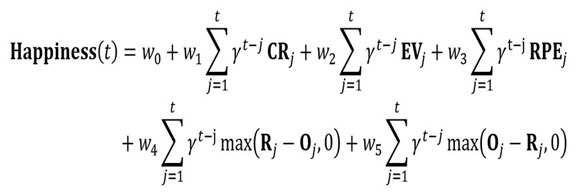
    Where t is the trial number, w0 is a constant term, other weights w capture the influence of different event types, 0 ≤ γ ≤ 1 is a forgetting factor that makes events in more recent trials more influential than those in earlier trials, CRj is the certain reward if chosen instead of a gamble on trial j, EVj is the average reward for the gamble if chosen on trial j, and RPEj is the RPE (reinforcement prediction error) on trial j contingent on choice of the gamble. The RPE is equal to the reward received minus the expectation in that trial EVj. If the CR was chosen, then EVj = 0 and RPEj = 0; if the gamble was chosen, then CRj = 0. The variables in the equation are quantities that the neuromodulator dopamine has been associated with in previous neuroscience studies. The additional term w4 relates to advantageous inequality (guilt) when the reward received by the subject Rj exceeds the reward received by the other player Oj, and w5 relates to disadvantageous inequality (envy) when Oj exceeds Rj.

    A new equation shows how our happiness depends not only on what happens to us and how this compares to other people. The team developed an equation to predict happiness in 2014, highlighting the importance of expectations, and the new updated equation also takes into account other people’s fortunes.

    The study, published in Nature Communications, found that inequality reduced happiness on average. This was true whether people were doing better or worse than another person they had just met. The subjects played gambles to try to win money and saw whether another person won or lost the same gambles. On average, when someone won a gamble they were happier when their partner also won the same gamble compared to when their partner lost. This difference could be attributed to guilt. Similarly, when people lost a gamble they were happier when their partner also lost compared to when their partner won, a difference that could be attributed to envy.

    “Our equation can predict exactly how happy people will be based not only on what happens to them but also what happens to the people around them,” explains one of the study’s co-lead authors, Dr. Robb Rutledge (UCL Institute of Neurology and Max Planck UCL Center for Computational Psychiatry and Ageing Research). “On average, we are less happy if others get more or less than us, but this varies a lot from person to person. Interestingly, the equation allows us to predict how generous an individual will be in a separate scenario when they are asked how they would like to split a small amount of money with another person. Based on exactly how inequality affects their happiness, we can predict which individuals will be altruistic.”

    For the study, 47 volunteers who did not know each other completed several tasks in small groups. In one task, they were asked how they would like to anonymously split a small amount of money with another person whom they had just met. In another task, they played monetary gambles that they could win or lose, and were told that they would see what another person received from the same gamble. In this way, subjects could get the same or different outcome from a social partner, sometimes getting more and sometimes getting less. Throughout this experiment, participants were asked how happy they felt at regular intervals.

    The results showed that people’s generosity was not dependent on who the partner was or which partner they said they preferred. This suggests that people were acting according to stable personality traits rather than specific feelings about the other player. On average, people whose happiness was more affected by getting more than others, something that might relate to guilt, gave away 30% of the money. Those who were more affected by getting less than others, something that might relate to envy, gave only 10%.

    “Our results suggest that generosity towards strangers relates to how our happiness is affected by the inequalities we experience in our daily life,” says Archy de Berker (UCL Institute of Neurology), co-lead author of the study, “The people who gave away half of their money when they had the opportunity showed no envy when they experienced inequality in a different task but showed a lot of guilt. By contrast, those who kept all the money for themselves displayed no signs of guilt in the other task but displayed a lot of envy. This is the first time that people’s generosity has been directly linked to how inequality affects their happiness. Economists have had difficulty explaining why some people are more generous than others, and our experiments offer an explanation. The task may prove to be a useful way of measuring empathy, which could offer insight into social disorders such as borderline personality disorder. Such methods could help us better understand certain aspects of social disorders, such as indifference to the suffering of others.”

    Reference: “The social contingency of momentary subjective well-being” by Robb B. Rutledge, Archy O. de Berker, Svenja Espenhahn, Peter Dayan and Raymond J. Dolan, 13 June 2016, Nature Communications.
    DOI: 10.1038/ncomms11825

    Never miss a breakthrough: Join the SciTechDaily newsletter.
    Follow us on Google and Google News.

    Behavioral Science Happiness Max Planck Institute Neurology Neuroscience Psychiatry
    Share. Facebook Twitter Pinterest LinkedIn Email Reddit

    Related Articles

    A New Treatment Approach for Charcot-Marie-Tooth Disease

    How the Anatomical Structure of the Brain Impacts Its Functioning

    Study Reveals Cortex Used for Making Sensory Associations, Not the Hippocampus

    Brain Regions Associated With the Successful Spread of Ideas Identified

    Hunger Affects Behavior and Changes Pathways in the Brain

    Homer-1 Could Be a Key to the Treatment of Stress-Induced Cognitive Deficits

    Curing Boredom

    Why People Like Watching the Same Thing Over and Over Again

    Aversion to Clashing Harmonies Is Due to Mathematical Relationships of Overtones

    Leave A Reply Cancel Reply

    • Facebook
    • Twitter
    • Pinterest
    • YouTube

    Don't Miss a Discovery

    Subscribe for the Latest in Science & Tech!

    Trending News

    Scientists Warn That This Common Pet Fish Can Wreck Entire Ecosystems

    Scientists Make Breakthrough in Turning Plastic Trash Into Clean Fuel Using Sunlight

    This Popular Supplement May Interfere With Cancer Treatment, Scientists Warn

    Scientists Finally Solved One of Water’s Biggest Mysteries

    Could This New Weight-Loss Pill Disrupt the Entire Market? Here’s What You Should Know About Orforglipron

    Earth’s Crust Is Tearing Open in Africa, and It Could Form a New Ocean

    Breakthrough Bowel Cancer Trial Leaves Patients Cancer-Free for Nearly 3 Years

    Natural Compound Shows Powerful Potential Against Rheumatoid Arthritis

    Follow SciTechDaily
    • Facebook
    • Twitter
    • YouTube
    • Pinterest
    • Newsletter
    • RSS
    SciTech News
    • Biology News
    • Chemistry News
    • Earth News
    • Health News
    • Physics News
    • Science News
    • Space News
    • Technology News
    Recent Posts
    • Kratom Use Explodes in the US, With Life-Changing Consequences
    • Scientists Uncover Fatal Weakness in “Zombie Cells” Linked to Cancer
    • World-First Study Reveals Human Hearts Can Regenerate After a Heart Attack
    • Why Your Dreams Feel So Real Sometimes and So Strange Other Times
    • Scientists Debunk 100-Year-Old Belief About Brain Cells, Rewriting Textbooks
    Copyright © 1998 - 2026 SciTechDaily. All Rights Reserved.
    • Science News
    • About
    • Contact
    • Editorial Board
    • Privacy Policy
    • Terms of Use

    Type above and press Enter to search. Press Esc to cancel.