
Close Menu
    Facebook X (Twitter) Instagram
    SciTechDaily
    • Biology
    • Chemistry
    • Earth
    • Health
    • Physics
    • Science
    • Space
    • Technology
    Facebook X (Twitter) Pinterest YouTube RSS
    SciTechDaily
    Home»Technology»New Lithium-Ion Battery Design Uses Silicon Nanoparticles
    Technology

    New Lithium-Ion Battery Design Uses Silicon Nanoparticles

    By Robert Perkins, USCFebruary 13, 2013No Comments3 Mins Read
    Facebook Twitter Pinterest Telegram LinkedIn WhatsApp Email Reddit
    Share
    Facebook Twitter LinkedIn Pinterest Telegram Email Reddit
    Advanced Battery Technology Breakthrough
    A new lithium-ion battery has been developed that uses silicon nanoparticles in place of traditional graphite anodes to provide superior performance.

    A team of scientists from the University of Southern California and Zhejiang University in China has developed a new lithium-ion battery that uses silicon nanoparticles in place of traditional graphite anodes to provide superior performance.

    Researchers at USC have developed a new lithium-ion battery design that uses porous silicon nanoparticles in place of traditional graphite anodes to provide superior performance.

    The new batteries — which could be used in anything from cellphones to hybrid cars — hold three times as much energy as comparable graphite-based designs and recharge within 10 minutes. The design, currently under a provisional patent, could be commercially available within two to three years.

    “It’s exciting research. It opens the door for the design of the next generation lithium-ion batteries,” said Chongwu Zhou, professor at the USC Viterbi School of Engineering, who led the team that developed the battery.
    new-lithium-ion-battery-design-that-uses-porous-silicon-nanoparticles
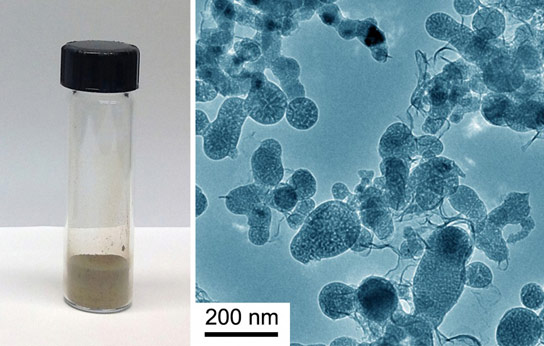
    On the left, a vial of the silicon nanpoarticles; on the right, silicon nanoparticles viewed under magnification. Credit: Photos/Mingyuan Ge and Chongwu Zhou

    Zhou worked with USC graduate students Mingyuan Ge, Jipeng Rong, Xin Fang and Anyi Zhang, as well as Yunhao Lu of Zhejiang University in China. Their research was published in Nano Research in January.

    Researchers have long attempted to use silicon, which is cheap and has a high potential capacity, in battery anodes. (Anodes are where current flows into a battery, while cathodes are where current flows out.)

    The problem has been that previous silicon anode designs, which were basically tiny plates of the material, broke down from repeated swelling and shrinking during charging/discharging cycles and quickly became useless.

    Last year, Zhou’s team experimented with porous silicon nanowires that are less than 100 nanometers in diameter and just a few microns long.

    The tiny pores on the nanowires allowed the silicon to expand and contract without breaking while simultaneously increasing the surface area, which in turn allows lithium ions to diffuse in and out of the battery more quickly, improving performance.

    Though the batteries functioned well, the nanowires are difficult to manufacture en masse. To solve the problem, Zhou’s team took commercially available nanoparticles — tiny silicon spheres — and etched them with the same pores as the nanowires. The particles function similarly and can be made in any quantity desired.

    Though the silicon nanoparticle batteries currently last for just 200 recharge cycles (compared to an average of 500 for graphite-based designs), the team’s older silicon nanowire-based design lasted for up to 2,000 cycles, which was reported in Nano Lett last April.

    Further development of the nanoparticle design should boost the battery’s lifespan, Zhou said.

    “The easy method we use may generate real impact on battery applications in the near future,” Zhou said.

    Future research by the group will focus on finding a new cathode material with a high capacity that will pair well with the porous silicon nanowires and/or porous silicon nanoparticles to create a completely redesigned battery.

    Reference: “Coaxial Si/anodic titanium oxide/Si nanotube arrays for lithium-ion battery anodes” by Jiepeng Rong, Xin Fang, Mingyuan Ge, Haitian Chen, Jing Xu and Chongwu Zhou, 29 January 2013, Nano Research.
    DOI: 10.1007/s12274-013-0294-x

    The work was funded by USC Viterbi.

    Never miss a breakthrough: Join the SciTechDaily newsletter.
    Follow us on Google and Google News.

    Battery Technology Nanotechnology USC Zhejiang University in China
    Share. Facebook Twitter Pinterest LinkedIn Email Reddit

    Related Articles

    Tin Nanocrystals Enable More Power to be Stored in Lithium Ion Batteries

    A Cost-Effective Fabrication Method for Micro-Scale Graphene-Based Supercapacitors

    Sulfur Cathodes Set a World Record for Energy Storage

    Silicon-Based Anode Shows Significant Improvement Over Current Graphite Anodes

    Spray Paint Battery Can be Painted on Virtually Any Surface

    Multi-Walled Carbon Nanotubes May Eventually Replace Expensive Platinum Catalysts

    Double-Walled Silicon Nanotube Battery Shows Promise

    Automated System Has Promising Uses in Battery and Fuel Cell Production

    Nanowires Covered in Nanoparticles Boost Performance

    Leave A Reply Cancel Reply

    • Facebook
    • Twitter
    • Pinterest
    • YouTube

    Don't Miss a Discovery

    Subscribe for the Latest in Science & Tech!

    Trending News

    Even Occasional Binge Drinking May Triple Liver Damage Risk

    Liftoff! NASA’s Artemis II Launch Sends Astronauts Around the Moon for First Time in 50 Years

    Scientists Discover New Way To Eliminate “Zombie Cells” Driving Aging

    This New Quantum Theory Could Change Everything We Know About the Big Bang

    This One Vitamin May Help Protect Your Brain From Dementia Years Later

    Stopping Weight-Loss Drugs Like Ozempic Can Quickly Erase Heart Benefits

    A 500-Million-Year-Old Surprise Is Forcing Scientists to Rethink Spider Evolution

    Coffee and Blood Pressure: What You Need To Know Before Your Next Cup

    Follow SciTechDaily
    • Facebook
    • Twitter
    • YouTube
    • Pinterest
    • Newsletter
    • RSS
    SciTech News
    • Biology News
    • Chemistry News
    • Earth News
    • Health News
    • Physics News
    • Science News
    • Space News
    • Technology News
    Recent Posts
    • Collapsing Plasma May Hold the Key to Cosmic Magnetism
    • DNA Meets Electronics: Scientists Create Ultra-Low Power Memory Breakthrough
    • A Strange Quantum Effect Could Power Future Electronics Without Batteries
    • This Breakthrough Solar Panel Generates Power From Both Sunlight and Raindrops
    • Greenland’s Ice Is Melting Faster Than Ever, and Scientists Are Alarmed
    Copyright © 1998 - 2026 SciTechDaily. All Rights Reserved.
    • Science News
    • About
    • Contact
    • Editorial Board
    • Privacy Policy
    • Terms of Use

    Type above and press Enter to search. Press Esc to cancel.