
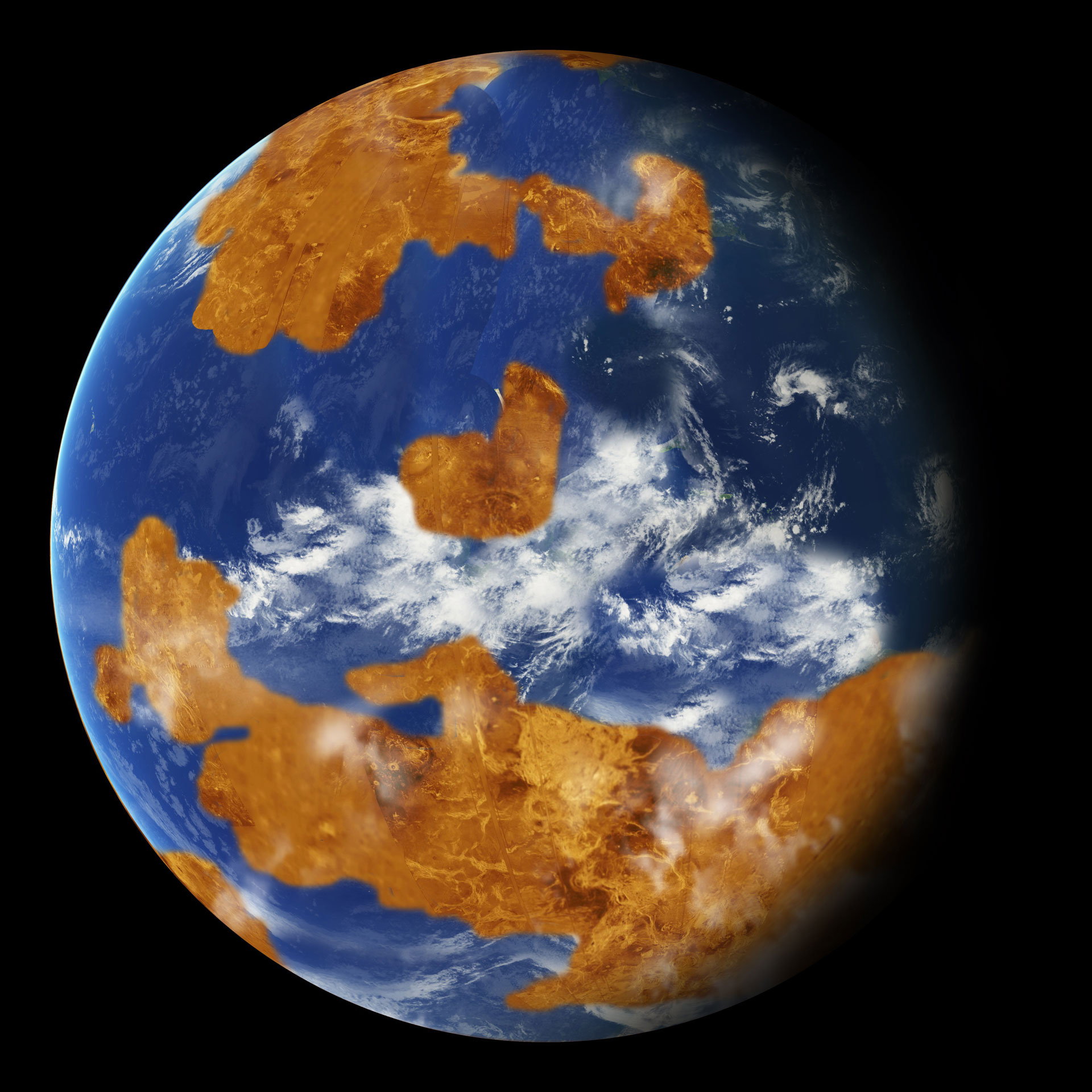
New research from NASA suggests that Venus may have had a shallow liquid-water ocean and habitable surface temperatures for up to 2 billion years of its early history.
The findings, published this week in the journal Geophysical Research Letters, were obtained with a model similar to the type used to predict future climate change on Earth.
“Many of the same tools we use to model climate change on Earth can be adapted to study climates on other planets, both past and present,” said Michael Way, a researcher at GISS and the paper’s lead author. “These results show ancient Venus may have been a very different place than it is today.”
Venus today is a hellish world. It has a crushing carbon dioxide atmosphere 90 times as thick as Earth’s. There is almost no water vapor. Temperatures reach 864 degrees Fahrenheit (462 degrees Celsius) at its surface.
Scientists long have theorized that Venus formed out of ingredients similar to Earth’s, but followed a different evolutionary path. Measurements by NASA’s Pioneer mission to Venus in the 1980s first suggested Venus originally may have had an ocean. However, Venus is closer to the sun than Earth and receives far more sunlight. As a result, the planet’s early ocean evaporated, water-vapor molecules were broken apart by ultraviolet radiation, and hydrogen escaped to space. With no water left on the surface, carbon dioxide built up in the atmosphere, leading to a so-called runaway greenhouse effect that created present conditions.
Previous studies have shown that how fast a planet spins on its axis affects whether it has a habitable climate. A day on Venus is 117 Earth days. Until recently, it was assumed that a thick atmosphere like that of modern Venus was required for the planet to have today’s slow rotation rate. However, newer research has shown that a thin atmosphere like that of modern Earth could have produced the same result. That means an ancient Venus with an Earth-like atmosphere could have had the same rotation rate it has today.
Another factor that impacts a planet’s climate is topography. The GISS team postulated ancient Venus had more dry land overall than Earth, especially in the tropics. That limits the amount of water evaporated from the oceans and, as a result, the greenhouse effect by water vapor. This type of surface appears ideal for making a planet habitable; there seems to have been enough water to support abundant life, with sufficient land to reduce the planet’s sensitivity to changes from incoming sunlight.
Way and his GISS colleagues simulated conditions of a hypothetical early Venus with an atmosphere similar to Earth’s, a day as long as Venus’ current day, and a shallow ocean consistent with early data from the Pioneer spacecraft. The researchers added information about Venus’ topography from radar measurements taken by NASA’s Magellan mission in the 1990s, and filled the lowlands with water, leaving the highlands exposed as Venusian continents. The study also factored in an ancient sun that was up to 30 percent dimmer. Even so, ancient Venus still received about 40 percent more sunlight than Earth does today.
“In the GISS model’s simulation, Venus’ slow spin exposes its dayside to the sun for almost two months at a time,” co-author and fellow GISS scientist Anthony Del Genio said. “This warms the surface and produces rain that creates a thick layer of clouds, which acts like an umbrella to shield the surface from much of the solar heating. The result is mean climate temperatures that are actually a few degrees cooler than Earth’s today.”
The research was done as part of NASA’s Planetary Science Astrobiology program through the Nexus for Exoplanet System Science (NExSS) program, which seeks to accelerate the search for life on planets orbiting other stars, or exoplanets, by combining insights from the fields of astrophysics, planetary science, heliophysics, and Earth science. The findings have direct implications for future NASA missions, such as the Transiting Exoplanet Survey Satellite and James Webb Space Telescope, which will try to detect possible habitable planets and characterize their atmospheres.
Reference: “Was Venus the First Habitable World of our Solar System?” by M. J. Way, Anthony D. Del Genio, Nancy Y. Kiang, Linda E. Sohl, David H. Grinspoon, Igor Aleinov, Maxwell Kelley and Thomas Clune, 11 August 2016, Geophysical Research Letters.
DOI: 10.1002/2016GL069790
Never miss a breakthrough: Join the SciTechDaily newsletter.
Follow us on Google and Google News.
2 Comments
Wow….. the climate Nazis are really getting desperate. But I love the smell of propaganda in the morning.
So, when future space missions go to Venus and look for fossils, will they find evidence of primitive life, or creatures that crawled around, or…?