
Close Menu
    Facebook X (Twitter) Instagram
    SciTechDaily
    • Biology
    • Chemistry
    • Earth
    • Health
    • Physics
    • Science
    • Space
    • Technology
    Facebook X (Twitter) Pinterest YouTube RSS
    SciTechDaily
    Home»Chemistry»Scientists Discover a Potential Bacterial Solution to “Forever Chemicals”
    Chemistry

    Scientists Discover a Potential Bacterial Solution to “Forever Chemicals”

    By University of Nebraska-LincolnNovember 6, 2025No Comments3 Mins Read
    Facebook Twitter Pinterest Telegram LinkedIn WhatsApp Email Reddit
    Share
    Facebook Twitter LinkedIn Pinterest Telegram Email Reddit
    Forever Chemicals PFAS Water Drops
    Researchers at the University of Nebraska–Lincoln have uncovered an unexpected microbial interaction with one of the world’s most stubborn pollutants. Their experiments revealed that a photosynthetic bacterium may naturally bind with toxic “forever chemicals,” hinting at a biological pathway toward cleanup. Credit: Shutterstock

    A photosynthetic bacterium shows promise in capturing PFAS, offering new hope for microbial cleanup of “forever chemicals.”

    Researchers from the University of Nebraska–Lincoln College of Engineering are turning to an unexpected source in their effort to combat toxic “forever chemicals.”

    In the laboratories of Rajib Saha and Nirupam Aich, scientists identified that a widely found photosynthetic bacterium, Rhodopseudomonas palustris, can interact with perfluorooctanoic acid (PFOA), one of the most persistent PFAS compounds. Their research, featured in Environmental Science: Advances, revealed that the bacterium absorbs PFOA into its cell membrane, with this interaction changing over time.

    This finding offers key insight into how naturally occurring microbes might eventually be used to help break down PFAS, presenting a promising path toward cleaner water and a healthier environment.

    Experimental findings and early limitations

    During controlled experiments, the researchers found that R. palustris was able to remove about 44% of PFOA from its surrounding medium within 20 days. However, a significant portion of the chemical was later released, most likely as a result of cell lysis, underscoring both the potential and current limitations of using living microorganisms to capture or transform PFAS.
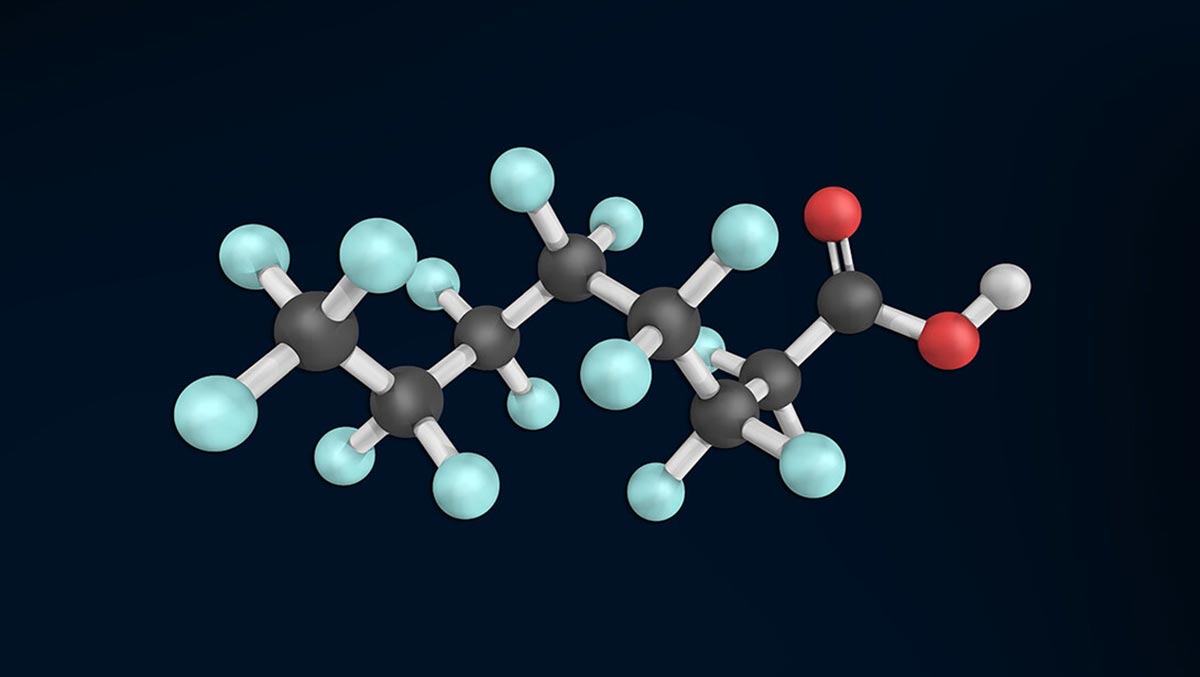
    3 D Rendering of a Perfluorooctanesulfonic Acid Molecule
    A 3-D rendering of a Perfluorooctanesulfonic Acid molecule is shown. Credit: University of Nebraska – Lincoln

    “While R. palustris didn’t completely degrade the chemical, our findings suggest a stepwise mechanism where the bacterium may initially trap PFOA in its membranes,” said Saha, Richard L. and Carol S. McNeel Associate Professor. “This gives us a foundation to explore future genetic or systems biology interventions that could improve retention or even enable biotransformation.”

    Cross-lab collaboration and interdisciplinary insights

    The Aich Lab contributed expertise in PFAS detection, enabling precise chemical analysis of PFOA concentrations and behavior over time. Meanwhile, Saha’s team performed experiments, helping interpret the organism’s reaction to varying PFAS concentrations.

    “This kind of collaboration is exactly what’s needed to address complex environmental challenges,” said Aich, Richard L. McNeel Associate Professor. “By bringing together microbiology, chemical engineering, and environmental analytical science, we’re gaining a more complete picture of how to tackle PFAS pollution with biological tools.”

    PFAS contamination has become a global concern due to its persistence in water and soil. Current treatment methods are costly and energy-intensive. Harnessing microbial systems offers a potentially lower-impact, scalable solution — though much work remains to be done.

    This research marks a promising step toward that goal, and the teams are already exploring follow-up studies involving microbial engineering and synthetic biology to enhance degradation potential.

    Reference: “Unique adaptations of a photosynthetic microbe Rhodopseudomonas palustris to the toxicological effects of perfluorooctanoic acid ” by Mark Kathol, Anika Azme, Sumaiya Saifur, Nirupam Aich and Rajib Saha, 1 July 2025, Environmental Science: Advances.
    DOI: 10.1039/D5VA00106D

    Funded by Layman Award and Nebraska Collaboration Initiative Grant Awarded to Aich and Saha

    Never miss a breakthrough: Join the SciTechDaily newsletter.
    Follow us on Google and Google News.

    PFAS Pollution Popular Synthetic Biology Toxicology University of Nebraska–Lincoln
    Share. Facebook Twitter Pinterest LinkedIn Email Reddit

    Related Articles

    New Research Exposes Shocking Health Risks of Chemicals Found in Popular Everyday Products

    Chemists Develop Sustainable Method To Remove “Forever Chemicals” From Water

    Tobacco Industry Tactics: Makers of PFAS “Forever Chemicals” Covered Up the Dangers

    Beauty’s Dark Secret: Toxic Chemicals in Cosmetics and Personal Care Products

    Scientists Discover Toxic “Forever Chemicals” in Fast-Food Packaging

    Thought To Be Safe: Replacement PFAS Used in Food Packaging Are Actually Hazardous

    Warning: Bleach-Alternative COVID-19 Surface Disinfectants May Pollute Indoor Air

    Warning: More Than 200 Million Americans Could Have Toxic PFAS in Their Drinking Water

    Blasting Toxic ‘Forever’ Chemicals Out of Drinking Water With Cold Plasma

    Leave A Reply Cancel Reply

    • Facebook
    • Twitter
    • Pinterest
    • YouTube

    Don't Miss a Discovery

    Subscribe for the Latest in Science & Tech!

    Trending News

    Could Low Vitamin D Be Making Your Pain Worse?

    Scientists Discover Once-Weekly Workout That Melts Belly Fat Surprisingly Effectively

    Scientists Just Tested a Thruster Powerful Enough for Human Missions to Mars

    Doctors Say Your Ice Pack Might Be Making Injuries Worse

    Scientists Discover 43-Foot Sea Reptile Twice the Size of a Great White Shark

    Bees and Birds Are Drinking Alcohol From Flowers

    Scientists Discover How Obesity May Trigger Alzheimer’s Disease

    Scientists Confirm Alcohol Causes Widespread Health Damage

    Follow SciTechDaily
    • Facebook
    • Twitter
    • YouTube
    • Pinterest
    • Newsletter
    • RSS
    SciTech News
    • Biology News
    • Chemistry News
    • Earth News
    • Health News
    • Physics News
    • Science News
    • Space News
    • Technology News
    Recent Posts
    • Just Minutes of Intense Exercise Could Slash Disease Risk by 50%
    • People Who Stop Ozempic Often Don’t Gain the Weight Back
    • Why More People in Their 30s Are Suddenly Getting Colon Cancer
    • Scientists Discover Sperm Seem To Bypass a Fundamental Law of Physics
    • The Secret Behind Indigenous Andeans’ “Digestive Superpower” May Be Potatoes
    Copyright © 1998 - 2026 SciTechDaily. All Rights Reserved.
    • Science News
    • About
    • Contact
    • Editorial Board
    • Privacy Policy
    • Terms of Use

    Type above and press Enter to search. Press Esc to cancel.