
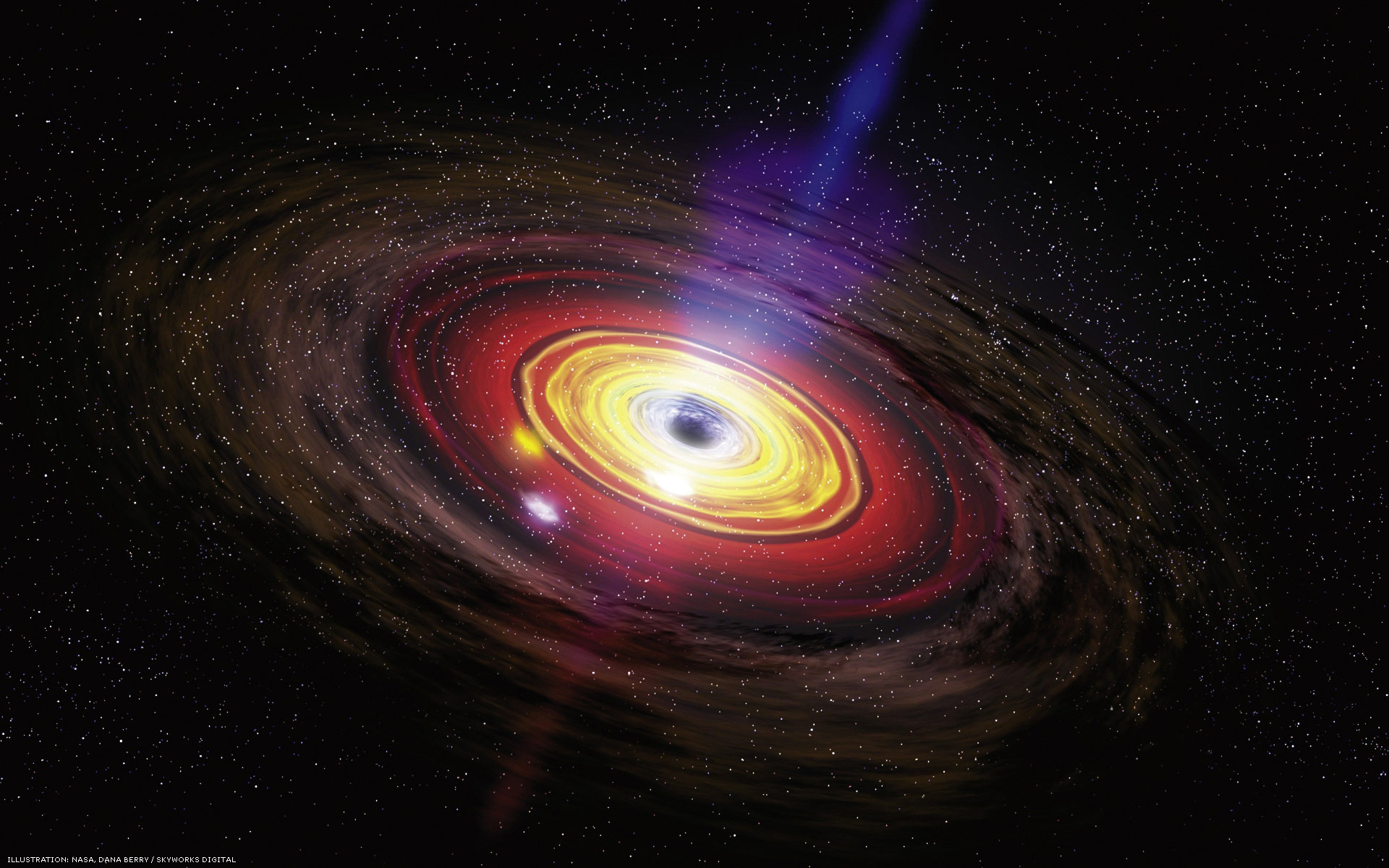
In a newly released study, scientists from the University of Sydney detail a huge outburst of energy that occurred two million years ago from the supermassive black hole at the center of our galaxy.
Two million years ago a supermassive black hole at the heart of our galaxy erupted in an explosion so immensely powerful that it lit up a cloud 200,000 light years away, a team of researchers led by the University of Sydney has revealed.
The finding is an exciting confirmation that black holes can ‘flicker’, moving from maximum power to switching off over, in cosmic terms, short periods of time.
“For 20 years astronomers have suspected that such a significant outburst occurred, but now we know when this sleeping dragon, four million times the mass of the sun, awoke and breathed fire with 100 million times the power it has today,” said Professor Joss Bland-Hawthorn, lead author of an article on the research to be published in The Astrophysical Journal, from the University’s School of Physics.
A computer simulation of a black hole in real time showing how gas falling in forms a disc that spins around the black hole. The friction causes the gas to become so hot it produces beams of UV radiation.
Ahead of publication, Professor Bland-Hawthorn will unveil the research at the international Galaxy Zoo science conference on 24 September in Sydney.
“It’s been long suspected that our Galactic Center might have sporadically flared up in the past. These observations are a highly suggestive ‘smoking gun’,” said Martin Rees, Astronomer Royal, who was one of the first scientists to suggest that massive black holes power quasars.
The evidence for the findings comes from a lacy filament of hydrogen gas called the Magellanic Stream. It trails behind our galaxy’s two small companion galaxies, the Large and Small Magellanic Clouds.
“Since 1996, we’ve been aware of an odd glow from the Magellanic Stream, but didn’t understand the cause. Then this year, it finally dawned on me that it must be the mark, the fossil record, of a huge outburst of energy from the supermassive black hole at the center of our galaxy.”
The region around the galaxy’s supermassive black hole and the black hole is called Sagittarius A* (pronounced Sagittarius A-star). It emits radio, infrared, ultraviolet, x-ray, and gamma-ray emissions. Flickers of radiation rise up when small clouds of gas fall onto the hot disk of matter that swirls around the black hole.
In stark contrast to this current inactivity, evidence is emerging that there was a cataclysmic event in the past.
“In particular, in 2010 NASA’s Fermi satellite discovered two huge bubbles of hot gas billowing out from the center of the galaxy, covering almost a quarter of the sky,” said Professor Bland-Hawthorn.
Earlier this year, computer simulations of the Fermi bubbles made by the University of California Santa Cruz controversially suggested that they were caused by a colossal explosion from Sagittarius A* within the last few million years.
https://www.youtube.com/watch?v=ASAmYz8rZfQ
Astrophysicist Joss Bland-Hawthorn discusses new research from the University of Sydney on black holes.
“When I saw this research I realized that this same event would also explain the mysterious glow that we see on the Magellanic Stream,” Professor Bland-Hawthorn said.
“Together with Dr Ralph Sutherland from Mount Stromlo Observatory and Dr Phil Maloney, from the University of Colorado, I calculated that to explain the glow it must have happened two million years ago because the energy release shown by the Santa Cruz group perfectly matched, to our delight, that from the Magellanic Stream.”
“The galaxy’s stars don’t produce enough ultraviolet to account for the glow, nor could they have in the past,” said Dr Maloney. “The Galactic Center never formed stars at a high enough rate. There had to be another explanation.”
Professor Bland-Hawthorn said, “In fact, the radiation from stars is one hundred times too little to account for the radiation now or at any time. The galaxy could never have produced enough UV radiation to account for it. So the only explanation was it had to be produced from our dragon, the massive black hole.”
“The realization that these black holes can switch on and off within a million years, which given the universe is 14 billion years old means very rapidly, is a significant discovery.”
Will such a colossal explosion ever happen again?
“Yes, absolutely! There are lots of stars and gas clouds that could fall onto the hot disk around the black hole,” says Professor Bland-Hawthorn. “There’s a gas cloud called G2 that astronomers around the world are anticipating will fall onto the black hole early next year. It’s small, but we’re looking forward to the fireworks!
Professor Bland-Hawthorn is a Fellow of the Australian Astronomical Observatory.
Reference: “Fossil imprint of a powerful flare at the Galactic Centre along the Magellanic Stream” by J. Bland-Hawthorn, Philip R. Maloney, Ralph S. Sutherland and G. J. Madsen, 6 November 2013, The Astrophysical Journal.
DOI: 10.1088/0004-637X/778/1/58
arXiv:1309.5455
Never miss a breakthrough: Join the SciTechDaily newsletter.
Follow us on Google and Google News.
2 Comments
This is an amazing claim and a, ‘Scientific Miracle’ bettering anything Jesus could have accomplished here on Earth. The reason being, ‘GALAXIES ARE EXPANDING’; Not, collapsing as is currently, (and wrongly) being peddled. It is also interesting to note that, for decades, these same scientists have claimed that, ‘NOTHING’ can escape from a ‘Black Hole’.. But of course the fact remains, not all that long ago, ‘Black Holes/ Infinite Density’ only existed within the realms of ‘SCIENCE FICTION’. Isn’t it amazing how such a transition can occur at the flick of a pencil!
Useful and interesting