
Close Menu
    Facebook X (Twitter) Instagram
    SciTechDaily
    • Biology
    • Chemistry
    • Earth
    • Health
    • Physics
    • Science
    • Space
    • Technology
    Facebook X (Twitter) Pinterest YouTube RSS
    SciTechDaily
    Home»Biology»Study Shows That Bees and Flowers Communicate Using Electrical Fields
    Biology

    Study Shows That Bees and Flowers Communicate Using Electrical Fields

    By University of BristolFebruary 22, 2013No Comments3 Mins Read
    Facebook Twitter Pinterest Telegram LinkedIn WhatsApp Email Reddit
    Share
    Facebook Twitter LinkedIn Pinterest Telegram Email Reddit
    Various Flowers
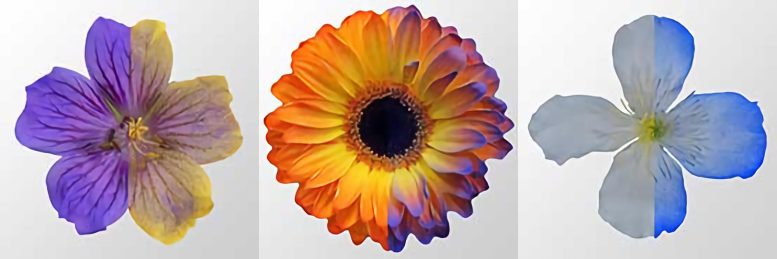
    Various flowers (Left: Geranium magnificum; Middle: Gerbera hybrida; Right: Clematis armandii) showing a composite of immediately before and after application of charged powder paint. The pattern of powder deposition reveals the shape of the electric field. Credit: Dominic Clarke and Daniel Robert

    Scientists from the University of Bristol have discovered that flowers use patterns of electrical signals in concert with the flower’s other attractive signals to enhance floral attraction to insect pollinators such as bumblebees.

    Flowers’ methods of communicating are at least as sophisticated as any devised by an advertising agency, according to a new study, published today in Science Express by researchers from the University of Bristol. However, for any advert to be successful, it has to reach, and be perceived by, its target audience. The research shows for the first time that pollinators such as bumblebees are able to find and distinguish electric signals given out by flowers.

    Flowers often produce bright colors, patterns, and enticing fragrances to attract their pollinators. Researchers at Bristol’s School of Biological Sciences, led by Professor Daniel Robert, found that flowers also have their equivalent of a neon sign – patterns of electrical signals that can communicate information to the insect pollinator. These electrical signals can work in concert with the flower’s other attractive signals and enhance floral advertising power.

    Plants are usually charged negatively and emit weak electric fields. On their side, bees acquire a positive charge as they fly through the air. No spark is produced as a charged bee approaches a charged flower, but a small electric force builds up that can potentially convey information.

    By placing electrodes in the stems of petunias, the researchers showed that when a bee lands, the flower’s potential changes and remains so for several minutes. Could this be a way by which flowers tell bees another bee has recently been visiting? To their surprise, the researchers discovered that bumblebees can detect and distinguish between different floral electric fields.

    Also, the researchers found that when bees were given a learning test, they were faster at learning the difference between two colors when electric signals were also available.

    How then do bees detect electric fields? This is not yet known, although the researchers speculate that hairy bumblebees bristle up under the electrostatic force, just like one’s hair in front of an old television screen.

    The discovery of such electric detection has opened up a whole new understanding of insect perception and flower communication.

    Dr. Heather Whitney, a co-author of the study said: “This novel communication channel reveals how flowers can potentially inform their pollinators about the honest status of their precious nectar and pollen reserves.”

    Professor Robert said: “The last thing a flower wants is to attract a bee and then fail to provide nectar: a lesson in honest advertising since bees are good learners and would soon lose interest in such an unrewarding flower.

    “The co-evolution between flowers and bees has a long and beneficial history, so perhaps it’s not entirely surprising that we are still discovering today how remarkably sophisticated their communication is.”

    Reference: “Detection and Learning of Floral Electric Fields by Bumblebees” by Dominic Clarke, Heather Whitney, Gregory Sutton and Daniel Robert, 21 February 2013, Science.
    DOI: 10.1126/science.1230883

    The research was supported by the Leverhulme Trust.

    Never miss a breakthrough: Join the SciTechDaily newsletter.
    Follow us on Google and Google News.

    Bees Biological Sciences Flowers University of Bristol
    Share. Facebook Twitter Pinterest LinkedIn Email Reddit

    Related Articles

    Common Pesticides Stop Bees and Flies From Getting a Good Night’s Sleep and Disrupts Their Memories

    Mystery That Baffled Darwin Solved: Clever Strategy Some Flowers Use to Ensure Effective Pollination by Bees

    Horizontal Gene Transfer Between Plants is More Widespread than Previously Thought

    Increased Number of Plant Species Responding to Global Warming

    Imidacloprid, A Major Factor in Colony Collapse Disorder

    Behavior in Curious Honeybees Similar to Humans

    Airborne Insecticide Emission From Pneumatic Drilling Machines Linked to Honeybee Death

    Researchers Recreate the Song of 165 Million Year Old Katydid

    Using Bees To Ease Tensions Between People And Elephants

    Leave A Reply Cancel Reply

    • Facebook
    • Twitter
    • Pinterest
    • YouTube

    Don't Miss a Discovery

    Subscribe for the Latest in Science & Tech!

    Trending News

    Scientists Uncover Potential Brain Risks of Popular Fish Oil Supplements

    Scientists Discover a Surprising Way To Make Bread Healthier and More Nutritious

    After 60 Years, Scientists Uncover Unexpected Brain Effects of Popular Diabetes Drug Metformin

    New Research Uncovers Hidden Side Effects of Popular Weight-Loss Drugs

    Scientists Rethink Extreme Warming After Surprising Ocean Discovery

    Landmark Study Links Never Marrying to Significantly Higher Cancer Risk

    Researchers Discover Unknown Beetle Species Just Steps From Their Lab

    Largest-Ever Study Finds Medicinal Cannabis Ineffective for Anxiety, Depression, PTSD

    Follow SciTechDaily
    • Facebook
    • Twitter
    • YouTube
    • Pinterest
    • Newsletter
    • RSS
    SciTech News
    • Biology News
    • Chemistry News
    • Earth News
    • Health News
    • Physics News
    • Science News
    • Space News
    • Technology News
    Recent Posts
    • Scientists Discover a “Protector” Protein That Could Help Reverse Hair Loss
    • Powerful Lasers Reveal How Matter Becomes Plasma in Trillionths of a Second
    • A Simpler Path to Super-Resolution: Scientists Reinvent Microscopy
    • Scientists Uncover Hidden Genetic Cause of Diabetes in Babies
    • Amazonian Chocolate Could Become the Next Superfood, Scientists Say
    Copyright © 1998 - 2026 SciTechDaily. All Rights Reserved.
    • Science News
    • About
    • Contact
    • Editorial Board
    • Privacy Policy
    • Terms of Use

    Type above and press Enter to search. Press Esc to cancel.