
Close Menu
    Facebook X (Twitter) Instagram
    SciTechDaily
    • Biology
    • Chemistry
    • Earth
    • Health
    • Physics
    • Science
    • Space
    • Technology
    Facebook X (Twitter) Pinterest YouTube RSS
    SciTechDaily
    Home»Space»Superheated Solar Tornadoes on the Sun
    Space

    Superheated Solar Tornadoes on the Sun

    By Royal Astronomical SocietyMarch 29, 2012No Comments3 Mins Read
    Facebook Twitter Pinterest Telegram LinkedIn WhatsApp Email Reddit
    Share
    Facebook Twitter LinkedIn Pinterest Telegram Email Reddit
    Huge Solar Tornado
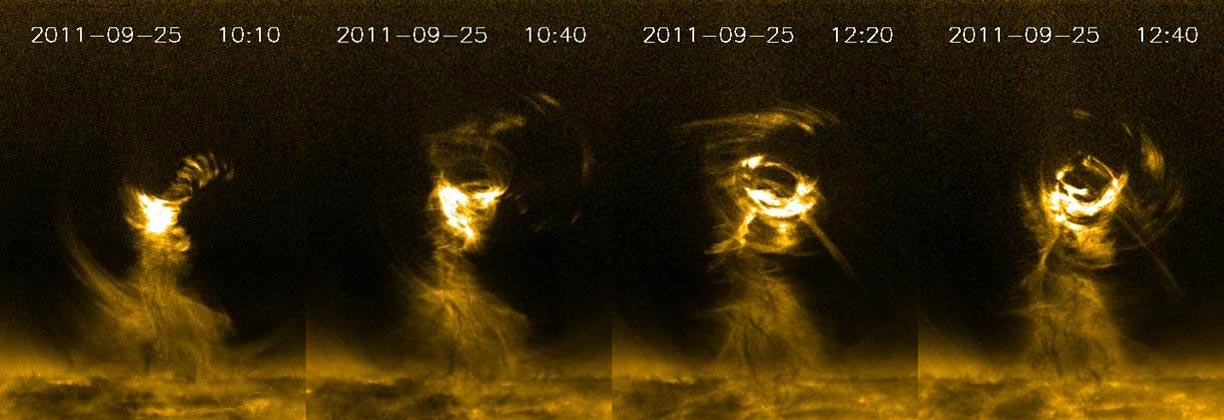
    The superb spatial and temporal resolution of the Solar Dynamic Observatory (SDO) allows us to observe the solar atmosphere in great detail. Using the Atmospheric Imaging Assembly (AIA) on board SDO, we are able to find spectacular rotation of material at solar prominences and the coronal cavities above them. Quite often, big coronal mass ejections will occur after these rotations are observed. The images and animated movies shown here are for a spectacular event observed on September 25, 2011, and a study of this event will be presented in the National Astronomy Meeting 2012 and submitted for publication in the Astrophysical Journal by us (Dr. Xing Li, Dr. Huw Morgan, and Mr. Drew Leonard). The tornado can be as wide as five earths. Credit: SDO

    Using the Atmospheric Imaging Assembly telescope, new imagery shows solar tornadoes comprised of superheated gases as hot as 50,000 – 2,000,000 Kelvin on the surface of the sun.

    Solar tornadoes several times as wide as the Earth can be generated in the solar atmosphere, say researchers in the UK. A solar tornado was discovered using the Atmospheric Imaging Assembly telescope on board the Solar Dynamic Observatory (SDO) satellite. A movie of the tornado will be presented at the National Astronomy Meeting 2012 in Manchester on Thursday, March 29th.

    “This is perhaps the first time that such a huge solar tornado is filmed by an imager. Previously much smaller solar tornadoes were found my SOHO satellite. But they were not filmed,” says Dr. Xing Li, of Aberystwyth University.
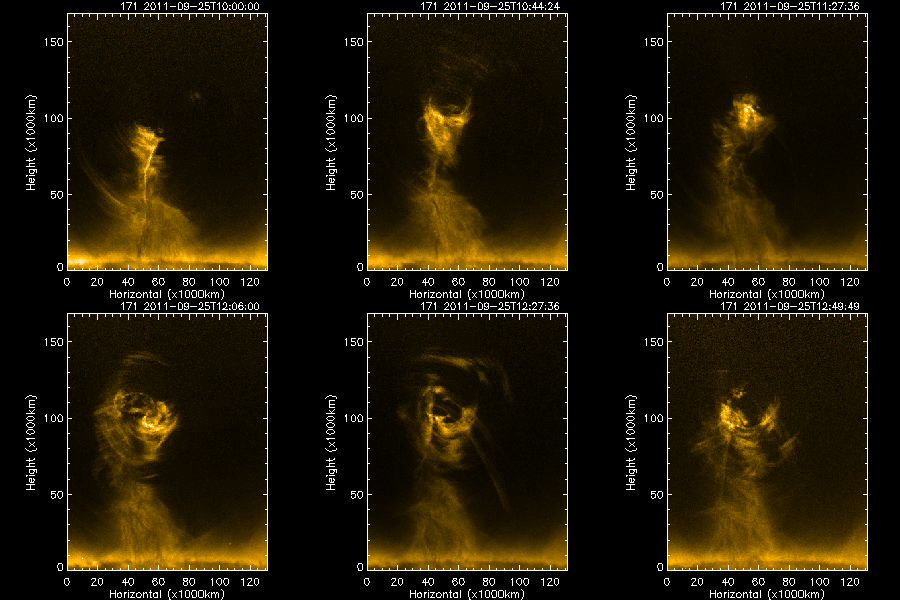
    tornadoes discovered on the Sun
    Credit: Royal Astronomical Society

    Dr. Huw Morgan, co-discover of the solar tornado, adds, “This unique and spectacular tornado must play a role in triggering global solar storms.”

    The Atmospheric Imaging Assembly saw superheated gases as hot as 50,000 – 2,000,000 Kelvin sucked from the root of a dense structure called prominence, and spiral up into the high atmosphere and travel about 200,000 kilometers along helical paths for a period of at least three hours. The tornadoes were observed on 25 September 2011.

    The hot gases in the tornadoes have speeds as high as 300,000 km per hour. Gas speeds of terrestrial tornadoes can reach 150km per hour.

    The tornadoes often occur at the root of huge coronal mass ejections. When heading toward the Earth, these coronal mass ejections can cause significant damage to the Earth’s space environment, satellites, and even knock out the electricity grid.

    The solar tornadoes drag winding magnetic field and electric currents into the high atmosphere. It is possible that the magnetic field and currents play a key role in driving the coronal mass ejections.

    SDO was launched in February 2010. The satellite is orbiting the Earth in a circular, geosynchronous orbit at an altitude of 36,000 kilometers (22,000 miles). It monitors constantly solar variations so scientists can understand the cause of the change and eventually have a capability to predict the space weather.

    Never miss a breakthrough: Join the SciTechDaily newsletter.
    Follow us on Google and Google News.

    Coronal Mass Ejections Royal Astronomical Society Sun Tornadoes
    Share. Facebook Twitter Pinterest LinkedIn Email Reddit

    Related Articles

    Eyes on the Skies: Scientists Crack Code on Earth-Threatening Solar Storms

    Image of Magnetic Loops on the Sun

    NASA’s Solar Dynamics Observatory Captures Filament Explosion

    The Sun Celebrates Independence Day With Solar Flare

    New Light Shed on the Origins of Extreme Space Storms

    NASA Captures Image of M1 Coronal Mass Ejection

    NASA Solar Dynamics Observatory Captures Eruption in Extreme UV

    NASA Continues to Monitor Solar Flares

    Strong Geomagnetic Storms a Possibility After Active Sunspot 1401 Erupted

    Leave A Reply Cancel Reply

    • Facebook
    • Twitter
    • Pinterest
    • YouTube

    Don't Miss a Discovery

    Subscribe for the Latest in Science & Tech!

    Trending News

    New Study Reveals Why Ozempic Works Better for Some People Than Others

    Climate Change Is Altering a Key Greenhouse Gas in a Way Scientists Didn’t Expect

    New Study Suggests Gravitational Waves May Have Created Dark Matter

    Scientists Discover Why the Brain Gets Stuck in Schizophrenia

    Scientists Engineer “Tumor-Eating” Bacteria That Devour Cancer From Within

    Even “Failed” Diets May Deliver Long-Term Health Gains, Study Finds

    NIH Scientists Discover Powerful New Opioid That Relieves Pain Without Dangerous Side Effects

    Collapsing Plasma May Hold the Key to Cosmic Magnetism

    Follow SciTechDaily
    • Facebook
    • Twitter
    • YouTube
    • Pinterest
    • Newsletter
    • RSS
    SciTech News
    • Biology News
    • Chemistry News
    • Earth News
    • Health News
    • Physics News
    • Science News
    • Space News
    • Technology News
    Recent Posts
    • The Surprising Reason You Might Want To Sleep Without a Pillow
    • Household Cats Could Hold the Secret to Fighting Breast Cancer
    • Scientists Say This Natural Hormone Reverses Obesity by Targeting the Brain
    • This 15,000-Year-Old Discovery Changes What We Know About Early Human Creativity
    • 35-Million-Year-Old Mystery: Strange Arachnid Discovered Preserved in Amber
    Copyright © 1998 - 2026 SciTechDaily. All Rights Reserved.
    • Science News
    • About
    • Contact
    • Editorial Board
    • Privacy Policy
    • Terms of Use

    Type above and press Enter to search. Press Esc to cancel.