
Close Menu
    Facebook X (Twitter) Instagram
    SciTechDaily
    • Biology
    • Chemistry
    • Earth
    • Health
    • Physics
    • Science
    • Space
    • Technology
    Facebook X (Twitter) Pinterest YouTube RSS
    SciTechDaily
    Home»Space»Synchrotron Emission Will Allow Astronomers to Find Stars That No One Has Seen Before
    Space

    Synchrotron Emission Will Allow Astronomers to Find Stars That No One Has Seen Before

    By Harvard-Smithsonian Center for AstrophysicsSeptember 22, 2015No Comments3 Mins Read
    Facebook Twitter Pinterest Telegram LinkedIn WhatsApp Email Reddit
    Share
    Facebook Twitter LinkedIn Pinterest Telegram Email Reddit
    Radio Telescopes Could Spot Stars Hidden in the Galactic Center
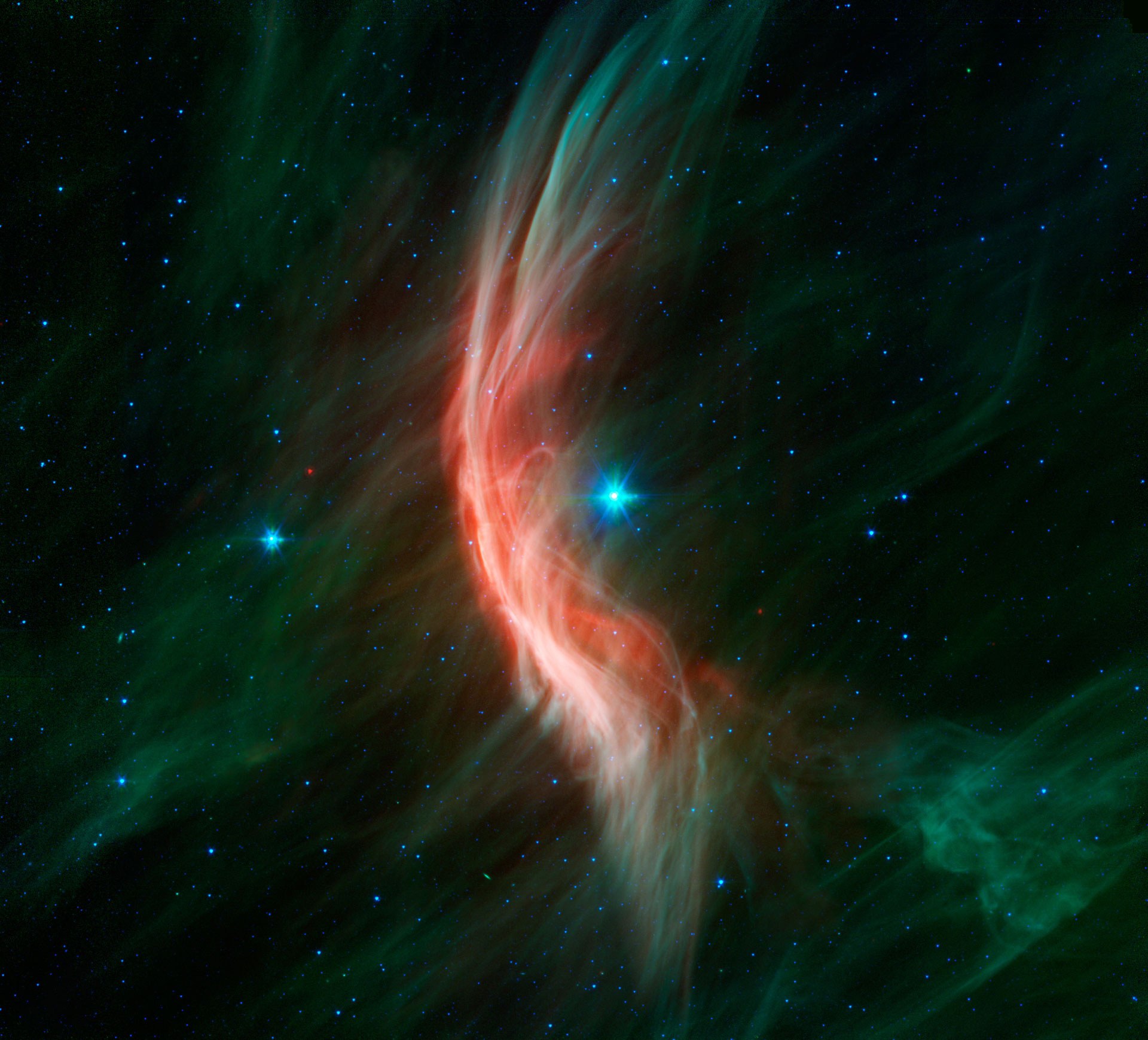
    In this infrared image from NASA’s Spitzer Space Telescope, stellar winds flowing out from the fast-moving star Zeta Ophiuchi are creating a bow shock seen as glowing gossamer threads, which, for this star, are only seen in infrared light. A similar process in the galactic center could allow us to find stars we can’t see any other way, according to new research. Credit: NASA/JPL-Caltech

    Astronomers believe that radio waves coming from supersonic stars will help them find stars that no one has seen before.

    The center of our Milky Way galaxy is a mysterious place. Not only is it thousands of light-years away, it’s also cloaked in so much dust that most stars within are rendered invisible. Harvard researchers are proposing a new way to clear the fog and spot stars hiding there. They suggest looking for radio waves coming from supersonic stars.

    “There’s a lot we don’t know about the galactic center, and a lot we want to learn,” says lead author Idan Ginsburg of the Harvard-Smithsonian Center for Astrophysics (CfA). “Using this technique, we think we can find stars that no one has seen before.”

    The long path from the center of our galaxy to Earth is so choked with dust that out of every trillion photons of visible light coming our way, only one photon will reach our telescopes. Radio waves, from a different part of the electromagnetic spectrum, have lower energies and longer wavelengths. They can pass through the dust unimpeded.

    On their own, stars aren’t bright enough in the radio for us to detect them at such distances. However, if a star is traveling through gas faster than the speed of sound, the situation changes. Material blowing off of the star as a stellar wind can plow into the interstellar gases and create a shock wave. And through a process called synchrotron radiation, electrons accelerated by that shock wave produce radio emission that we could potentially detect.

    “In a sense, we’re looking for the cosmic equivalent of a sonic boom from an airplane,” explains Ginsburg.

    To create a shock wave, the star would have to be moving at a speed of thousands of miles per second. This is possible in the galactic center since the stars there are influenced by the strong gravity of a supermassive black hole. When an orbiting star reaches its closest approach to the black hole, it can easily acquire the required speed.

    The researchers suggest looking for this effect from one already known star called S2. This star, which is hot and bright enough to be seen in the infrared despite all the dust, will make its closest approach to the Galactic center in late 2017 or early 2018. When it does, radio astronomers can target it to look for radio emission from its shock wave.

    “S2 will be our litmus test. If it’s seen in the radio, then potentially we can use this method to find smaller and fainter stars – stars that can’t be seen any other way,” says co-author Avi Loeb of the CfA.

    This work is reported in a paper authored by Idan Ginsburg, Xiawei Wang, Avi Loeb, and Ofer Cohen (CfA). It has been accepted for publication in the Monthly Notices of the Royal Astronomical Society.

    Reference: “Detecting Stars at the Galactic Centre via Synchrotron Emission” by Idan Ginsburg, Xiawei Wang, Abraham Loeb and Ofer Cohen, 20 October 2015, MNRAS Letters.
    DOI: 10.1093/mnrasl/slv138
    arXiv: 1509.06251

    Never miss a breakthrough: Join the SciTechDaily newsletter.
    Follow us on Google and Google News.

    Astronomy Astrophysics Black Hole Harvard-Smithsonian Center for Astrophysics Popular Space Exploration Stars
    Share. Facebook Twitter Pinterest LinkedIn Email Reddit

    Related Articles

    Behold! Rare Quasar Triplet Forms Most Massive Object in Universe

    Artificial Intelligence Helps Resolve Long-Running Astrophysics Debate on Supermassive Black Holes

    The Give and Take of Stellar Mega-Flares: By Studying Thousands of Young Stars, New Information Has Emerged

    Telescopes Unite in Unprecedented Observations of Famous Black Hole Across the Entire Electromagnetic Spectrum

    Massive X-ray Jet – Extending for 160,000 Light-Years – Spied From Supermassive Black Hole in Early Universe

    Astronomers Detect a Supermassive Black Hole on the Move – Unusual Motion Thus Far Unexplained

    Chandra Studies Extraordinary Magnetar: Fastest Spinning and Possibly the Youngest Magnetar Known

    Stranger Than Fiction: The Monster in the Middle of the Milky Way Is…Spinning Slowly?

    Death by Spaghettification: Telescopes Record Last Moments of Star Devoured by a Black Hole

    Leave A Reply Cancel Reply

    • Facebook
    • Twitter
    • Pinterest
    • YouTube

    Don't Miss a Discovery

    Subscribe for the Latest in Science & Tech!

    Trending News

    Scientists Discover How Coffee Impacts Memory, Mood, and Gut Health

    Why Did the Neanderthals Disappear? Scientists Reveal Humans Had a Hidden Advantage

    Physicists Propose Strange Experiment Where Time Goes Quantum

    Magnesium Magic: New Drug Melts Fat Even on a High-Fat, High-Sugar Diet

    Weight-Loss Drugs Like Ozempic May Come With an Unexpected Cost

    Mezcal “Worm” in a Bottle Mystery: DNA Testing Reveals a Surprise

    New Research Reveals That Your Morning Coffee Activates an Ancient Longevity Switch

    This Is What Makes You Irresistible to Mosquitoes

    Follow SciTechDaily
    • Facebook
    • Twitter
    • YouTube
    • Pinterest
    • Newsletter
    • RSS
    SciTech News
    • Biology News
    • Chemistry News
    • Earth News
    • Health News
    • Physics News
    • Science News
    • Space News
    • Technology News
    Recent Posts
    • Harvard Scientists Reveal Secret Structure Behind How You Smell
    • Scientists Just Discovered the Hidden Trick That Keeps Your Cells Alive
    • This Simple Movement Could Be Secretly Cleaning Your Brain
    • Male Birth Control Breakthrough: Scientists Find Way To Turn Sperm Production Off and Back On
    • A Common Vitamin Could Hold the Key to Treating Fatty Liver Disease
    Copyright © 1998 - 2026 SciTechDaily. All Rights Reserved.
    • Science News
    • About
    • Contact
    • Editorial Board
    • Privacy Policy
    • Terms of Use

    Type above and press Enter to search. Press Esc to cancel.