
Close Menu
    Facebook X (Twitter) Instagram
    SciTechDaily
    • Biology
    • Chemistry
    • Earth
    • Health
    • Physics
    • Science
    • Space
    • Technology
    Facebook X (Twitter) Pinterest YouTube RSS
    SciTechDaily
    Home»Health»Targeted Isolation May Be the Most Effective Way to Reduce Transmission of Ebola
    Health

    Targeted Isolation May Be the Most Effective Way to Reduce Transmission of Ebola

    By Michael Greenwood, Yale UniversityOctober 28, 2014No Comments3 Mins Read
    Facebook Twitter Pinterest Telegram LinkedIn WhatsApp Email Reddit
    Share
    Facebook Twitter LinkedIn Pinterest Telegram Email Reddit
    Isolation May Be the Most Effective Way to Reduce Transmission of Ebola
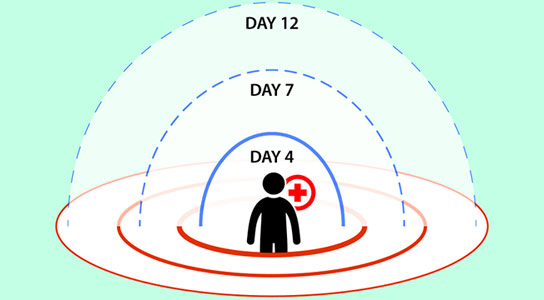
    New research indicates that isolating the most critically ill Ebola patients before the fifth day of their illness could be the most efficient method to decrease virus transmission. Credit: Michael S. Helfenbein

    New research led by the Yale School of Public Health shows that isolating 75% of infected individuals in critical condition within four days of symptom onset has a high chance of eliminating the spread of Ebola.

    Isolating the most severely ill Ebola patients before the fifth day of their illness may be the most effective way to reduce transmission of the virus, new research led by the Yale School of Public Health suggests.

    A team of scientists from Yale and Liberia created a disease transmission model that uses epidemiological and clinical data from Liberia, the country hardest hit by the current outbreak. They found that each infected person is transmitting the disease to 1.73 other people. But people who will eventually die from the disease are spreading it even further, causing 2.36 people to become infected.

    The researchers’ model found that isolating 75% of infected individuals in critical condition within four days of symptom onset has a high chance of eliminating the spread of the disease. The research is published October 28 in the Annals of Internal Medicine.

    “In the absence of sufficient isolation units, our model emphasizes that targeted isolation of those who are mostly responsible for transmission may be the most efficient way to contain Ebola,” said lead author Dan Yamin, a postdoctoral associate at Yale School of Public Health.

    Senior author Alison P. Galvani, a professor of epidemiology at the School of Public Health, added, “In particular, infectiousness increases greatly with disease progression, and thus early case-isolation is paramount to reducing household and community transmission.”

    This new Ebola transmission model is believed to be the first to consider the effect of disease progression, the rate at which the virus replicates in the body, and the link between the risk of mortality and transmission to others.

    The Ebola outbreak now sweeping West Africa is the worst ever recorded. There have been approximately 9,000 reported cases and 4,500 deaths from the disease in Liberia, Sierra Leone, and Guinea since the outbreak began last December. For the first time, cases have been confirmed among healthcare workers treating patients in the United States and parts of Europe. Co-author Dr. Frederick Altice, professor of internal medicine and public health added, “Lessons from Liberia and this modeling study have important implications for the ill-advised current quarantine regulations that have been imposed in several states, which are not based on solid public health principles.”

    The researchers acknowledge that the model has several limitations, including projections that are based upon the initial dynamics of the epidemic. While these projections may change as the outbreak and interventions evolve, note the researchers, they nonetheless suggest that effective isolation, through the construction of sufficient numbers of Ebola isolation units is crucial to containing the epidemic.

    Other authors on the study included Shai Gertler, Martial L. Ndeffo-Mbah, Laura A. Skrip, Mosoka Fallah, and Tolbert G. Nyenswah.

    The National Institutes of Public Health funded the study.

    Reference: “Effect of Ebola Progression on Transmission and Control in Liberia” Dan Yamin, PhD; Shai Gertler; Martial L. Ndeffo-Mbah, PhD; Laura A. Skrip, MPH; Mosoka Fallah, PhD; Tolbert G. Nyenswah, MPH; Frederick L. Altice, MD, MA and Alison P. Galvani, PhD, 28 October 2014, Annals of Internal Medicine.
    DOI: 10.7326/M14-2255

    Never miss a breakthrough: Join the SciTechDaily newsletter.
    Follow us on Google and Google News.

    Disease Ebola Epidemiology Popular Yale University
    Share. Facebook Twitter Pinterest LinkedIn Email Reddit

    Related Articles

    Yale Study Links Depression During Pregnancy to Risky Postpartum Sexual Behavior

    Lysosomes May Contribute to Alzheimer’s Disease

    Fewer Doses of Prophylaxis Provides Near-Optimal Protection Against RSV

    Yale Study Shows HIV Protease Inhibitors Also Offer Protection Against Malaria

    Yale Study Shows Ebola Virus Spreads in Social Clusters

    Yale Scientists Reveal Ebola Epidemic in Africa Poised to Explode

    21-Day Quarantine Might Not Be Enough to Prevent the Spread of Ebola

    Tick-Borne Infection Borrelia Miyamotoi Discovered in the United States

    Ebola Outbreak in Uganda Tests Readiness

    Leave A Reply Cancel Reply

    • Facebook
    • Twitter
    • Pinterest
    • YouTube

    Don't Miss a Discovery

    Subscribe for the Latest in Science & Tech!

    Trending News

    Scientists Uncover Potential Brain Risks of Popular Fish Oil Supplements

    Scientists Discover a Surprising Way To Make Bread Healthier and More Nutritious

    After 60 Years, Scientists Uncover Unexpected Brain Effects of Popular Diabetes Drug Metformin

    New Research Uncovers Hidden Side Effects of Popular Weight-Loss Drugs

    Scientists Rethink Extreme Warming After Surprising Ocean Discovery

    Landmark Study Links Never Marrying to Significantly Higher Cancer Risk

    Researchers Discover Unknown Beetle Species Just Steps From Their Lab

    Largest-Ever Study Finds Medicinal Cannabis Ineffective for Anxiety, Depression, PTSD

    Follow SciTechDaily
    • Facebook
    • Twitter
    • YouTube
    • Pinterest
    • Newsletter
    • RSS
    SciTech News
    • Biology News
    • Chemistry News
    • Earth News
    • Health News
    • Physics News
    • Science News
    • Space News
    • Technology News
    Recent Posts
    • Researchers Uncover Source of Strange Deformation in Earth’s Largest Continental Rift
    • Scientists Solve Mystery of Where the Colorado River Vanished Millions of Years Ago
    • Not Just Alzheimer’s: Scientists Uncover Clues to a Second, Overlooked Disorder
    • Scientists Uncover Dangerous Connection Between Serotonin and Heart Valve Disease
    • Scientists Discover a “Protector” Protein That Could Help Reverse Hair Loss
    Copyright © 1998 - 2026 SciTechDaily. All Rights Reserved.
    • Science News
    • About
    • Contact
    • Editorial Board
    • Privacy Policy
    • Terms of Use

    Type above and press Enter to search. Press Esc to cancel.