
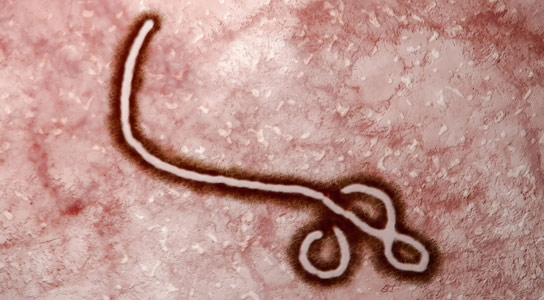
A new study from Drexel University suggests that 21 days might not be enough to completely prevent the spread of Ebola, revealing that there could be up to a 12 percent chance that someone could be infected even after the 21-day quarantine.
As medical personnel and public health officials are responding to the first reported cases of Ebola Virus in the United States, many of the safety and treatment procedures for treating the virus and preventing its spread are being reexamined. One of the tenets for minimizing the risk of spreading the disease has been a 21-day quarantine period for individuals who might have been exposed to the virus. But a new study by Charles Haas, PhD, a professor in Drexel’s College of Engineering, suggests that 21 days might not be enough to completely prevent the spread of the virus.
Haas’s study “On the Quarantine Period for Ebola Virus,” recently published in PLOS Currents: Outbreaks looks at the murky basis for our knowledge about the virus, namely previous outbreaks in Africa in 1976 (Zaire) and 2000 (Uganda) as well as the first 9 months of the current outbreak.
In both cases, data gathered by the World Health Organization reported a 2-21 day incubation period for the virus –meaning that after 21 days if the individual hasn’t presented symptoms they are likely not to be infected or contagious. This is likely the genesis of the Centers for Disease Control and Prevention’s 21-day quarantine period, but there is little indication from the CDC as to what other considerations played into this policy.
“Twenty-one days has been regarded as the appropriate quarantine period for holding individuals potentially exposed to Ebola Virus to reduce risk of contagion, but there does not appear to be a systemic discussion of the basis for this period,” said Haas, who is the head of the Civil, Architectural and Environmental Engineering Department at Drexel.
Haas suggests that a broader look at risk factors and costs and benefits should be considered when setting this standard. With any scientific data of this nature there is a standard deviation in results –a percentage by which they may vary. In the case of Ebola’s incubation period the range of results generated from the Zaire and Uganda data varied little. This might have contributed to the health organizations’ certainty that a 21-day quarantine period was a safe course of action.
But looking more broadly at data from other Ebola outbreaks, in Congo in 1995 and recent reports from the outbreak in West Africa, the range of deviation is between 0.1 and 12 percent, according to Haas. This means that there could be up to a 12 percent chance that someone could be infected even after the 21-day quarantine.
“While the 21-day quarantine value, currently used, may have arisen from a reasonable interpretation of early outbreak data, this work suggests reconsideration is in order and that 21 days might not be sufficiently protective of public health,” Haas said.
Haas, who has an extensive background in analyzing the risk of transmitting biological pathogens, explains that these quarantine periods must be determined by looking at the cost of enforcing the quarantine versus the cost of releasing exposed individuals. Looking at the potential tradeoff between costs and benefits as the quarantine time is extended should guide public health officials in determining the appropriate time. Obviously, with more contagious and potentially deadly diseases the cost of making a mistake on the short side when determining a quarantine is extremely high.
“Clearly for pathogens that have a high degree of transmissibility and/or a high degree of severity, the quarantine time should be greater than for agents with lower transmissibility and/or severity. The purpose of this paper is not to estimate where the balancing point should be, but to suggest a method for determining the balancing point.”
Reference: “On the Quarantine Period for Ebola Virus” by Charles N. Haas, 14 October 2014, PLOS Currents Outbreaks.
DOI: 10.1371/currents.outbreaks.2ab4b76ba7263ff0f084766e43abbd89
Never miss a breakthrough: Join the SciTechDaily newsletter.
Follow us on Google and Google News.
1 Comment
very useful, thx