
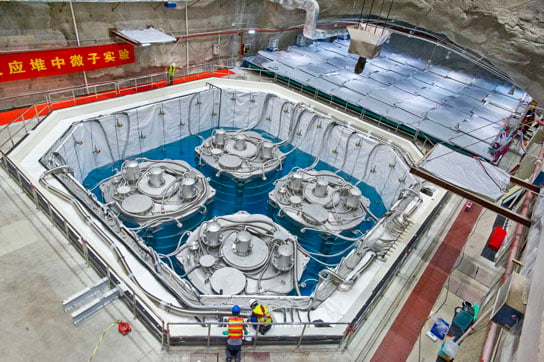
The Daya Bay Neutrino experiment, recognized by Science magazine as a runner-up for the breakthrough of the year, is helping physicists explain why the universe is dominated by matter and not by anti-matter.
A collaboration with major participation by physicists at the University of Wisconsin-Madison has made a precise measurement of elusive, nearly massless particles, and obtained a crucial hint as to why the universe is dominated by matter, not by its close relative, anti-matter.
The particles, called anti-neutrinos, were detected at the underground Daya Bay experiment, located near a nuclear reactor in China, 55 kilometers north of Hong Kong.
For the measurement of anti-neutrinos it made in 2012, the Daya Bay collaboration has been named runner-up for breakthrough of the year from Science magazine.
Anti-particles are almost identical twins of sub-atomic particles (electrons, protons, and neutrons) that make up our world. When an electron encounters an anti-electron, for example, both are annihilated in a burst of energy. Failure to see these bursts in the universe tells physicists that anti-matter is vanishingly rare, and that matter rules the roost in today’s universe.
“At the beginning of time, in the Big Bang, a soup of particles and anti-particles was created, but somehow an imbalance came about,” says Karsten Heeger, a professor of physics at UW-Madison. “All the studies that have been done have not found enough difference between particles and anti-particles to explain the dominance of matter over anti-matter.”
But the neutrino, an extremely abundant but almost massless particle, may have the right properties, and may even be its own anti-particle, Heeger says. “And that’s why physicists have put their last hope on the neutrino to explain the absence of anti-matter in the universe.”
Heeger and his group at UW-Madison have been responsible for much of the design and development of the anti-neutrino detectors at Daya Bay. Jeff Cherwinka, from the university’s Physical Sciences Laboratory in Stoughton, Wis. is chief engineer of the experiment and has overseen much of the detector assembly and installation. The construction of the experiment was completed this fall and data-taking started in October using the full set of anti-neutrino detectors.
Reactors, Heeger says, are a fertile source of anti-neutrinos, and measuring how they change during their short flights from the reactor to the detector, gives a basis for calculating a quantity called the “mixing angle,” the probability of transformation from one flavor into another.
The measurement of the Daya Bay experiment, released in March 2012, even before the last set of detectors was installed, showed a surprisingly large angle, Heeger says. “People thought the angle might be really tiny, so we built an experiment that was 10 times as sensitive as we ended up needing.
“The neutrino community has been waiting for a long time for this parameter, which will be used for planning experiments for next decade and beyond,” says Heeger, “and that is why it was recognized by Science.”
As expected, Science’s breakthrough of the year was the detection of the Higgs boson, an elusive sub-atomic particle that completes the “particle zoo” predicted by the standard model of physics. That discovery also had major participation by physicists from the UW-Madison.
Recent Related Studies:
“Observation of Electron-Antineutrino Disappearance at Daya Bay” by F. P. An, J. Z. Bai, A. B. Balantekin, H. R. Band, D. Beavis, W. Beriguete, M. Bishai, S. Blyth, K. Boddy, R. L. Brown, B. Cai, G. F. Cao, J. Cao, R. Carr, W. T. Chan, J. F. Chang, Y. Chang, C. Chasman, H. S. Chen, H. Y. Chen, S. J. Chen, S. M. Chen, X. C. Chen, X. H. Chen, X. S. Chen, Y. Chen, Y. X. Chen, J. J. Cherwinka, M. C. Chu, J. P. Cummings, Z. Y. Deng, Y. Y. Ding, M. V. Diwan, L. Dong, E. Draeger, X. F. Du, D. A. Dwyer, W. R. Edwards, S. R. Ely, S. D. Fang, J. Y. Fu, Z. W. Fu, L. Q. Ge, V. Ghazikhanian, R. L. Gill, J. Goett, M. Gonchar, G. H. Gong, H. Gong, Y. A. Gornushkin, L. S. Greenler, W. Q. Gu, M. Y. Guan, X. H. Guo, R. W. Hackenburg, R. L. Hahn, S. Hans, M. He, Q. He, W. S. He, K. M. Heeger, Y. K. Heng, P. Hinrichs, T. H. Ho, Y. K. Hor, Y. B. Hsiung, B. Z. Hu, T. Hu, T. Hu, H. X. Huang, H. Z. Huang, P. W. Huang, X. Huang, X. T. Huang, P. Huber, Z. Isvan, D. E. Jaffe, S. Jetter, X. L. Ji, X. P. Ji, H. J. Jiang, W. Q. Jiang, J. B. Jiao, R. A. Johnson, L. Kang, S. H. Kettell, M. Kramer, K. K. Kwan, M. W. Kwok, T. Kwok, C. Y. Lai, W. C. Lai, W. H. Lai, K. Lau, L. Lebanowski, J. Lee, M. K. P. Lee, R. Leitner, J. K. C. Leung, K. Y. Leung , C. A. Lewis, B. Li, F. Li, G. S. Li, J. Li, Q. J. Li, S. F. Li, W. D. Li, X. B. Li, X. N. Li, X. Q. Li, Y. Li, Z. B. Li, H. Liang, J. Liang, C. J. Lin, G. L. Lin, S. K. Lin, S. X. Lin, Y. C. Lin, J. J. Ling, J. M. Link, L. Littenberg, B. R. Littlejohn, B. J. Liu, C. Liu, D. W. Liu, H. Liu, J. C. Liu, J. L. Liu, S. Liu, X. Liu, Y. B. Liu, C. Lu, H. Q. Lu, A. Luk, K. B. Luk, T. Luo, X. L. Luo, L. H. Ma, Q. M. Ma, X. B. Ma, X. Y. Ma, Y. Q. Ma, B. Mayes, K. T. McDonald, M. C. McFarlane, R. D. McKeown, Y. Meng, D. Mohapatra, J. E. Morgan, Y. Nakajima, J. Napolitano, D. Naumov, I. Nemchenok, C. Newsom, H. Y. Ngai, W. K. Ngai, Y. B. Nie, Z. Ning, J. P. Ochoa-Ricoux, D. Oh, A. Olshevski, A. Pagac, S. Patton, C. Pearson, V. Pec, J. C. Peng, L. E. Piilonen, L. Pinsky, C. S. J. Pun, F. Z. Qi, M. Qi, X. Qian, N. Raper, R. Rosero, B. Roskovec, X. C. Ruan, B. Seilhan, B. B. Shao, K. Shih, H. Steiner, P. Stoler, G. X. Sun, J. L. Sun, Y. H. Tam, H. K. Tanaka, X. Tang, H. Themann, Y. Torun, S. Trentalange, O. Tsai, K. V. Tsang, R. H. M. Tsang, C. Tull, B. Viren, S. Virostek, V. Vorobel, C. H. Wang, L. S. Wang, L. Y. Wang, L. Z. Wang, M. Wang, N. Y. Wang, R. G. Wang, T. Wang, W. Wang, X. Wang, X. Wang, Y. F. Wang, Z.Wang, Z.Wang, Z. M.Wang, D. M.Webber, Y. D.Wei, L. J.Wen, D. L.Wenman, K. Whisnant, C. G. White, L. Whitehead, C. A. Whitten Jr., J. Wilhelmi, T. Wise, H. C. Wong, H. L. H. Wong, J. Wong, E. T. Worcester, F. F. Wu, Q. Wu, D. M. Xia, S. T. Xiang, Q. Xiao, Z. Z. Xing, G. Xu, J. Xu, J. Xu, J. L. Xu, W. Xu, Y. Xu, T. Xue, C. G. Yang, L. Yang, M. Ye, M. Yeh, Y. S. Yeh, K. Yip, B. L. Young, Z. Y. Yu, L. Zhan, C. Zhang, F. H. Zhang, J. W. Zhang, Q. M. Zhang, K. Zhang, Q. X. Zhang, S. H. Zhang, Y. C. Zhang, Y. H. Zhang, Y. X. Zhang, Z. J. Zhang, Z. P. Zhang, Z. Y. Zhang, J. Zhao, Q. W. Zhao, Y. B. Zhao, L. Zheng, W. L. Zhong, L. Zhou, Z. Y. Zhou, H. L. Zhuang and J. H. Zou, 23 April 2012, Physical Review Letters.
DOI: 10.1103/PhysRevLett.108.171803
“A side-by-side comparison of Daya Bay antineutrino detectors” by Daya Bay Collaboration: F. P. An, Q. An, J. Z. Bai, A. B. Balantekin, H. R. Band, W. Beriguete, M. Bishai, S. Blyth, R. L. Brown, G. F. Cao, J. Cao, R. Carr, J. F. Chang, Y. Chang, C. Chasman, H. S. Chen, S. J. Chen, S. M. Chen, X. C. Chen, X. H. Chen, X. S. Chen, Y. Chen, J. J. Cherwinka, M. C. Chu, J. P. Cummings, Z. Y. Deng, Y. Y. Ding, M. V. Diwan, E. Draeger, X. F. Du, D. Dwyer, W. R. Edwards, S. R. Ely, S. D. Fang, J. Y. Fu, Z. W. Fu, L. Q. Ge, R. L. Gill, M. Gonchar, G. H. Gong, H. Gong, Y. A. Gornushkin, L. S. Greenler, W. Q. Gu, M. Y. Guan, X. H. Guo, R. W. Hackenburg, R. L. Hahn, S. Hans, H. F. Hao, M. He, Q. He, W. S. He, K. M. Heeger, Y. K. Heng, P. Hinrichs, T. H. Ho, Y. K. Hor, Y. B. Hsiung, B. Z. Hu, T. Hu, T. Hu, H. X. Huang, H. Z. Huang, P. W. Huang, X. Huang, X. T. Huang, P. Huber, D. E. Jaffe, S. Jetter, X. L. Ji, X. P. Ji, H. J. Jiang, W. Q. Jiang, J. B. Jiao, R. A. Johnson, L. Kang, S. H. Kettell, M. Kramer, K. K. Kwan, M. W. Kwok, T. Kwok, C. Y. Lai, W. C. Lai, W. H. Lai, K. Lau, L. Lebanowski, M. K. P. Lee, R. Leitner, J. K. C. Leung, K. Y. Leung, C. A. Lewis, F. Li, G. S. Li, J. Li, Q. J. Li, S. F. Li, W. D. Li, X. B. Li , X. N. Li, X. Q. Li, Y. Li, Z. B. Li, H. Liang, C. J. Lin, G. L. Lin, S. K. Lin, S. X. Lin, Y. C. Lin, J. J. Ling, J. M. Link, L. Littenberg, B. R. Littlejohn, B. J. Liu, D. W. Liu, J. C. Liu, J. L. Liu, S. Liu, X. Liu, Y. B. Liu, C. Lu, H. Q. Lu, A. Luk, K. B. Luk, X. L. Luo, L. H. Ma, Q. M. Ma, X. Y. Ma, Y. Q. Ma, B. Mayes, K. T. McDonald, M. C. McFarlane, R. D. McKeown, Y. Meng, D. Mohapatra, Y. Nakajima, J. Napolitano, D. Naumov, I. Nemchenok, C. Newsom, H. Y. Ngai, W. K. Ngai, Y. B. Nie, Z. Ning, J. P. Ochoa-Ricoux, A. Olshevski, A. Pagac, S. Patton, V. Pec, J. C. Peng, L. E. Piilonen, L. Pinsky, C. S. J. Pun, F. Z. Qi, M. Qi, X. Qian, R. Rosero, B. Roskovec, X. C. Ruan, B. Seilhan, B. B. Shao, K. Shih, H. Steiner, P. Stoler, G. X. Sun, J. L. Sun, Y. H. Tam, H. K. Tanaka, X. Tang, Y. Torun, S. Trentalange, O. Tsai, K. V. Tsang, R. H. M. Tsang, C. Tull, B. Viren, V. Vorobel, C. H. Wang, L. S. Wang, L. Y. Wang, M. Wang, N. Y. Wang, R. G. Wang, W. Wang, X. Wang, Y. F. Wang, Z. Wang, Z. Wang, Z. M. Wang, D. M. Webber, Y. D. Wei, L. J. Wen, D. L. Wenman, K. Whisnant, C. G. White, L. Whitehead, J. Wilhelmi, T. Wise, H. L. H. Wong, J. Wong, F. F. Wu, Q. Wu, J. B. Xi, D. M. Xia, Q. Xiao, Z. Z. Xing, G. Xu, J. Xu, J. Xu, J. L. Xu, Y. Xu, T. Xue, C. G. Yang, L. Yang, M. Ye, M. Yeh, Y. S. Yeh, B. L. Young, Z. Y. Yu, L. Zhan, C. Zhang, F. H. Zhang, J. W. Zhang, Q. M. Zhang, S. H. Zhang, Y. C. Zhang, Y. H. Zhang, Y. X. Zhang, Z. J. Zhang, Z. P. Zhang, Z. Y. Zhang, H. Zhao, J. Zhao, Q. W. Zhao, Y. B. Zhao, L. Zheng, W. L. Zhong, L. Zhou, Y. Z. Zhou, Z. Y. Zhou, H. L. Zhuang and J. H. Zou, 1 September 2012, Nuclear Instruments and Methods in Physics Research Section A: Accelerators, Spectrometers, Detectors and Associated Equipment.
DOI: 10.1016/j.nima.2012.05.030
“Search for sterile neutrinos with a radioactive source at Daya Bay” by D. A. Dwyer, K. M. Heeger, B. R. Littlejohn and P. Vogel, 2 May 2013, Physical Review D.
DOI: 10.1103/PhysRevD.87.093002
“A search for the dark matter annual modulation in South Pole ice” by J. Cherwinka, R. Co, D. F. Cowen, D. Grant, F. Halzen, K. M. Heeger, L. Hsu, A. Karle, V. A. Kudryavtsev, R. Maruyama, W. Pettus, M. Robinson and N. J. C. Spooner, 24 March 2012, Astroparticle Physics.
DOI: 10.1016/j.astropartphys.2012.03.003
Never miss a breakthrough: Join the SciTechDaily newsletter.
Follow us on Google and Google News.
2 Comments
First order, Second order and Third order of matter producing electron-neutrino, mu-neutrino and tau-neutrino are the three classes of neutrinos produced in matter world. But it had been long observed that every neutrino of other type change the color in transit to become simple neutrinos namely electron-neutrino. This experiment suggests that anti-matter of neutrino also changes its color to ordinary neutrino in transit. This is in consistent with the nature of zoo of neutrinos in cosmos thus transforming themselves to ordinary matter neutrinos. This is what the Nobel Laurette in Physics has found out some three years before that Top and Bottom quarks undergo two different routes of disintegration to become First order of Matter stable, when the routes culminate with anti-matter and matter particles annihilating one another rather completely, but for a few matter particle alone left in the residue. This will entail a vast universe stable, to be built up only with matter particle and not with ant-world finally. Thank You.
Now i see what is meant by reactor science.
and thanks M.V.C for the explanation.