
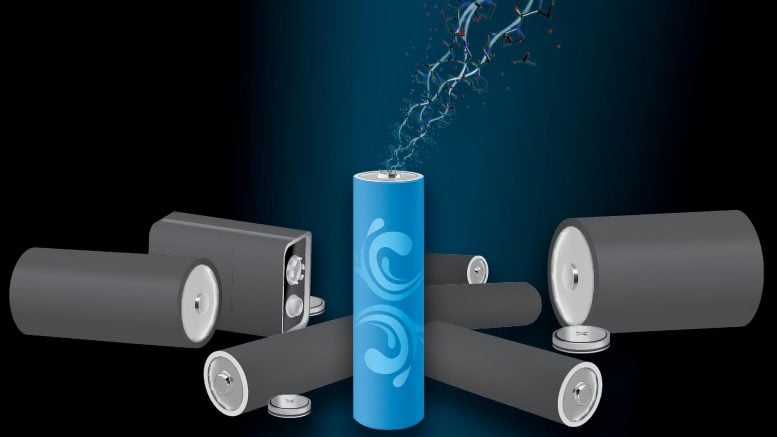
Texas A&M researchers have found a significant increase in the storage capacity of water-based battery electrodes.
Texas A&M University scientists have discovered a 1,000% difference in the storage capacity of metal-free, water-based battery electrodes.
The metal-free water-based batteries are unique from those that utilize cobalt in their lithium-ion form. The research group’s focus on this type of battery stems from a desire for greater control over the domestic supply chain as cobalt and lithium are commonly sourced from outside the country. Additionally, the batteries’ safer chemistry could prevent fires.
Chemical engineering professor Dr. Jodie Lutkenhaus and chemistry assistant professor Dr. Daniel Tabor has published their findings about lithium-free batteries in Nature Materials.
“There would be no battery fires anymore because it’s water-based,” Lutkenhaus said. “In the future, if materials shortages are projected, the price of lithium-ion batteries will go way up. If we have this alternative battery, we can turn to this chemistry, where the supply is much more stable because we can manufacture them here in the United States, and materials to make them are here.”
Core Components and Chemistry of Aqueous Batteries
Lutkenhaus said aqueous batteries consist of a cathode, an electrolyte, and an anode. The cathodes and anodes are polymers that can store energy, and the electrolyte is water mixed with organic salts. The electrolyte is key to ion conduction and energy storage through its interactions with the electrode.
“If an electrode swells too much during cycling, then it can’t conduct electrons very well, and you lose all the performance,” she said. “I believe that there is a 1,000% difference in energy storage capacity, depending on the electrolyte choice because of swelling effects.”
According to their article, redox-active, non-conjugated radical polymers (electrodes) are promising candidates for metal-free aqueous batteries because of the polymers’ high discharge voltage and fast redox kinetics. The reaction is complex and difficult to resolve because of the simultaneous transfer of electrons, ions, and water molecules.
“We demonstrate the nature of the redox reaction by examining aqueous electrolytes of varying chao-/kosmotropic character using electrochemical quartz crystal microbalance with dissipation monitoring at a range of timescales,” according to researchers in the article.
Computational Insights into Battery Dynamics
Tabor’s research group complemented the experimental efforts with computational simulation and analysis. The simulations gave insights into the microscopic molecular-scale picture of the structure and dynamics.
“Theory and experiment often work closely together to understand these materials. One of the new things that we do computationally in this paper is that we actually charge up the electrode to multiple states of charge and see how the surroundings respond to this charging,” Tabor said.
Researchers macroscopically observed if the battery cathode was working better in the presence of certain kinds of salts by measuring exactly how much water and salt is going into the battery as it is operating.
“We did that to explain what has been observed experimentally,” he said. “Now, we would like to expand our simulations to future systems. We needed to have our theory confirmed of what are the forces that are driving that kind of injection of water and solvent.
“With this new energy storage technology, this is a push forward to lithium-free batteries. We have a better molecular level picture of what makes some battery electrodes work better than others, and this gives us strong evidence of where to go forward in materials design,” Tabor said.
Reference: “The role of the electrolyte in non-conjugated radical polymers for metal-free aqueous energy storage electrodes” by Ting Ma, Cheng-Han Li, Ratul Mitra Thakur, Daniel P. Tabor and Jodie L. Lutkenhaus, 27 March 2023, Nature Materials.
DOI: 10.1038/s41563-023-01518-z
The project is funded by the U.S. Department of Energy and the National Science Foundation through the Texas A&M Engineering Experiment Station.
Never miss a breakthrough: Join the SciTechDaily newsletter.
Follow us on Google and Google News.
1 Comment
Amazing world we live in
You people are amazing