
Close Menu
    Facebook X (Twitter) Instagram
    SciTechDaily
    • Biology
    • Chemistry
    • Earth
    • Health
    • Physics
    • Science
    • Space
    • Technology
    Facebook X (Twitter) Pinterest YouTube RSS
    SciTechDaily
    Home»Space»12-Frame Mosaic of Europa’s Jupiter-Facing Hemisphere
    Space

    12-Frame Mosaic of Europa’s Jupiter-Facing Hemisphere

    By NASAMay 27, 2015No Comments2 Mins Read
    Facebook Twitter Pinterest Telegram LinkedIn WhatsApp Email Reddit
    Share
    Facebook Twitter LinkedIn Pinterest Telegram Email Reddit
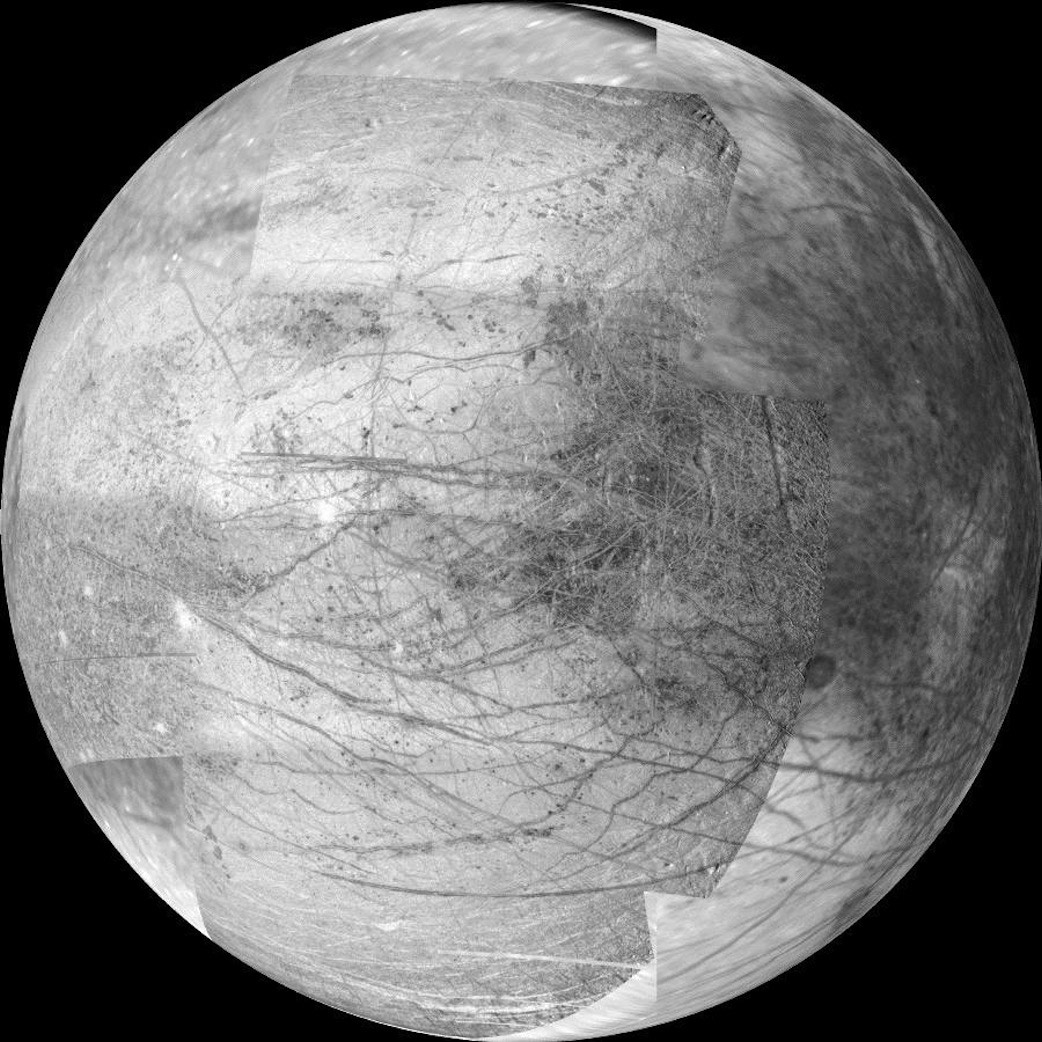
    Europa's Jupiter-Facing Hemisphere
    This 12-frame mosaic provides the highest resolution view ever obtained of the side of Jupiter’s moon Europa that faces the giant planet. It was obtained by the camera onboard NASA’s Galileo spacecraft on November 25, 1999 during the spacecrafts 25th orbit of Jupiter. NASA/JPL/University of Arizona

    This 12-frame mosaic was taken by Galileo’s camera when the spacecraft was 94,000 kilometers from Europa, providing the highest resolution view ever obtained of the side of Jupiter’s moon Europa that faces the giant planet.

    This 12-frame mosaic provides the highest resolution view ever obtained of the side of Jupiter’s moon Europa that faces the giant planet. It was obtained on November 25, 1999 by the camera onboard the Galileo spacecraft, a past NASA mission to Jupiter and its moons which ended in 2003. NASA will announce today, Tuesday, May 26, the selection of science instruments for a mission to Europa, to investigate whether it could harbor conditions suitable for life. The Europa mission would conduct repeated close flybys of the small moon during a three-year period.

    Numerous linear features in the center of this mosaic and toward the poles may have formed in response to tides strong enough to fracture Europa’s icy surface. Some of these features extend for over 1,500 kilometers (900 miles). Darker regions near the equator on the eastern (right) and western (left) limb may be vast areas of chaotic terrain. Bright white spots near the western limb are the ejecta blankets of young impact craters.

    North is to the top of the picture and the sun illuminates the surface from the left. The image, centered at 0 latitude and 10 longitude, covers an area approximately 2,500 by 3,000 kilometers. The finest details that can be discerned in this picture are about 2 kilometers across (about 1,550 by 1,860 miles). The images were taken by Galileo’s camera when the spacecraft was 94,000 kilometers (58,000 miles) from Europa.


    Never miss a breakthrough: Join the SciTechDaily newsletter.
    Follow us on Google and Google News.

    Astronomy Europa NASA Galileo Mission
    Share. Facebook Twitter Pinterest LinkedIn Email Reddit

    Related Articles

    Europa Plumes Remain Elusive

    Evidence of Tectonic Plate-Like System on Europa

    Radio Signals from Jupiter Could Aid in the Search for Extraterrestrial Life on Its Moons

    Hubble Detects Water Vapor Over Jupiter’s Moon Europa

    NASA’s Galileo Mission Discovers Clay-Like Minerals on Europa

    NASA Scientists Determine Europa Likely Spun on a Tilted Axis

    Researchers Assess the Surface of Europa for Materials Representing Ocean Composition

    Study Maps the Chemistry Needed for Life on Jupiter’s Moon Europa

    New Data Suggests a Chemical Exchange Between Europa’s Ocean and Surface

    Leave A Reply Cancel Reply

    • Facebook
    • Twitter
    • Pinterest
    • YouTube

    Don't Miss a Discovery

    Subscribe for the Latest in Science & Tech!

    Trending News

    Massive Study Warns Marijuana Use in Teens Is Linked to Serious Mental Illness

    Scientists Discover a Completely Unexpected Way T Cells Kill Cancer

    Scientists Just Found the Solar System’s Original “Planet Factory”

    Study Warns Widely Used Food Preservatives Linked to High Blood Pressure and Heart Disease

    New Treatment Could Reverse Osteoarthritis Within Weeks

    Physicists Have Measured “Negative Time” in Bizarre Quantum Experiment

    The Deadly Tapeworm Spreading Across America Has Reached the Pacific Northwest

    Could Low Vitamin D Be Making Your Pain Worse?

    Follow SciTechDaily
    • Facebook
    • Twitter
    • YouTube
    • Pinterest
    • Newsletter
    • RSS
    SciTech News
    • Biology News
    • Chemistry News
    • Earth News
    • Health News
    • Physics News
    • Science News
    • Space News
    • Technology News
    Recent Posts
    • Stanford’s Revolutionary New Microscope Reveals Living Cells in Stunning Detail
    • Scientists Discover a Sea Slug Smaller Than a Sesame Seed in Taiwan
    • Wasp Colonies Explode Into Violence After Losing Their Queen
    • Antarctica Suddenly Became Far More Sensitive to Climate Change 1 Million Years Ago
    • A Hidden Arctic Ocean Crisis Is Unfolding Beneath the Melting Ice
    Copyright © 1998 - 2026 SciTechDaily. All Rights Reserved.
    • Science News
    • About
    • Contact
    • Editorial Board
    • Privacy Policy
    • Terms of Use

    Type above and press Enter to search. Press Esc to cancel.