
The first and the best-known metallocene is ‘ferrocene’, which contains a single iron atom. Sandwich complexes are now standard topics in inorganic chemistry textbooks, and the bonding and electronic structure of metallocenes are covered in undergraduate chemistry courses. These sandwich molecules are also significant in industry, where they serve as catalysts and are utilized in the creation of unique metallopolymers.
Nobody knows exactly how many sandwich molecules there are today, but the number is certainly in the thousands. And they all have one thing in common: a single metal atom located between two flat rings of carbon atoms. At least that was what was thought up until 2004, when a research group from the University of Seville made a startling discovery.
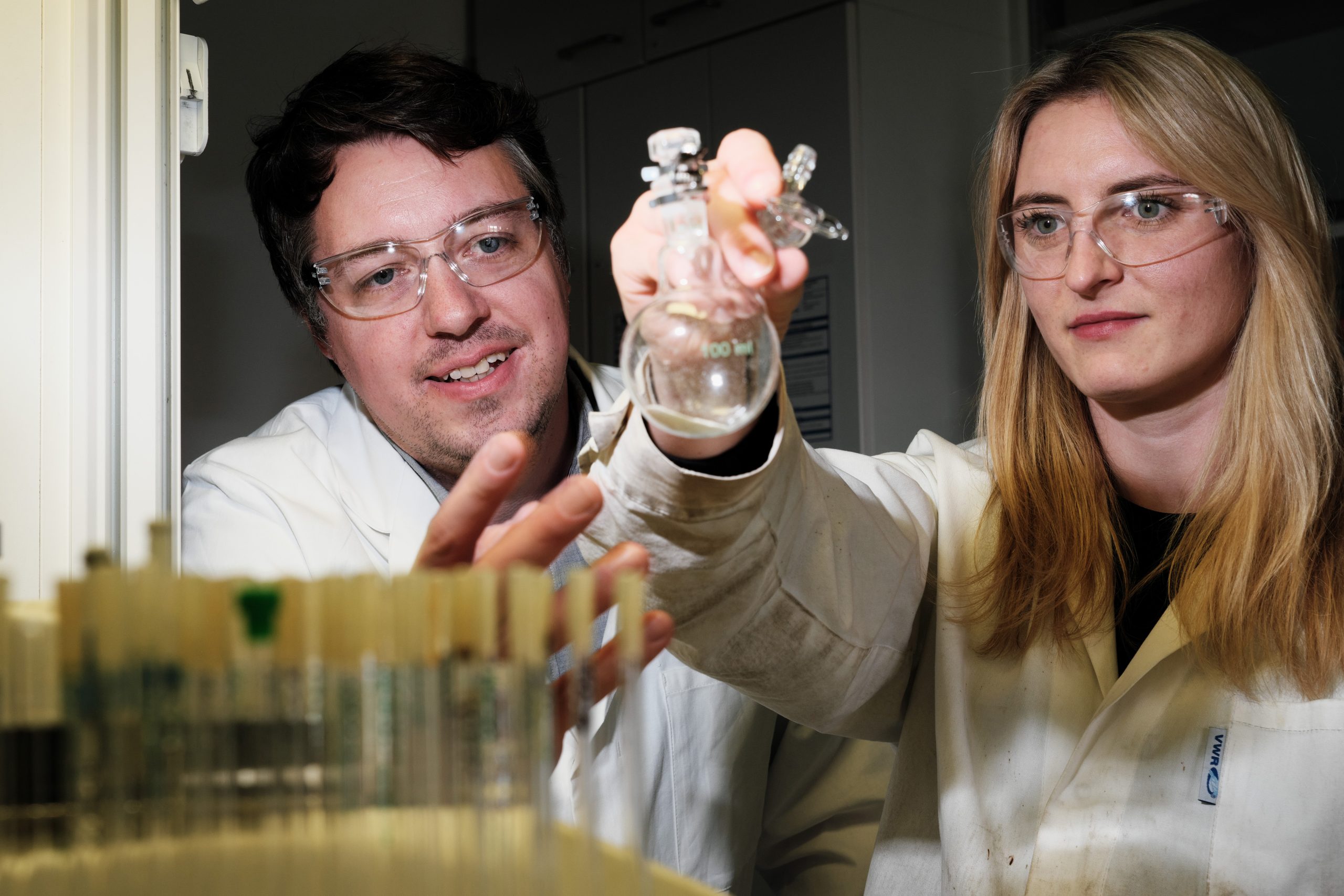
The Spanish research team succeeded in synthesizing a sandwich molecule that contained not one but two metal atoms. For a long time, this ‘dimetallocene’ containing two zinc atoms remained the only example of its kind until a group in the UK succeeded last year in synthesizing a very similar molecule that contained two beryllium atoms. But now, Inga Bischoff, a doctoral student in Dr. André Schäfer’s research team at Saarland University, has taken things one big step further. She has managed to synthesize in the laboratory the world’s first ‘heterobimetallic’ sandwich complex – a dimetallocene that contains two different metal atoms.
Theoretical and Practical Breakthroughs
Shortly after the discovery of the first dimetallocene in 2004, theoretical work indicated that dimetallocenes do not necessarily have to contain two identical metal atoms, and that a complex with two different metal atoms should also be stable. These predictions were made on the basis of quantum-chemical modeling calculations using powerful computers. Despite this predicted stability, all attempts to create such a molecule in the lab were unsuccessful until Inga Bischoff’s current breakthrough.
‘It is really exciting and special when you realize what you’re holding in your hands. To the naked eye, it just looks like another white powder. But I can still clearly remember the moment when we first saw the experimentally determined molecular structure on the computer screen and we knew that we had a sandwich molecule with two different metal atoms,’ said Dr. André Schäfer.
‘Which carbon rings you choose is just as important as which metal atoms you want to enclose between them. This is critical because the electronic structures of the cyclic carbon rings and the metal atoms have to match one another,’ explained Inga Bischoff. ‘The metals contained in our ‘heterobimetallic dimetallocene’ are lithium and aluminum. Calculations predicted that these two metals would be suitable candidates because their electronic structure is in some senses similar to that of two zinc atoms, which we knew could form a stable dimetallocene.’
But what sounds so simple and straightforward took months to achieve. The molecule turns out to be so reactive that it can only be synthesized, stored, and analyzed under an inert nitrogen or argon blanket. If it came into contact with air, it would simply decompose. Once it had been synthesized, the molecule needed to be characterized, which involved a whole team of scientists from Saarland University. The results of their work have now been published in the highly respected journal Nature Chemistry.
‘Our heterobimetallic dimetallocene represents what is effectively a whole new class of sandwich molecules,’ said group leader Dr. André Schäfer. ‘Who knows, maybe it will also be included in a student textbook one day. But first of all, we need to study it further. At the moment, we have a pretty good understanding of its structure, but still know very little about its reactivity. If we find other suitable combinations of metal atoms, it may well prove possible in the future to synthesize other heterobimetallic dimetallocenes.’
The enormous significance of this class of molecules is underlined by award of the Nobel Prize in 1973 to the German chemist Ernst Otto Fischer and the British chemist Geoffrey Wilkinson ‘for their pioneering work, performed independently, on the chemistry of the organometallic, so-called sandwich compounds.’
Reference: “A lithium–aluminium heterobimetallic dimetallocene” by Inga-Alexandra Bischoff, Sergi Danés, Philipp Thoni, Bernd Morgenstern, Diego M. Andrada, Carsten Müller, Jessica Lambert, Elias C. J. Gießelmann, Michael Zimmer and André Schäfer, 14 May 2024, Nature Chemistry.
DOI: 10.1038/s41557-024-01531-y
Never miss a breakthrough: Join the SciTechDaily newsletter.
Follow us on Google and Google News.
4 Comments
Well done Inga n Dr Schäfer.
Maybe a Noble prize 2024 like 1973 by Otto Fischer n Wilkinson. Believe or not I remember that award. Always a Hugh fan of Noble prize organization 😀.
This is all very interesting indeed
What are potential applications of the new heterobimetallic dimetallocenes?
excellent work. new to me.
concerns about biodegradability are certainly a key factor, yet rather than investing in ways only to improve metallocene’s extremely poor biodegradability, one can imagine to invest in its opposite indestructability as well. why? this might lead us to an industry that produces according to need, rather than mass-destruction for profit, minimising trash.
trash that is not produced, does not need to be biodegradable.
thrash trash!