
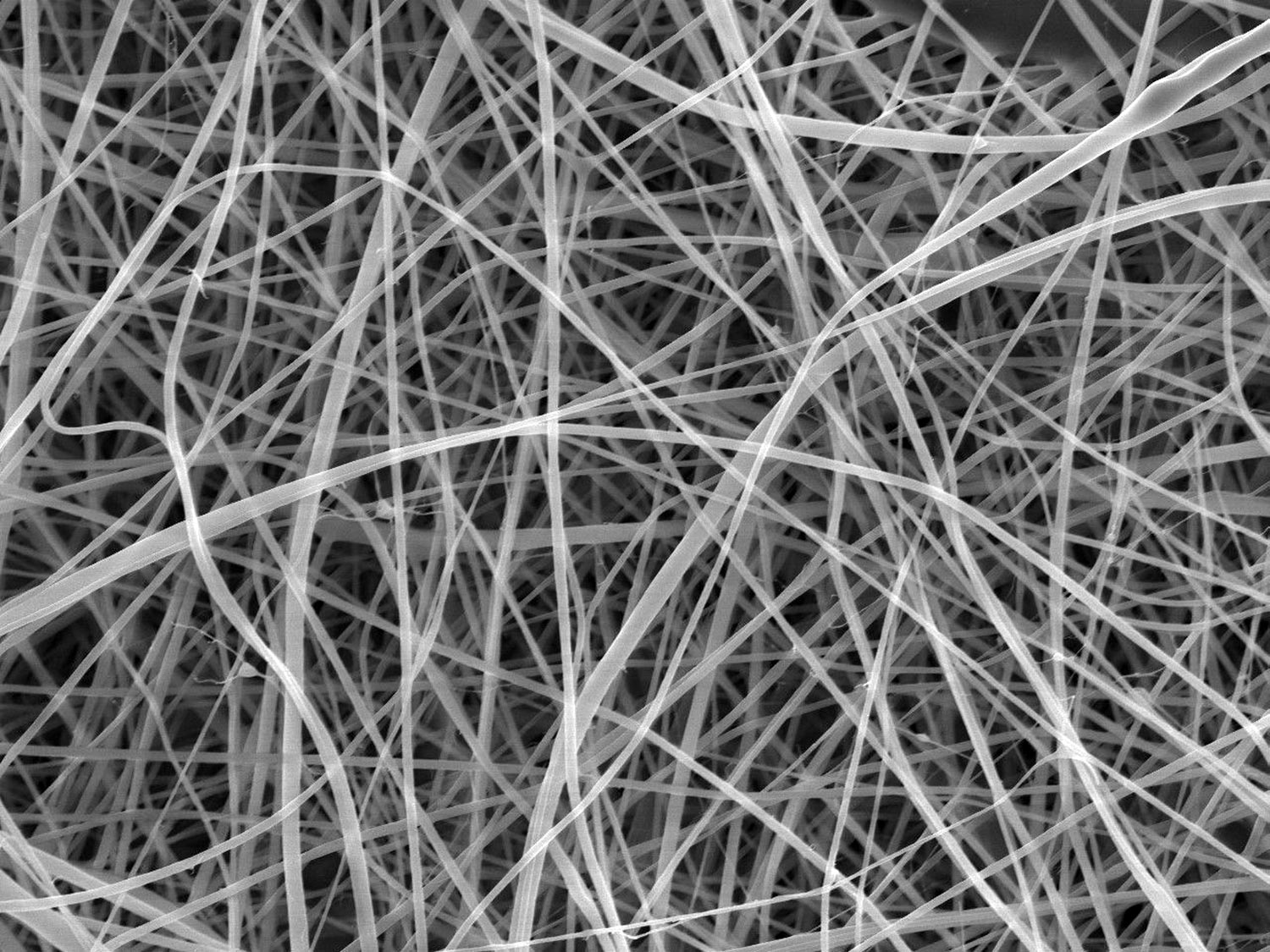
Scientists have created ultra-thin spaghetti through electrospinning, not for eating but for uses like medical scaffolding and drug delivery.
This spaghetti is made from flour to reduce the environmental impact compared to traditional methods that use purified starch, offering a new approach to nanofiber production.
Nanofiber Spaghetti
A team of researchers led by UCL has created the world’s thinnest spaghetti, measuring about 200 times thinner than a human hair.
This ultra-fine spaghetti isn’t a new culinary invention but an innovative material with significant potential in medicine and industry. These incredibly thin strands, known as nanofibers, are made from starch, a substance plants commonly use to store excess glucose.
Advancements in Nanofiber Applications
Starch-based nanofibers hold promise for a range of applications, including wound-healing bandages, where their highly porous structure allows moisture to pass through while keeping bacteria out. They can also serve as scaffolding for bone regeneration and as carriers for drug delivery. However, conventional methods of producing starch nanofibers require extracting and purifying starch from plants, a process that consumes large amounts of water and energy.
A more environmentally friendly method, the researchers say, is to create nanofibers directly from a starch-rich ingredient like flour, which is the basis for pasta.

Electrospinning: A Revolutionary Technique
In a new paper in Nanoscale Advances, the team describes making spaghetti just 372 nanometres (billionths of a meter) across using a technique called electrospinning, in which threads of flour and liquid are pulled through the tip of a needle by an electric charge. The work was performed by Beatrice Britton, who carried out the study as part of her master’s degree in chemistry at UCL.
Co-author Dr. Adam Clancy (UCL Chemistry) said: “To make spaghetti, you push a mixture of water and flour through metal holes. In our study, we did the same except we pulled our flour mixture through with an electrical charge. It’s literally spaghetti but much smaller.”
Comparisons and Potential of Nanofibers
In their paper, the researchers describe the next thinnest known pasta, called su filindeu (“threads of God”), made by hand by a pasta maker in the town of Nuoro, Sardinia. This pasta lunga (“long pasta”) is estimated at about 400 microns wide – 1,000 times thicker than the new electrospun creation, which, at 372 nanometres, is narrower than some wavelengths of light.
The novel “nanopasta” formed a mat of nanofibers about 2 cm across, and so is visible, but each individual strand is too narrow to be clearly captured by any form of visible light camera or microscope, so their widths were measured with a scanning electron microscope.

Future Prospects and Challenges
Co-author Professor Gareth Williams (UCL School of Pharmacy) said: “Nanofibers, such as those made of starch, show potential for use in wound dressings as they are very porous. In addition, nanofibers are being explored for use as a scaffold to regrow tissue, as they mimic the extra-cellular matrix – a network of proteins and other molecules that cells build to support themselves.”
Dr. Clancy said: “Starch is a promising material to use as it is abundant and renewable – it is the second largest source of biomass on Earth, behind cellulose – and it is biodegradable, meaning it can be broken down in the body.
“But purifying starch requires lots of processing. We’ve shown that a simpler way to make nanofibers using flour is possible. The next step would be to investigate the properties of this product. We would want to know, for instance, how quickly it disintegrates, how it interacts with cells, and if you could produce it at scale.”
Professor Williams added: “I don’t think it’s useful as pasta, sadly, as it would overcook in less than a second, before you could take it out of the pan.”
The Process and Challenges of Electrospinning with Flour
In electrospinning, the needle in which the mixture is contained and the metal plate upon which the mixture is deposited form two ends of a battery. Applying an electrical charge makes the mixture complete the circuit by streaming out of the needle on to the metal plate.
Electrospinning using a starch-rich ingredient such as white flour is more challenging than using pure starch, as the impurities – the protein and cellulose – make the mixture more viscous and unable to form fibers.
The researchers used flour and formic acid rather than water, as the formic acid breaks up the giant stacks of spirals (or helices) that make up starch. This is because the layers of helices stuck together are too big to be the building blocks of nanofibers. (Cooking has the same effect on the starch as the formic acid – it breaks up the layers of helices, making the pasta digestible.)
The formic acid then evaporates as the noodle flies through the air to the metal plate.
The researchers also had to carefully warm up the mixture for several hours before slowly cooling it back down to make sure it was the right consistency.
Reference: “Nanopasta: Electrospinning Nanofibres of White Flour” by Beatrice Britton, Fangyuan Zhang, David Benbow Anthony, Cesar III D. L. Reyes, Michal Pawlus, Gareth R Williams and Adam J Clancy, 30 October 2024, Nanoscale Advances.
DOI: 10.1039/D4NA00601A
Never miss a breakthrough: Join the SciTechDaily newsletter.
Follow us on Google and Google News.