

Close Menu
    Facebook X (Twitter) Instagram
    SciTechDaily
    • Biology
    • Chemistry
    • Earth
    • Health
    • Physics
    • Science
    • Space
    • Technology
    Facebook X (Twitter) Pinterest YouTube RSS
    SciTechDaily
    Home»Earth»2950 Feet Wide: Earth’s Largest Modern Crater Discovered in China
    Earth

    2950 Feet Wide: Earth’s Largest Modern Crater Discovered in China

    By American Institute of PhysicsNovember 19, 2025No Comments3 Mins Read
    Facebook Twitter Pinterest Telegram LinkedIn WhatsApp Email Reddit
    Share
    Facebook Twitter LinkedIn Pinterest Telegram Email Reddit
    Fiery Meteorite Earth Artist's Illustration
    A newly discovered crater in southern China is rewriting what scientists know about Earth’s recent encounters with space debris. Hidden within ancient granite and astonishingly well-preserved, the site holds rare clues to a powerful impact that reshaped part of our planet’s surface. Credit: Stock

    The Jinlin crater, measuring 900 meters across, formed during Earth’s current geological epoch.

    A recently identified and exceptionally well-preserved impact crater is offering scientists new insight into how objects from space have struck Earth over time.

    In a study published in Matter and Radiation at Extremes by AIP Publishing, researchers from Shanghai and Guangzhou, China, describe the Jinlin crater, an ancient impact site situated on a hillside and sealed within a thick layer of weathered granite.

    This crater, located in Zhaoqing, Guangdong Province, is among only about 200 confirmed impact sites on the planet and is considered quite young in geological terms. Based on local soil erosion data, scientists estimate it formed during the early-to-mid Holocene (our current geological epoch that began roughly 11,700 years ago at the end of the last ice age). Measuring 900 meters (about 2,950 feet) across, Jinlin is the largest known impact crater from this period, surpassing Russia’s 300-meter (roughly 985-foot) Macha crater, which previously held that distinction.
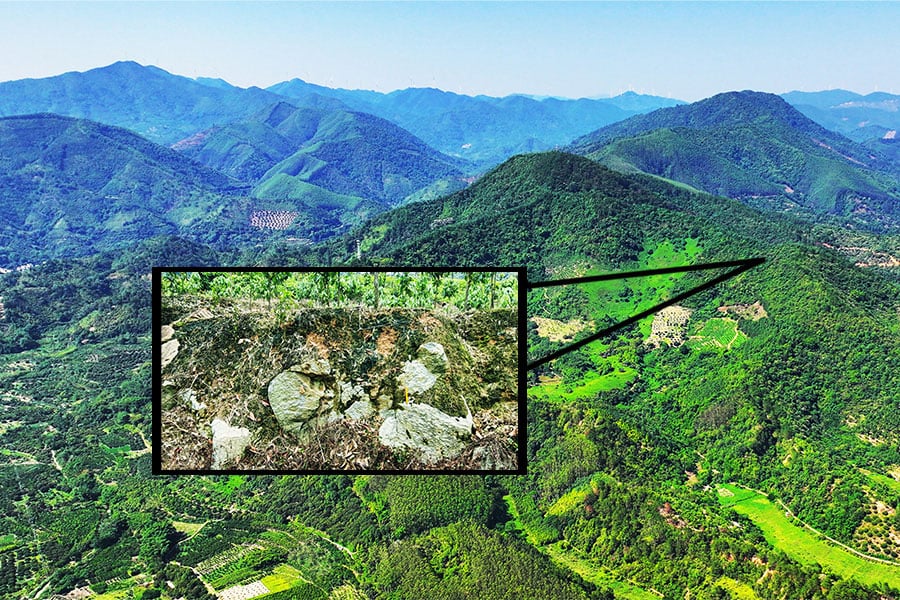
    Panoramic Aerial Drone Image of the Jinlin Crater
    A panoramic aerial drone image of the Jinlin crater with the approximate location of the crater rim labeled, with an insert of the crater floor, which shows a mix of granite weathered soil and granite fragments. The yellow ruler is 20 centimeters long. Credit: Ming Chen

    “This discovery shows that the scale of impacts of small extraterrestrial objects on the Earth in the Holocene is far greater than previously recorded,” said author Ming Chen.

    In this instance, the “small” object that struck Earth was identified as a meteorite instead of a comet. A comet of similar size would have produced a crater measuring at least 10 kilometers across. The researchers have not yet established whether the meteorite’s composition was primarily iron or stone.

    Evidence Hidden in Granite

    One of the most surprising traits of this crater is how well-preserved it is, especially given the region’s monsoons, heavy rainfall, and high humidity — all conditions that accelerate erosion. Within the granite layers that help to protect and preserve its impact structure, the researchers found many pieces of quartz with unique microfeatures, called planar deformation features, that geologists use as evidence of some type of impacts.

    “On the Earth, the formation of planar deformation features in quartz is only from the intense shockwaves generated by celestial body impacts, and its formation pressure ranges from 10 to 35 gigapascals, which is a shock effect that cannot be produced by any geological process of the Earth itself,” said Chen.

    It is generally believed that throughout Earth’s history, every point on its surface has faced roughly equal odds of being struck by an extraterrestrial object. However, geological differences mean that the historical footprints of these impacts eroded at varying rates, and some have fully disappeared. This makes the Jinlin Crater’s discovery particularly significant.

    “The impact crater is a true record of Earth’s impact history,” said Chen. “The discovery of the Earth impact crater can provide us with a more objective basis for understanding the distribution, geological evolution, and impact history and regulation of small extraterrestrial bodies.”

    Reference: “Jinlin crater, Guangdong Province, China: Impact origin confirmed” by Ming Chen, Dayong Tan, Wenge Yang, Ho-Kwang Mao, Xiande Xie, Feng Yin and Jinfu Shu, 15 October 2025, Matter and Radiation at Extremes.
    DOI: 10.1063/5.0301625

    Never miss a breakthrough: Join the SciTechDaily newsletter.
    Follow us on Google and Google News.

    American Institute of Physics Earth Science Geology Planetary Science
    Share. Facebook Twitter Pinterest LinkedIn Email Reddit

    Related Articles

    Scientists Discover How Early Earth Saved Its Water From Total Destruction

    Scientists Provide Evidence for Why Earth’s Early Climate Was More Stable and Warmer

    Tectonic Plates Used to Sink Much Further Than They do Today

    NASA Study Reveals West Antarctic Glaciers in Irreversible State of Decline

    Study Reveals Ancient Impact of Massive Asteroid

    “Iron-Rich Blobs” Penetrate Deep Into Earth’s Mantle

    Grand Canyon Thought to Be 65 Million Years Older Than Previous Estimates

    Unusual Indian Ocean Earthquakes May Signal Tectonic Breakup

    Defects in Mantle Rocks Slow Down the Passage of Seismic Waves

    Leave A Reply Cancel Reply

    • Facebook
    • Twitter
    • Pinterest
    • YouTube

    Don't Miss a Discovery

    Subscribe for the Latest in Science & Tech!

    Trending News

    Scientists Say This Natural Hormone Reverses Obesity by Targeting the Brain

    35-Million-Year-Old Mystery: Strange Arachnid Discovered Preserved in Amber

    Is AI Really Just a Tool? It Could Be Altering How You See Reality

    JWST Reveals a “Forbidden” Planet With a Baffling Composition

    The Protein “Sabotaging” Aging Muscle Recovery Could Be Key to Surviving Aging

    This Diet–Gut Interaction Could Transform Fat Into a Calorie-Burning Machine

    Scientists Discover Hidden Virus Linked to Colorectal Cancer

    Scientists Discover 132-Million-Year-Old Dinosaur Tracks on South Africa’s Coast

    Follow SciTechDaily
    • Facebook
    • Twitter
    • YouTube
    • Pinterest
    • Newsletter
    • RSS
    SciTech News
    • Biology News
    • Chemistry News
    • Earth News
    • Health News
    • Physics News
    • Science News
    • Space News
    • Technology News
    Recent Posts
    • Scientists Create “Optical Tornadoes” That Twist Light Into a Swirling Vortex
    • Scientists Uncover Hidden Superconductivity in Material Once Thought Only Magnetic
    • Scientists Baffled by Bizarre “Living Fossil” From 275 Million Years Ago
    • 500 Million Years Ago, Life Changed Forever: Scientists Reveal the DNA Changes That Helped Animals Move Onto Land
    • Surprise RNA Discovery Challenges Long-Held Beliefs About How Genes Work
    Copyright © 1998 - 2026 SciTechDaily. All Rights Reserved.
    • Science News
    • About
    • Contact
    • Editorial Board
    • Privacy Policy
    • Terms of Use

    Type above and press Enter to search. Press Esc to cancel.