
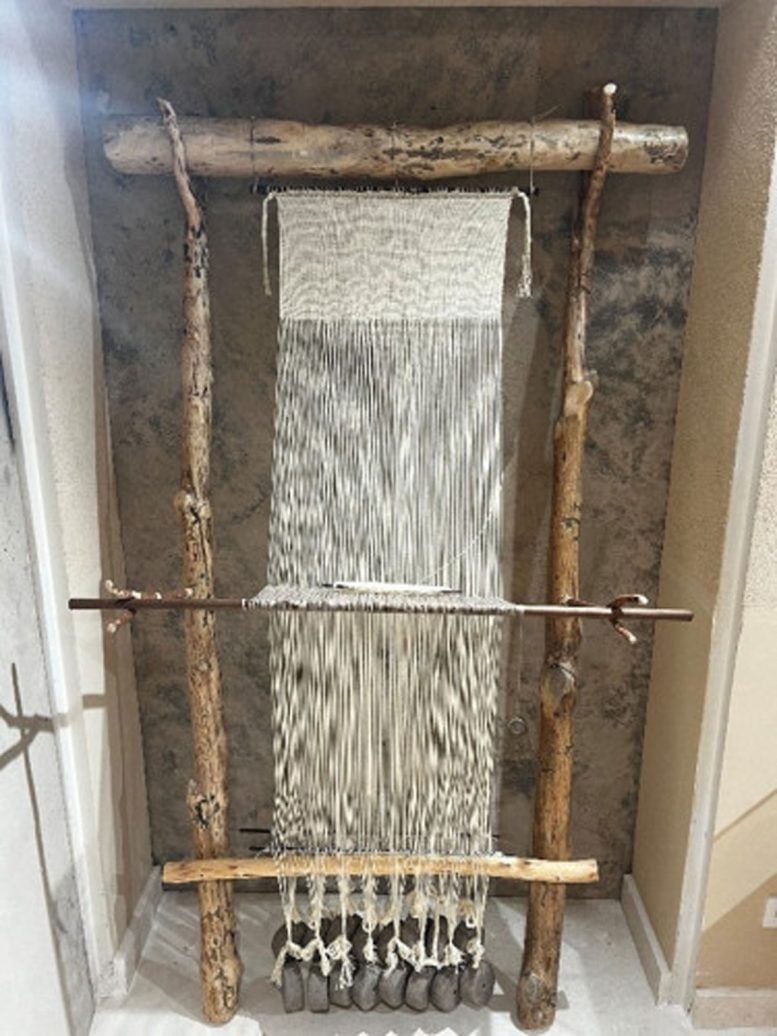
A reconstructed Bronze Age loom from Cabezo Redondo reveals advanced textile production, including potential early twill weaving, suggesting a shift toward more complex fabrics and wool use.
Researchers have analyzed and partially rebuilt a warp-weighted loom from the second millennium BC site of Cabezo Redondo in Spain, offering a rare look at how textile technology developed in the western Mediterranean during the Bronze Age.
Warp-weighted looms were widely used across prehistoric Europe and the Mediterranean to make fabrics. In this type of loom, threads hang vertically and are kept tight by clay or stone weights attached at the bottom.
Because these looms were made from wood and plant-based materials, they seldom survive in the archaeological record. As a result, most knowledge of early textile production has come from studying loom weights rather than the looms themselves.
Limits of Archaeological Evidence
“The existence of textile production in Bronze Age southeastern Iberia was well established, particularly through the study of loom weights and spindle whorls,” states lead author of the research, Dr. Ricardo E. Basso Rial from the University of Granada. “However, the wooden components of looms themselves are rarely preserved, which has severely limited our ability to reconstruct loom morphology, spatial organization, and weaving practices in detail.”
At Cabezo Redondo, researchers uncovered charred wooden beams and plant fiber ropes alongside clay loom weights at a Bronze Age settlement in southern Spain. These remains have been identified as parts of a warp-weighted loom.
This find is one of the best-preserved examples of its kind in the western Mediterranean and offers an unusual chance to better understand how textiles were made in Bronze Age Iberia.
Reconstructing the Ancient Loom
By studying the preserved wood and weights, the team was able to partially reconstruct how the loom was built and used.
The wooden elements were made from Aleppo pine, a tree native to the area. The loom weights stand out because they are much lighter than others found across Mediterranean Iberia, which may indicate they were designed for producing finer or more varied fabrics.
“The characteristics of the loom weights suggest that this loom was capable not only of producing open tabby fabrics but also potentially denser and more technically complex textiles, probably including early twill weaves,” says Dr. Basso Rial. “This represents a notable advance in our understanding of Bronze Age textile technology in Iberia.”
Advances in Textile Technology
Tabby weaving, often done with plant fibers like flax, was the dominant technique from the Neolithic through the Bronze Age. Twill weaving, on the other hand, did not become common until the early 1st millennium BC.
Twill fabrics were usually made from wool, which suggests that Cabezo Redondo may have played a role in a broader “textile revolution” marked by increased use of wool and more diverse fabric production.
“This discovery allows us to see not just the partial tools that are usually preserved, but the loom itself—frozen at the moment it was in use nearly 3,500 years ago—offering a rare glimpse into the everyday craft of Bronze Age weaving,” concludes Dr. Basso Rial.
Reference: “Evidence of a warp-weighted loom in the Bronze Age settlement of Cabezo Redondo (south-east Spain)” by Ricardo E. Basso Rial, Gabriel García Atiénzar, Yolanda Carrión Marco, Paula Martín de la Sierra Pareja, Virginia Barciela González and Mauro S. Hernández Pérez, 16 March 2026, Antiquity.
DOI: 10.15184/aqy.2026.10312
Never miss a breakthrough: Join the SciTechDaily newsletter.
Follow us on Google and Google News.
1 Comment
thanks for this