
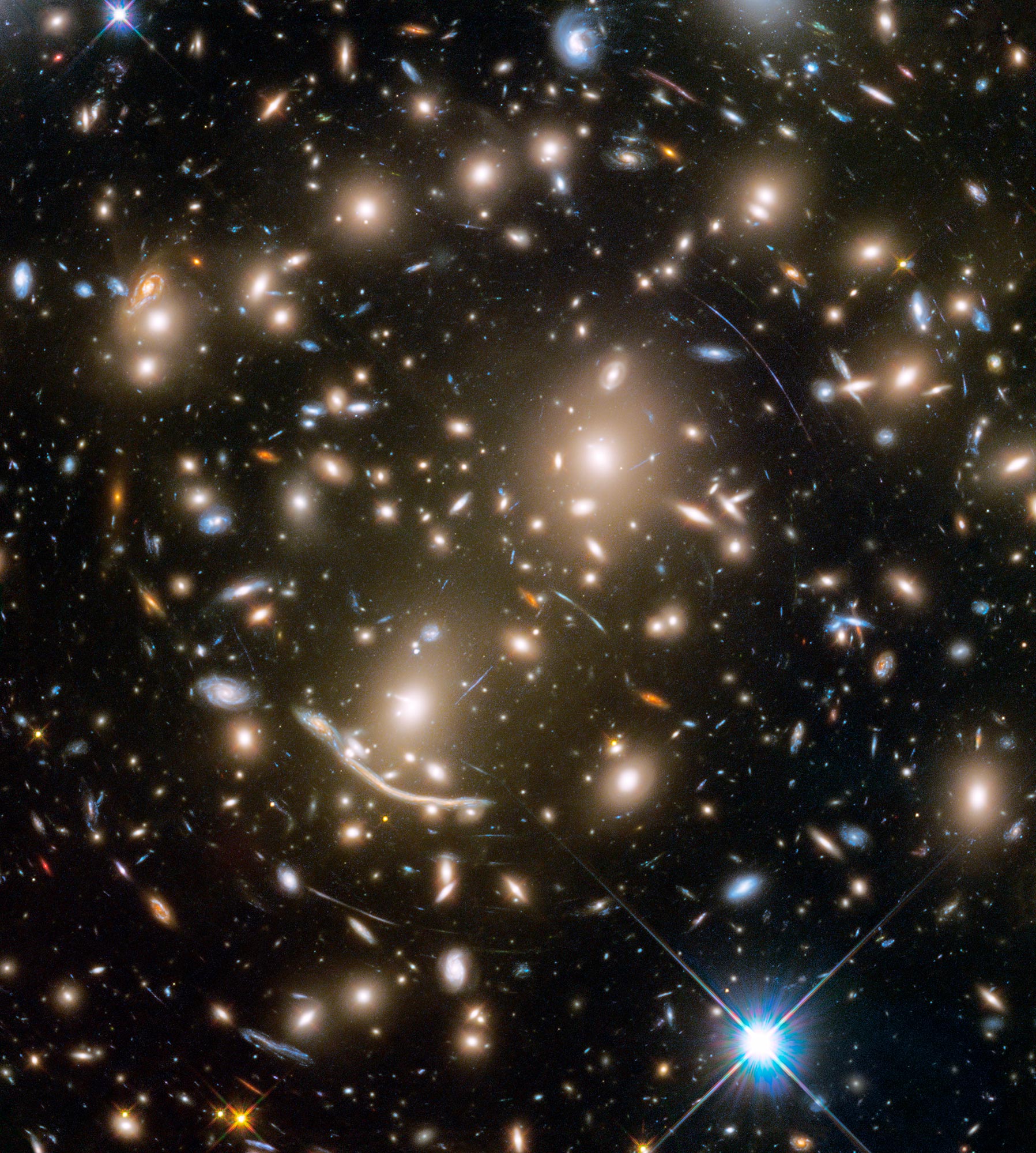
In an astronomical feat, using NASA’s James Webb Space Telescope, a team of astronomers observed a distant galaxy, uncovering 44 individual stars 6.5 billion light-years away.
This discovery, enabled by gravitational lensing, sets a new record for observing distant stars and opens new avenues for understanding dark matter and the universe’s structure at its early stages.
Record-Breaking Discoveries in Distant Galaxies
Peering halfway across the observable universe to spot individual stars might seem impossible — like trying to see grains of dust inside moon craters with binoculars. Yet, thanks to a remarkable cosmic phenomenon, a team of astronomers achieved just that.
Using NASA’s James Webb Space Telescope (JWST), Fengwu Sun, a postdoctoral researcher at the Center for Astrophysics | Harvard & Smithsonian (CfA), and his team observed a galaxy located 6.5 billion light-years away. This galaxy, visible as it appeared when the universe was half its current age, revealed 44 individual stars. These stars were detected through the powerful combination of JWST’s light-collecting capabilities and a natural phenomenon called gravitational lensing.

Exploring the Frontiers of Dark Matter and Stellar Evolution
This groundbreaking discovery, published in Nature Astronomy, sets a new record for the number of individual stars observed in a galaxy so distant. It also opens the door to studying one of the universe’s greatest enigmas: dark matter.
“This groundbreaking discovery demonstrates, for the first time, that studying large numbers of individual stars in a distant galaxy is possible,” Sun, a co-author on the study, said. “While previous studies with the Hubble Space Telescope found around seven stars, we now have the capability to resolve stars that were previously outside of our capability. Importantly, observing more individual stars will also help us better understand dark matter in the lensing plane of these galaxies and stars, which we couldn’t do with only the handful of individual stars observed previously.”

The Dragon Arc and Gravitational Lensing
CfA’s Sun found this treasure trove of stars while inspecting JWST images of a galaxy known as the Dragon Arc, located along the line of sight from Earth behind a massive cluster of galaxies called Abell 370. Due to its gravitational lensing effect, Abell 370 stretches the Dragon Arc’s signature spiral into an elongated shape – like a hall of mirrors of cosmic proportions.
The research team carefully analyzed colors of each of the stars inside the Dragon Arc and found that many are red supergiants, similar to Betelgeuse in the constellation of Orion, which is in the final stages of its life. This contrasts with earlier discoveries, which predominantly identified blue “supergiants” similar to Rigel and Deneb, which are among the brightest stars in the night sky. According to the researchers, this difference in stellar types also highlights the unique power of JWST observations at infrared wavelengths that could reveal stars at lower temperatures.
“When we discovered these individual stars, we were actually looking for a background galaxy that is lensing-magnified by the galaxies in this massive cluster,” said Sun. “But when we processed the data, we realized that there were what appeared to be a lot of individual star points. It was an exciting find because it was the first time we were able to see so many individual stars so far away.”

From Local Supergiants to Early Galaxies
Sun, in particular, is excited for the next opportunity to study these red supergiants. “We know more about red supergiants in our local galactic neighborhood because they are closer and we can take better images and spectra, and sometimes even resolve the stars. We can use the knowledge we’ve gained from studying red supergiants in the local universe to interpret what happens next for them at such an early epoch of galaxy formation in future studies.”
Most galaxies, including the Milky Way, contain tens of billions of stars. In nearby galaxies such as the Andromeda galaxy, astronomers can observe stars one by one. However, in galaxies billions of light-years away, stars appear blended together as their light needs to travel for billions of light-years before it reaches us, presenting a long-standing challenge to scientists studying how galaxies form and evolve.
“To us, galaxies that are very far away usually look like a diffuse, fuzzy blob,” said lead study author Yoshinobu Fudamoto, an assistant professor at Chiba University in Japan. “But actually, those blobs consist of many, many individual stars. We just can’t resolve them with our telescopes.”
Gravitational Lensing: Nature’s Telescope
Recent advances in astronomy have opened new possibilities by leveraging gravitational lensing – a natural magnification effect caused by the strong gravitational fields of massive objects. As predicted by Albert Einstein, gravitational lenses can amplify the light of distant stars by factors of hundreds or even thousands, making them detectable with sensitive instruments like JWST.
“These findings have typically been limited to just one or two stars per galaxy,” Fudamoto said. “To study stellar populations in a statistically meaningful way, we need many more observations of individual stars.”
Future Discoveries and Dark Matter Insights
Future JWST observations are expected to capture more magnified stars in the Dragon Arc galaxy. These efforts could lead to detailed studies of hundreds of stars in distant galaxies. Moreover, observations of individual stars could provide insight into the structure of gravitational lenses and even shed light on the elusive nature of dark matter.
Reference: “Identification of more than 40 gravitationally magnified stars in a galaxy at redshift 0.725” by Yoshinobu Fudamoto, Fengwu Sun, Jose M. Diego, Liang Dai, Masamune Oguri, Adi Zitrin, Erik Zackrisson, Mathilde Jauzac, David J. Lagattuta, Eiichi Egami, Edoardo Iani, Rogier A. Windhorst, Katsuya T. Abe, Franz Erik Bauer, Fuyan Bian, Rachana Bhatawdekar, Thomas J. Broadhurst, Zheng Cai, Chian-Chou Chen, Wenlei Chen, Seth H. Cohen, Christopher J. Conselice, Daniel Espada, Nicholas Foo, Brenda L. Frye, Seiji Fujimoto, Lukas J. Furtak, Miriam Golubchik, Tiger Yu-Yang Hsiao, Jean-Baptiste Jolly, Hiroki Kawai, Patrick L. Kelly, Anton M. Koekemoer, Kotaro Kohno, Vasily Kokorev, Mingyu Li, Zihao Li, Xiaojing Lin, Georgios E. Magdis, Ashish K. Meena, Anna Niemiec, Armin Nabizadeh, Johan Richard, Charles L. Steinhardt, Yunjing Wu, Yongda Zhu and Siwei Zou, 6 January 2025, Nature Astronomy.
DOI: 10.1038/s41550-024-02432-3
Never miss a breakthrough: Join the SciTechDaily newsletter.
Follow us on Google and Google News.
1 Comment
Can the image of the distant galaxy be un-distorted to see what it looked like if it were viewed directly? That would be interesting if it could be un-distorted using maybe AI.