
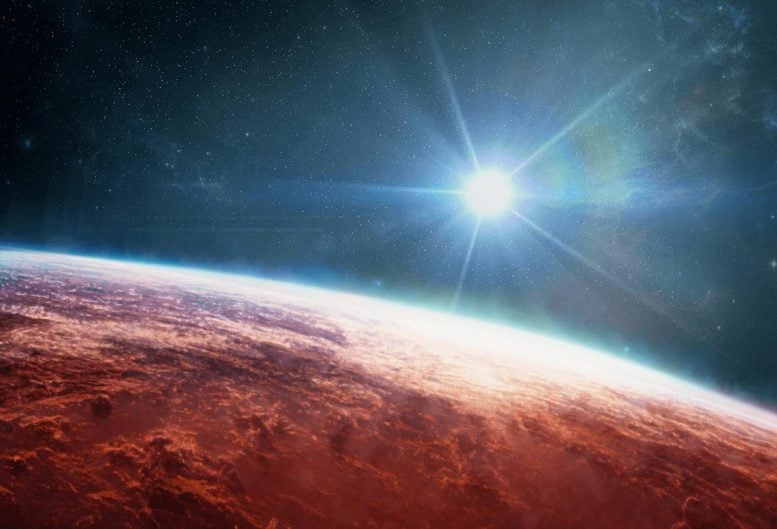
New Webb Space Telescope observations of WASP-39 b reveal a never-before-seen molecule in the atmosphere of a planet — sulfur dioxide — among other details.
The telescope’s array of highly sensitive instruments was trained on the atmosphere of WASP-39 b, a “hot Saturn” located around 700 light-years away. A hot Saturn is an exoplanet that is about as massive as Saturn and orbits closely to a star such that it has high surface-atmosphere temperatures. Although Webb and other space telescopes, including Hubble and Spitzer, have previously revealed isolated ingredients of this broiling planet’s atmosphere, the new readings provide a full menu of atoms, molecules, and even signs of active chemistry and clouds.
“The clarity of the signals from a number of different molecules in the data is remarkable,” says Mercedes López-Morales, an astronomer at the Center for Astrophysics | Harvard & Smithsonian and one of the scientists who contributed to the new results.
“We had predicted that we were going to see many of those signals, but still, when I first saw the data, I was in awe,” López-Morales adds.
Insights into Exoplanet Clouds and Chemistry
The latest data also give a hint of how these clouds in exoplanets might look up close: broken up rather than a single, uniform blanket over the planet.
The findings bode well for the capability of Webb to conduct the broad range of investigations on exoplanets — planets around other stars — scientists hoped for. That includes probing the atmospheres of smaller, rocky planets like those in the TRAPPIST-1 system.
“We observed the exoplanet with multiple instruments that, together, provide a broad swath of the infrared spectrum and a panoply of chemical fingerprints inaccessible until Webb,” said Natalie Batalha, an astronomer at the University of California, Santa Cruz, who contributed to and helped coordinate the new research. “Data like these are a game changer.”
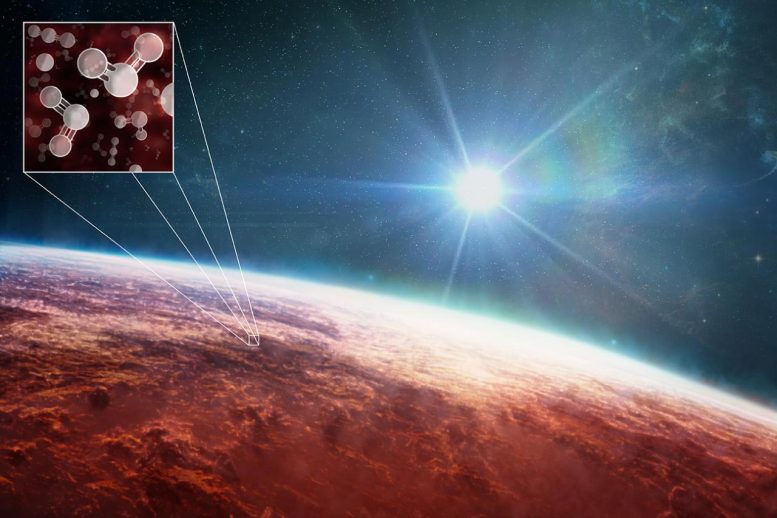
The suite of discoveries is detailed in a set of five new submitted scientific papers, available on the preprint server arXiv. Among the unprecedented revelations is the first detection in an exoplanet atmosphere of sulfur dioxide, a molecule produced from chemical reactions triggered by high-energy light from the planet’s parent star. On Earth, the protective ozone layer in the upper atmosphere is created in a similar way.
Links Between Hot Saturns and Earth’s Photochemistry
“The surprising detection of sulfur dioxide finally confirms that photochemistry shapes the climate of hot Saturns,'” says Diana Powell, a NASA Hubble fellow, astronomer at the Center for Astrophysics and core member of the team that made the sulfur dioxide discovery. “Earth’s climate is also shaped by photochemistry, so our planet has more in common with ‘hot Saturns’ than we previously knew!”
Jea Adams a graduate student at Harvard and researcher at the Center for Astrophysics analyzed the data that confirmed the sulfur dioxide signal.
“As an early career researcher in the field of exoplanet atmospheres, it’s so exciting to be a part of a detection like this,” Adams says. “The process of analyzing this data felt magical. We saw hints of this feature in early data, but this higher precision instrument revealed the signature of SO2 clearly and helped us solve the puzzle.”
At an estimated temperature of 1,600 degrees Fahrenheit and an atmosphere made mostly of hydrogen, WASP-39 b is not believed to be habitable. The exoplanet has been compared to both Saturn and Jupiter, with a mass similar to Saturn, but an overall size as big as Jupiter. But the new work points the way to finding evidence of potential life on a habitable planet.
The planet’s proximity to its host star – eight times closer than Mercury is to our Sun – also makes it a laboratory for studying the effects of radiation from host stars on exoplanets. Better knowledge of the star-planet connection should bring a deeper understanding of how these processes create the diversity of planets observed in the galaxy.
Comprehensive Chemical Profiles of WASP-39 b
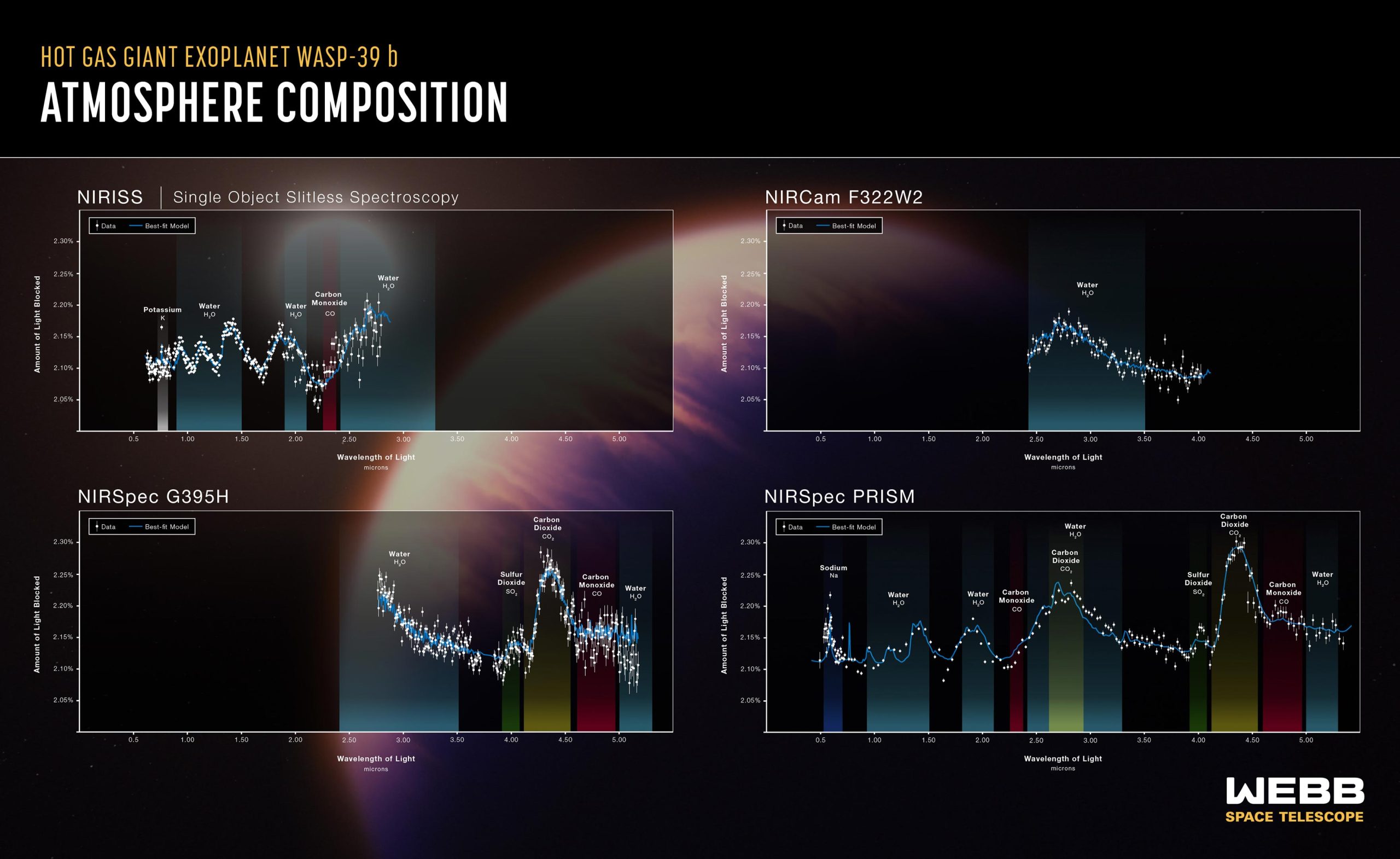
Other atmospheric constituents detected by Webb include sodium, potassium, and water vapor, confirming previous space and ground-based telescope observations as well as finding additional water features, at longer wavelengths, that haven’t been seen before.
Webb also saw carbon dioxide at higher resolution, providing twice as much data as reported from its previous observations. Meanwhile, carbon monoxide was detected, but obvious signatures of both methane and hydrogen sulfide were absent from the data. If present, these molecules occur at very low levels, a significant finding for scientists making inventories of exoplanet chemistry in order to better understand the formation and development of these distant worlds.
Capturing such a broad spectrum of WASP-39 b’s atmosphere was a scientific tour de force, as an international team numbering in the hundreds independently analyzed data from four of Webb’s finely calibrated instrument modes. They then made detailed inter-comparisons of their findings, yielding yet more scientifically nuanced results.
Webb views the universe in infrared light, on the red end of the light spectrum beyond what human eyes can see; that allows the telescope to pick up chemical fingerprints that can’t be detected in visible light.
Each of the three instruments even has some version of the “IR” of infrared in its name: NIRSpec, NIRCam, and NIRISS.
To see light from WASP-39 b, Webb tracked the planet as it passed in front of its star, allowing some of the star’s light to filter through the planet’s atmosphere. Different types of chemicals in the atmosphere absorb different colors of the starlight spectrum, so the colors that are missing tell astronomers which molecules are present.
By so precisely parsing an exoplanet atmosphere, the Webb instruments performed well beyond scientists’ expectations — and promise a new phase of exploration among the broad variety of exoplanets in the galaxy.
López-Morales says, “I am looking forward to seeing what we find in the atmospheres of small, terrestrial planets.”
For more on this topic, see NASA’s Webb Reveals an Exoplanet Unlike Any in Our Solar System.
Reference: “Direct Evidence of Photochemistry in an Exoplanet Atmosphere” by Shang-Min Tsai, Elspeth K. H. Lee, Diana Powell, Peter Gao, Xi Zhang, Julianne Moses, Eric Hébrard, Olivia Venot, Vivien Parmentier, Sean Jordan, Renyu Hu, Munazza K. Alam, Lili Alderson, Natalie M. Batalha, Jacob L. Bean, Björn Benneke, Carver J. Bierson, Ryan P. Brady, Ludmila Carone, Aarynn L. Carter, Katy L. Chubb, Julie Inglis, Jérémy Leconte, Mercedes Lopez-Morales, Yamila Miguel, Karan Molaverdikhani, Zafar Rustamkulov, David K. Sing, Kevin B. Stevenson, Hannah R Wakeford, Jeehyun Yang, Keshav Aggarwal, Robin Baeyens, Saugata Barat, Miguel de Val Borro, Tansu Daylan, Jonathan J. Fortney, Kevin France, Jayesh M Goyal, David Grant, James Kirk, Laura Kreidberg, Amy Louca, Sarah E. Moran, Sagnick Mukherjee, Evert Nasedkin, Kazumasa Ohno, Benjamin V. Rackham, Seth Redfield, Jake Taylor, Pascal Tremblin, Channon Visscher, Nicole L. Wallack, Luis Welbanks, Allison Youngblood, Eva-Maria Ahrer, Natasha E. Batalha, Patrick Behr, Zachory K. Berta-Thompson, Jasmina Blecic, S.L. Casewell, Ian J.M. Crossfield, Nicolas Crouzet, Patricio E. Cubillos, Leen Decin, Jean-Michel Désert, Adina D. Feinstein, Neale P. Gibson, Joseph Harrington, Keivn Heng, Thomas Henning, Eliza M.-R. Kempton, Jessica Krick, Pierre-Olivier Lagage, Monika Lendl, Michael Line, Joshua D. Lothringer, Megan Mansfield, N. J. Mayne, Thomas Mikal-Evans, Enric Palle, Everett Schlawin, Oliver Shorttle, Peter J. Wheatley and Sergei N. Yurchenko, 18 November 2022, Astrophysics > Earth and Planetary Astrophysics.
arXiv:2211.10490
Never miss a breakthrough: Join the SciTechDaily newsletter.
Follow us on Google and Google News.