
Stars powered with dark matter still need proving but could reveal clues about the nature of one of the universe’s great mysteries.
Stars beam brightly out of the darkness of space thanks to fusion, atoms melding together and releasing energy. But what if there’s another way to power a star?
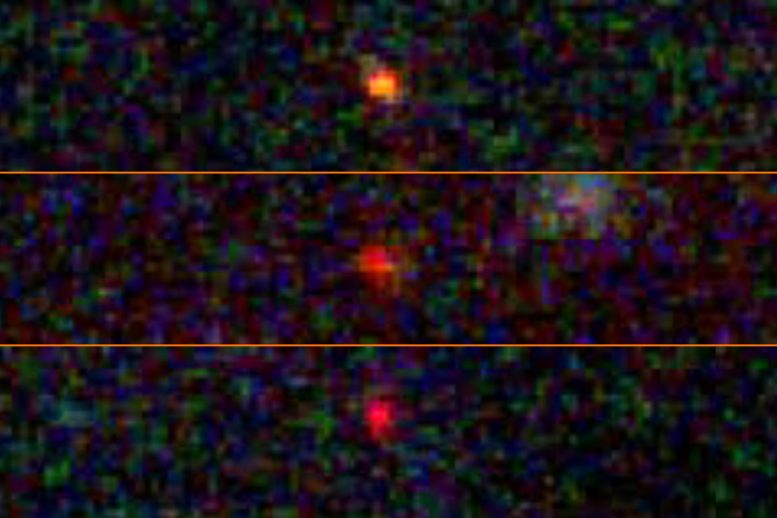
A team of three astrophysicists — Katherine Freese at The University of Texas at Austin, in collaboration with Cosmin Ilie and Jillian Paulin ’23 at Colgate University — analyzed images from the James Webb Space Telescope (JWST) and found three bright objects that might be “dark stars,” theoretical objects much bigger and brighter than our sun, powered by particles of dark matter annihilating. If confirmed, dark stars could reveal the nature of dark matter, one of the deepest unsolved problems in all of physics.
“Discovering a new type of star is pretty interesting all by itself, but discovering it’s dark matter that’s powering this—that would be huge,” said Freese, director of the Weinberg Institute for Theoretical Physics and the Jeff and Gail Kodosky Endowed Chair in Physics at UT Austin.
Although dark matter makes up about 25% of the universe, its nature has eluded scientists. Scientists believe it consists of a new type of elementary particle, and the hunt to detect such particles is on. Among the leading candidates are Weakly Interacting Massive Particles. When they collide, these particles annihilate themselves, depositing heat into collapsing clouds of hydrogen and converting them into brightly shining dark stars. The identification of supermassive dark stars would open up the possibility of learning about the dark matter based on their observed properties.
The research was published on July 11 in the Proceedings of the National Academy of Sciences.
Follow-up observations from JWST of the objects’ spectroscopic properties — including dips or excess of light intensity in certain frequency bands — could help confirm whether these candidate objects are indeed dark stars.
Confirming the existence of dark stars might also help solve a problem created by JWST: There seem to be too many large galaxies too early in the universe to fit the predictions of the standard model of cosmology.
“It’s more likely that something within the standard model needs tuning, because proposing something entirely new, as we did, is always less probable,” Freese said. “But if some of these objects that look like early galaxies are actually dark stars, the simulations of galaxy formation agree better with observations.”
The three candidate dark stars (JADES-GS-z13-0, JADES-GS-z12-0, and JADES-GS-z11-0) were originally identified as galaxies in December 2022 by the JWST Advanced Deep Extragalactic Survey (JADES). Using spectroscopic analysis, the JADES team confirmed the objects were observed at times ranging from about 320 million to 400 million years after the Big Bang, making them some of the earliest objects ever seen.
How Dark Stars Differ from Ordinary Stars
“When we look at the James Webb data, there are two competing possibilities for these objects,” Freese said. “One is that they are galaxies containing millions of ordinary, population-III stars. The other is that they are dark stars. And believe it or not, one dark star has enough light to compete with an entire galaxy of stars.”
Dark stars could theoretically grow to be several million times the mass of our sun and up to 10 billion times as bright as the sun.
“We predicted back in 2012 that supermassive dark stars could be observed with JWST,” said Ilie, assistant professor of physics and astronomy at Colgate University. “As shown in our recently published PNAS article, we already found three supermassive dark star candidates when analyzing the JWST data for the four high redshift JADES objects spectroscopically confirmed by Curtis-Lake et al, and I am confident we will soon identify many more.”
The Evolution of the Dark Star Hypothesis
The idea for dark stars originated in a series of conversations between Freese and Doug Spolyar, at the time a graduate student at the University of California, Santa Cruz. They wondered: What does dark matter do to the first stars to form in the universe? Then they reached out to Paolo Gondolo, an astrophysicist at the University of Utah, who joined the team. After several years of development, they published their first paper on this theory in the journal Physical Review Letters in 2008.
Together, Freese, Spolyar and Gondolo developed a model that goes something like this: At the centers of early protogalaxies, there would be very dense clumps of dark matter, along with clouds of hydrogen and helium gas. As the gas cooled, it would collapse and pull in dark matter along with it. As the density increased, the dark matter particles would increasingly annihilate, adding more and more heat, which would prevent the gas from collapsing all the way down to a dense enough core to support fusion as in an ordinary star. Instead, it would continue to gather more gas and dark matter, becoming big, puffy, and much brighter than ordinary stars. Unlike ordinary stars, the power source would be evenly spread out, rather than concentrated in the core. With enough dark matter, dark stars could grow to be several million times the mass of our sun and up to 10 billion times as bright as the sun.
Reference: “Supermassive Dark Star candidates seen by JWST” by Cosmin Ilie, Jillian Paulin and Katherine Freese, 11 July 2023, Proceedings of the National Academy of Sciences.
DOI: 10.1073/pnas.2305762120
Funding for this research was provided by the U.S. Department of Energy’s Office of High Energy Physics program and the Vetenskapsradet (Swedish Research Council) at the Oskar Klein Centre for Cosmoparticle Physics at Stockholm University.
Never miss a breakthrough: Join the SciTechDaily newsletter.
Follow us on Google and Google News.
8 Comments
Great progress, in identifying key areas we can prove elements that will enable the construction of new efficient designs for future energy!!
“Follow-up observations from JWST of the objects’ spectroscopic properties — including dips or excess of light intensity in certain frequency bands — could help confirm whether these candidate objects are indeed dark stars.”
“When we look at the James Webb data, there are two competing possibilities for these objects,” Freese said. “One is that they are galaxies containing millions of ordinary, population-III stars. The other is that they are dark stars. And believe it or not, one dark star has enough light to compete with an entire galaxy of stars.”
“Funding for this research was provided by the U.S. Department of Energy’s Office of High Energy Physics program”
Black hole for a new form of money waste discovered.
I’m SOOO tired of reading this absolute BS about “dark matter” which doesn’t exist!!!! There are no dark stars. There is no dark sun. It’s maddening to watch grown men and women write about absolute science fiction bull crap.
The entire concept of BOTH is due 100% due to MATCH KLUDGES designed to explain why RED SHIFT observations relative to mass and size (based on false distance assumptions) don’t match predicted models. The problem is with the Red Shift assumptions.
It’s such an obvious and easy thing to understand. If there’s matter between you and something you’re observing far away (let’s call it DUST), it’s going to DIM the light you see and RED SHIFT it to appear farther away than it actually is. Not only is the size wrong, but the distance is wrong! We’ve got scientists spending BILLIONS of dollars chasing after a flipping ILLUSION!!!
Wake up! You can’t just make up particles and energies because your stupid models are WRONG!!! Eventually, science will figure this out and there’s going to be so much flipping EGG on so many faces that wasted their entire lives chasing something that doesn’t exist. Mark my words.
Deep Space farts
“If there’s matter between you and something you’re observing far away (let’s call it DUST), it’s going to DIM the light you see and RED SHIFT it to appear farther away than it actually is.”
Personally, I do not believe FOR EVEN ONE SINGLE SECOND that someone here is not doing a bit where they pretend to not know the difference between reddening and red-shifting.
“Discovering a new type of star is pretty interesting all by itself, but discovering it’s dark matter that’s powering this—that would be huge”
Dark matter and Big Bang claims really belong somewhere where responses are not allowed, to keep them protected from cynicism.
I may be mis-remembering but I thought it was the presence of dark matter that was responsible for accelerating the expansion of the universe and why there will not be a “big crunch”. If dark matter causes space/matter to move apart how does it form into a star?
Or condensing dark matter in the early universe pulled the hydrogen and helium with it forming megs stars and direct collapse black holes. A large part of the mass of these stars and black holes would actually be liquid dark matter a thousand times or more more concentrated than the gaseous dark matter. Once AGN’s and the stars kicked in the LDM would begin to vaporize. The average LDM would have been dropping faster and first and then more slowly as time went on forming galactic haloes of vaporized dark matter with a chance of scattered clouds of LDM.