
Close Menu
    Facebook X (Twitter) Instagram
    SciTechDaily
    • Biology
    • Chemistry
    • Earth
    • Health
    • Physics
    • Science
    • Space
    • Technology
    Facebook X (Twitter) Pinterest YouTube RSS
    SciTechDaily
    Home»Science»500 Million Year Old Tulip-Shaped Creature Discovered
    Science

    500 Million Year Old Tulip-Shaped Creature Discovered

    By University of TorontoJanuary 20, 20121 Comment3 Mins Read
    Facebook Twitter Pinterest Telegram LinkedIn WhatsApp Email Reddit
    Share
    Facebook Twitter LinkedIn Pinterest Telegram Email Reddit
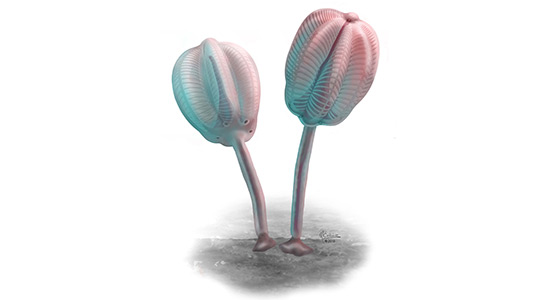
    Siphusauctum Gregarium
    Reconstruction of Siphusauctum gregarium. The animals are shown in life position, standing upright in the water column partially anchored into the sediment by a small holdfast. Credit: M. Collins

    Fossils found in the Middle Cambrian Burgess Shale in the Canadian Rockies reveal a strange creature with a tulip shape. This ocean animal, officially named Siphusauctum gregarium, lived roughly 500 million years ago and used the bulbous structure on top as a filter feeding system.

    A bizarre creature that lived in the ocean more than 500 million years ago has emerged from the famous Middle Cambrian Burgess Shale in the Canadian Rockies.

    Officially named Siphusauctum gregarium, fossils reveal a tulip-shaped creature that is about the length of a dinner knife (approximately 20 centimeters) and has a unique filter feeding system.

    Siphusauctum has a long stem, with a calyx – a bulbous cup-like structure – near the top which encloses an unusual filter feeding system and a gut. The animal is thought to have fed by filtering particles from water actively pumped into its calyx through small holes. The stem ends with a small disc that anchored the animal to the seafloor. Siphusauctum lived in large clusters, as indicated by slabs containing over 65 individual specimens.

    Lorna O’Brien, a PhD candidate in the Department of Ecology and Evolutionary Biology at the University of Toronto and her supervisor Jean-Bernard Caron, curator of invertebrate paleontology at the Royal Ontario Museum, report on the discovery today in the online science journal PLoS ONE.
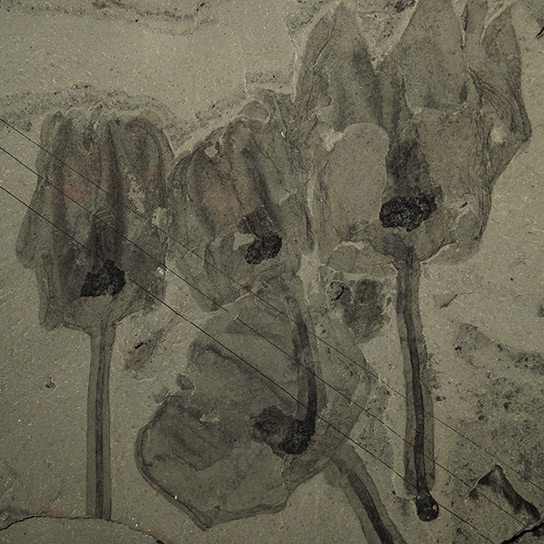
    Siphusauctum Gregarium Fossils
    Cluster of four specimens of Siphusauctum gregarium. Credit: Royal Ontario Museum

    “Most interesting is that this feeding system appears to be unique among animals. Recent advances have linked many bizarre Burgess Shale animals as primitive members of many animal groups that are found today but Siphusauctum defies this trend. We do not know where it fits in relation to other organisms,” said O’Brien.

    “Our description is based on more than 1,100 fossil specimens from a new Burgess Shale locality that has been nicknamed the Tulip Beds,” said lead author O’Brien. Located in Yoho National Park, British Columbia, the Tulip Beds were first discovered in 1983 by the Royal Ontario Museum. They are located high on Mount Stephen, overlooking the town of Field. Like the rest of the Burgess Shale, the Beds represent rock layers with exceptional preservation of mostly soft-bodied organisms. The Burgess Shale, protected under the larger Rocky Mountain Parks UNESCO World Heritage site and managed by Parks Canada, preserves fossil evidence of some of the earliest complex animals that lived in the oceans of our planet nearly 505 million years ago. The discovery of Siphusauctum expands the range of animal diversity that existed during this time period.

    Never miss a breakthrough: Join the SciTechDaily newsletter.
    Follow us on Google and Google News.

    Burgess Shale Fossils Royal Ontario Museum University of Toronto
    Share. Facebook Twitter Pinterest LinkedIn Email Reddit

    Related Articles

    Three-Eyed “Sea-Moth” Predator From 506 Million Years Ago Stuns Scientists

    What a Bizarre Taco-Shaped Sea Creature Can Teach Us About Evolution

    Discovery of 8.7-Million-Year-Old Fossil Ape Challenges Long-Accepted Ideas of Human Origins

    World’s Oldest Dinosaur Bonebed Reveals How Dinosaur Embryos Grew and Developed

    Jurassic Period Super-Sized Fleas Had Armored Mouthparts to Attack the Thick Hide of Dinosaurs

    Researchers Discover Remains of Possibly Earliest Known Ancestor

    Oldest Dinosaur Nesting Site Discovered

    Hundreds of Lost Fossils From the Darwin Collection Rediscovered by the British Geological Survey

    Nest of Juvenile Protoceratops Andrewsi Dinosaurs Discovered

    1 Comment

    1. Rock on December 5, 2012 11:47 am

      The quote that comes to mind is “Oh F**K! Not ANOTHER phylum!”

      🙂

      Reply
    Leave A Reply Cancel Reply

    • Facebook
    • Twitter
    • Pinterest
    • YouTube

    Don't Miss a Discovery

    Subscribe for the Latest in Science & Tech!

    Trending News

    New “Nanozyme Hypothesis” Could Rewrite the Story of Life’s Origins

    Anatomy Isn’t Finished: The Human Body Still Holds Secrets

    “Pretty Close to Home”: The Hidden Earthquake Threat Beneath Seattle

    The Surprising Reason You Might Want To Sleep Without a Pillow

    Scientists Say This Natural Hormone Reverses Obesity by Targeting the Brain

    35-Million-Year-Old Mystery: Strange Arachnid Discovered Preserved in Amber

    Is AI Really Just a Tool? It Could Be Altering How You See Reality

    JWST Reveals a “Forbidden” Planet With a Baffling Composition

    Follow SciTechDaily
    • Facebook
    • Twitter
    • YouTube
    • Pinterest
    • Newsletter
    • RSS
    SciTech News
    • Biology News
    • Chemistry News
    • Earth News
    • Health News
    • Physics News
    • Science News
    • Space News
    • Technology News
    Recent Posts
    • These New Molecules Could Change How We Treat Lupus and Arthritis
    • Saunas May Do More Than Raise Body Temperature – They Activate Your Immune System
    • Exercise in a Pill? Metformin Shows Surprising Effects in Cancer Patients
    • Saturn’s Magnetic Shield Isn’t What Scientists Expected
    • Hidden Oceans of Magma Could Be Protecting Alien Life
    Copyright © 1998 - 2026 SciTechDaily. All Rights Reserved.
    • Science News
    • About
    • Contact
    • Editorial Board
    • Privacy Policy
    • Terms of Use

    Type above and press Enter to search. Press Esc to cancel.