
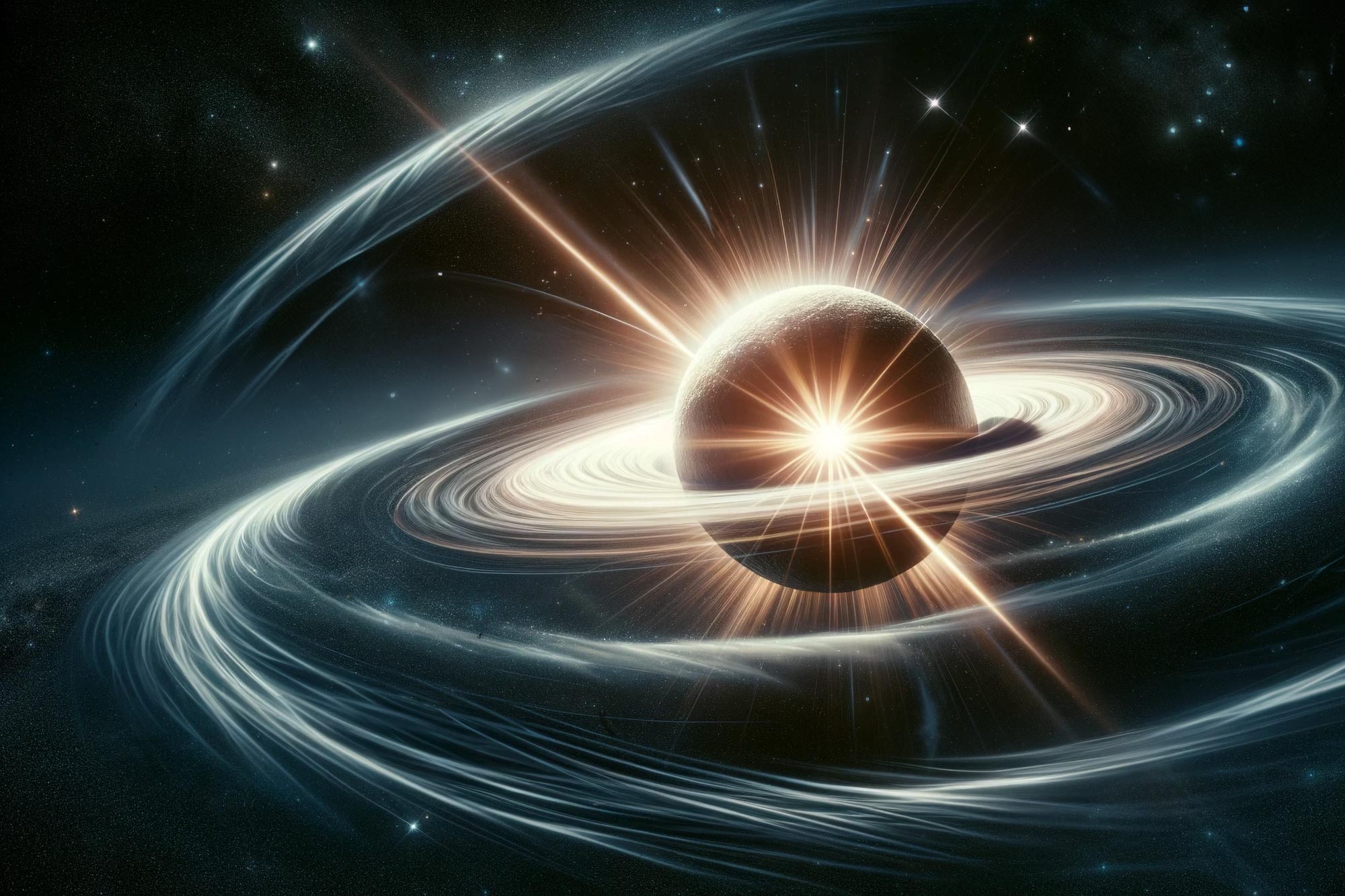
Researchers have made a groundbreaking discovery of a neutron star in the Milky Way that rotates at an astonishing 716 times per second, placing it among the fastest-spinning stars ever observed.
The neutron star was identified using NASA’s NICER X-ray telescope, which captured extreme thermonuclear bursts resembling atomic explosions. These bursts shine up to 100,000 times brighter than the Sun, providing insights into neutron stars’ life cycles and the creation of elements in the universe.
Discovering a Fast-Spinning Neutron Star
The Milky Way still holds many mysteries about the universe, and researchers at DTU have just uncovered another one. Using an X-ray telescope mounted on the International Space Station (ISS), they observed an incredibly dense and fast-spinning neutron star. This neutron star, named 4U 1820-30, is part of an “X-ray binary star system” located in the Sagittarius constellation near the center of our galaxy.
“We were studying thermonuclear explosions from this system and then found remarkable oscillations, suggesting a neutron star spinning around its center axis at an astounding 716 times per second,” explains Dr. Gaurava K. Jaisawal, a senior scientist at DTU Space. He is part of an international research team behind this discovery and lead author of a recent paper on the findings published in The Astrophysical Journal.
“If future observations confirm this, the 4U 1820-30 neutron star would be one of the fastest-spinning objects ever observed in the universe, matched only by another neutron star called PSR J1748–2446.”
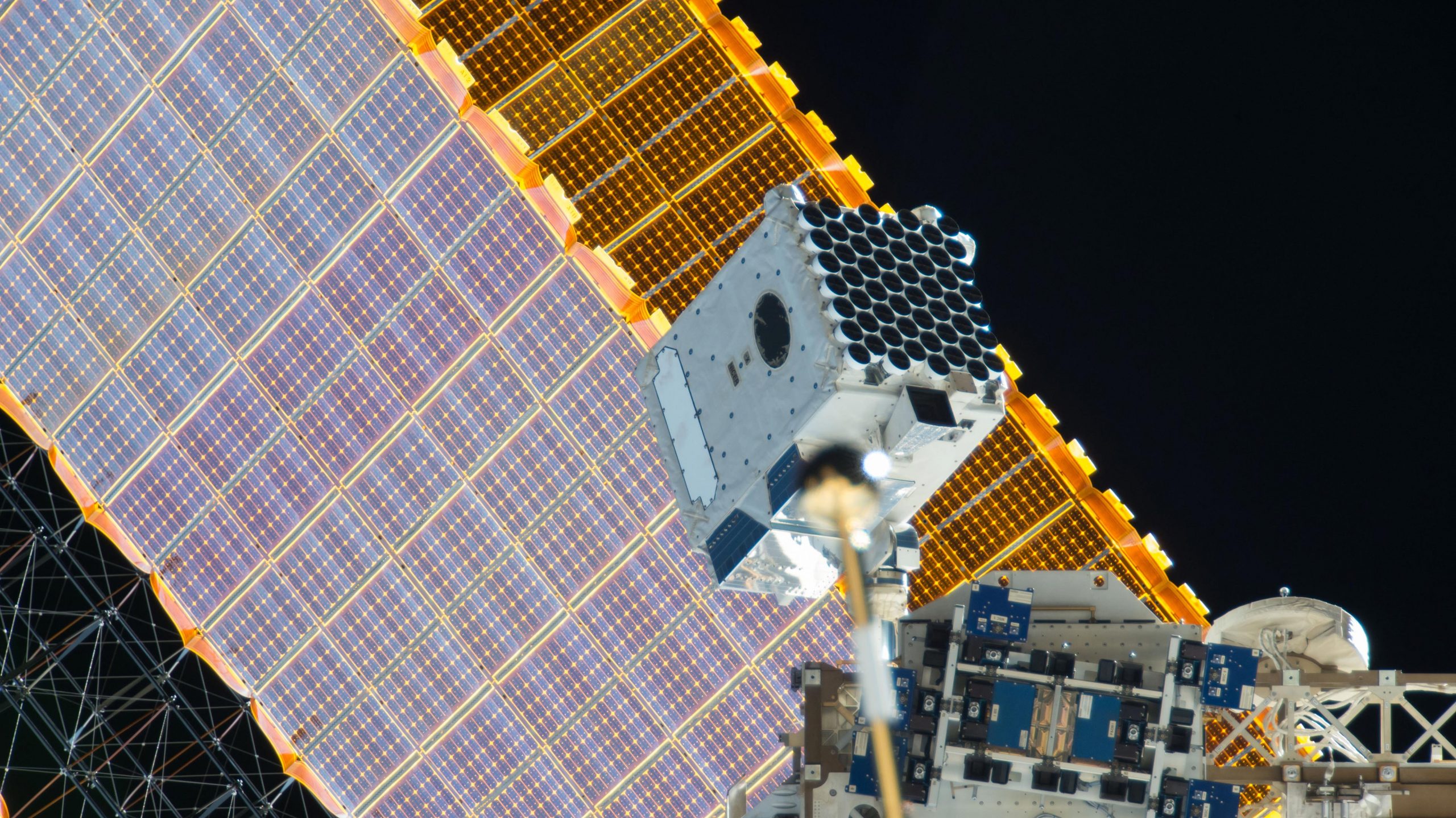
The team made this discovery using NASA’s NICER X-ray telescope, which is equipped with star tracker technology developed by DTU Space. Mounted on the exterior of the ISS, the star tracker system keeps the telescope accurately pointed at distant neutron stars throughout the Milky Way.
A very extreme phenomenon very far away
A neutron star, also called a dead star, consists of the remnant of a large, massive star that has exploded in a supernova. A few thousand of them have been discovered, and they are extreme in pretty many ways.
They are the densest objects that can be observed in the cosmos. The neutron star in question is only 12 km across but has a mass 1.4 times greater than the Sun’s.
It is located 26,000 light years away from Earth. By comparison, the distance to Earth’s nearest star, Proxima Centauri, is about 4.3 light years. This means that light from Proxima Centauri takes 4.3 years to reach us on Earth, while the light from the neutron star travels for 26,000 years before we can observe it on Earth.
The neutron star is part of an X-ray binary star system. Such a system consists of two stars orbiting each other. What is also peculiar with the system ‘4U 1820-30’ is that the companion star is a white dwarf about the same size as the Earth. It is known to orbit the neutron star every 11 minutes, making it the system with the shortest known orbital period.
Surface burst as powerful as an atomic bomb
Due to its intense gravity, the neutron star pulls material away from its companion star. When enough material has accumulated on its surface, a violent thermonuclear burst occurs on the neutron star, similar to an atomic bomb.
“During these bursts, the neutron star becomes up to 100,000 times brighter than the Sun, releasing an immense amount of energy,” explains Associate Professor at DTU Space, Jerome Chenevez, who contributed to the new article in Astrophysical Journal.
“So we are dealing with very extreme events, and by studying them in detail, we get new insights into the exiting life cycles of binary star systems and the formation of elements in the universe.”
Through observations made with NICER between 2017 and 2021, the researchers discovered 15 thermonuclear X-ray bursts from the X-ray binary star system called ’4U 1820-30’. It was one of these bursts that showed a signature known as ‘thermonuclear burst oscillations’, occurring at a frequency of 716 Hz.
These burst oscillations match the spin frequency of the neutron star itself, meaning that it rotates on its axis at a record-high rate of 716 times per second.
Reference: “A Comprehensive Study of Thermonuclear X-Ray Bursts from 4U 1820–30 with NICER: Accretion Disk Interactions and a Candidate Burst Oscillation” by Gaurava K. Jaisawal, Z. Funda Bostancı, Tuğba Boztepe, Tolga Güver, Tod E. Strohmayer, David R. Ballantyne, Jens H. Beck, Ersin Göğüş, Diego Altamirano, Zaven Arzoumanian, Deepto Chakrabarty, Keith C. Gendreau, Sebastien Guillot, Renee M. Ludlam, Mason Ng, Andrea Sanna and Jérôme Chenevez, 25 October 2024, The Astrophysical Journal.
DOI: 10.3847/1538-4357/ad794e
Never miss a breakthrough: Join the SciTechDaily newsletter.
Follow us on Google and Google News.
4 Comments
Hi
Imagine having a house there…
Just the thought of it makes me dizzy.
So matter moves at the equator (when d=12km) at a speed of 26979 km/sec. It is not flat and does not fly apart at about one-tenth the speed of light. Gravity is the doer!