
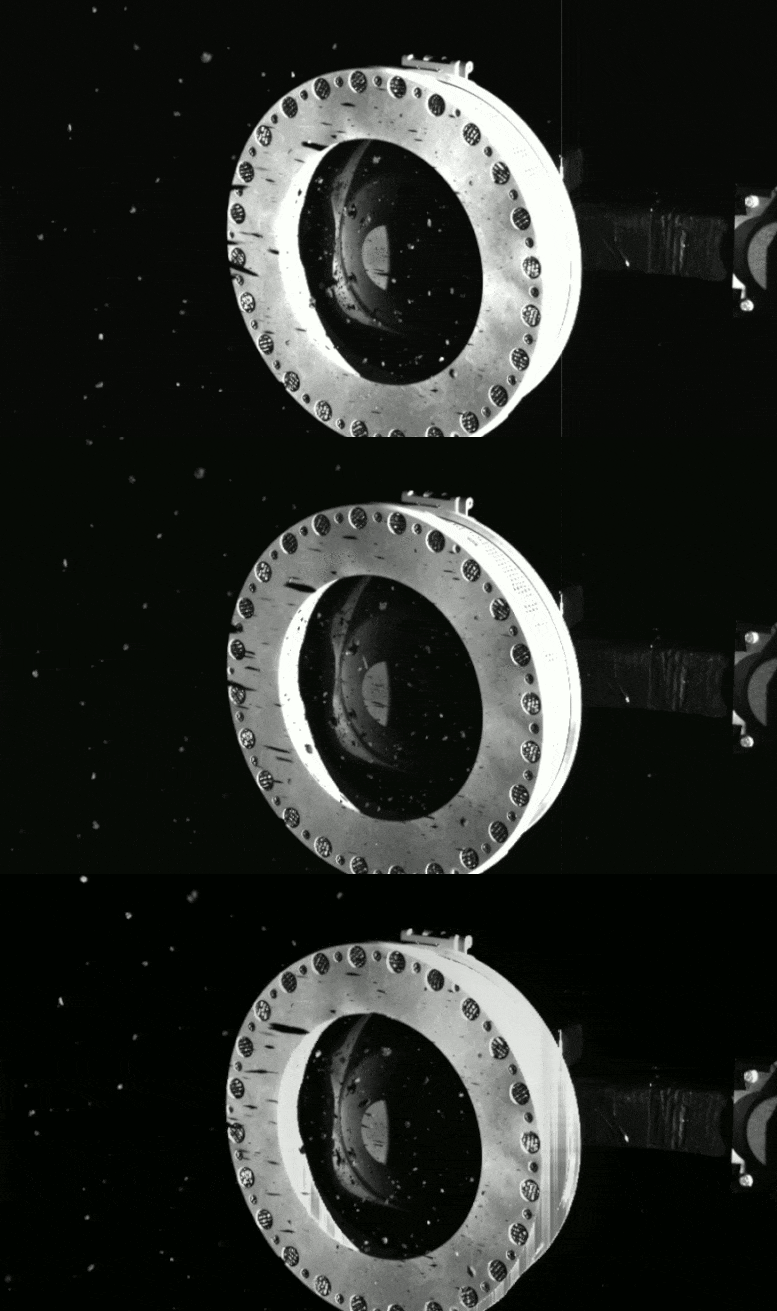
Two days after touching down on asteroid Bennu, NASA’s OSIRIS-REx mission team received on Thursday, October 22, images that confirm the spacecraft has collected more than enough material to meet one of its main mission requirements – acquiring at least 2 ounces (60 grams) of the asteroid’s surface material.
The spacecraft captured images of the sample collector head as it moved through several different positions. In reviewing these images, the OSIRIS-REx team noticed both that the head appeared to be full of asteroid particles, and that some of these particles appeared to be escaping slowly from the sample collector, called the Touch-And-Go Sample Acquisition Mechanism (TAGSAM) head. They suspect bits of material are passing through small gaps where a mylar flap – the collector’s “lid” – is slightly wedged open by larger rocks.
Animation of OSIRIS-REx using its SamCam instrument to visually inspect the TAGSAM head and verify sample collection. Credit: NASA/Goddard/CI Lab
“Bennu continues to surprise us with great science and also throwing a few curveballs,” said Thomas Zurbuchen, NASA’s associate administrator for science at the agency’s headquarters in Washington. “And although we may have to move more quickly to stow the sample, it’s not a bad problem to have. We are so excited to see what appears to be an abundant sample that will inspire science for decades beyond this historic moment.”
The team believes it has collected a sufficient sample and is on a path to stow the sample as quickly as possible. They came to this conclusion after comparing images of the empty collector head with October 22 images of the TAGSAM head after the sample collection event.
The images also show that any movement to the spacecraft and the TAGSAM instrument may lead to further sample loss. To preserve the remaining material, the mission team decided to forego the Sample Mass Measurement activity originally scheduled for Saturday, October 24, and canceled a braking burn scheduled for Friday to minimize any acceleration to the spacecraft.
From here, the OSIRIS-Rex team will focus on stowing the sample in the Sample Return Capsule (SRC), where any loose material will be kept safe during the spacecraft’s journey back to Earth.
This (silent) animation shows the OSIRIS-REx spacecraft deploying its Touch-and-Go Sample Acquisition Mechanism (TAGSAM) to collect a sample of regolith (loose rocks and dirt) from the surface of the asteroid Bennu. The sampler head, with the regolith safely inside, is then sealed up in the spacecraft’s Sample Return Capsule, which will be returned to Earth in late 2023. Scientists will study the sample for clues about the early solar system and the origins of life. Credit: NASA/Goddard
“We are working to keep up with our own success here, and my job is to safely return as large a sample of Bennu as possible,” said Dante Lauretta, OSIRIS-REx principal investigator at the University of Arizona in Tucson, who leads the science team and the mission’s science observation planning and data processing. “The loss of mass is of concern to me, so I’m strongly encouraging the team to stow this precious sample as quickly as possible.”
The TAGSAM head performed the sampling event in optimal conditions. Newly available analyses show that the collector head was flush with Bennu’s surface when it made contact and when the nitrogen gas bottle was fired to stir surface material. It also penetrated several centimeters into the asteroid’s surface material. All data so far suggest that the collector head is holding much more than 2 ounces of regolith.
OSIRIS-REx remains in good health, and the mission team is finalizing a timeline for sample storage. An update will be provided once a decision is made on the sample storage timing and procedures.
NASA’s Goddard Space Flight Center in Greenbelt, Maryland, provides overall mission management, systems engineering and the safety and mission assurance for OSIRIS-REx. Lockheed Martin Space in Denver built the spacecraft and is providing flight operations. Goddard and KinetX Aerospace of Tempe, Arizona, are responsible for navigating the OSIRIS-REx spacecraft. OSIRIS-REx is the third mission in NASA’s New Frontiers Program, which is managed by NASA’s Marshall Space Flight Center in Huntsville, Alabama, for the agency’s Science Mission Directorate in Washington.
Never miss a breakthrough: Join the SciTechDaily newsletter.
Follow us on Google and Google News.