
Close Menu
    Facebook X (Twitter) Instagram
    SciTechDaily
    • Biology
    • Chemistry
    • Earth
    • Health
    • Physics
    • Science
    • Space
    • Technology
    Facebook X (Twitter) Pinterest YouTube RSS
    SciTechDaily
    Home»Space»Beauty From Chaos: Hubble Spots “Bioluminescent Sea Monster”
    Space

    Beauty From Chaos: Hubble Spots “Bioluminescent Sea Monster”

    By ESA/HubbleOctober 30, 2020No Comments2 Mins Read
    Facebook Twitter Pinterest Telegram LinkedIn WhatsApp Email Reddit
    Share
    Facebook Twitter LinkedIn Pinterest Telegram Email Reddit
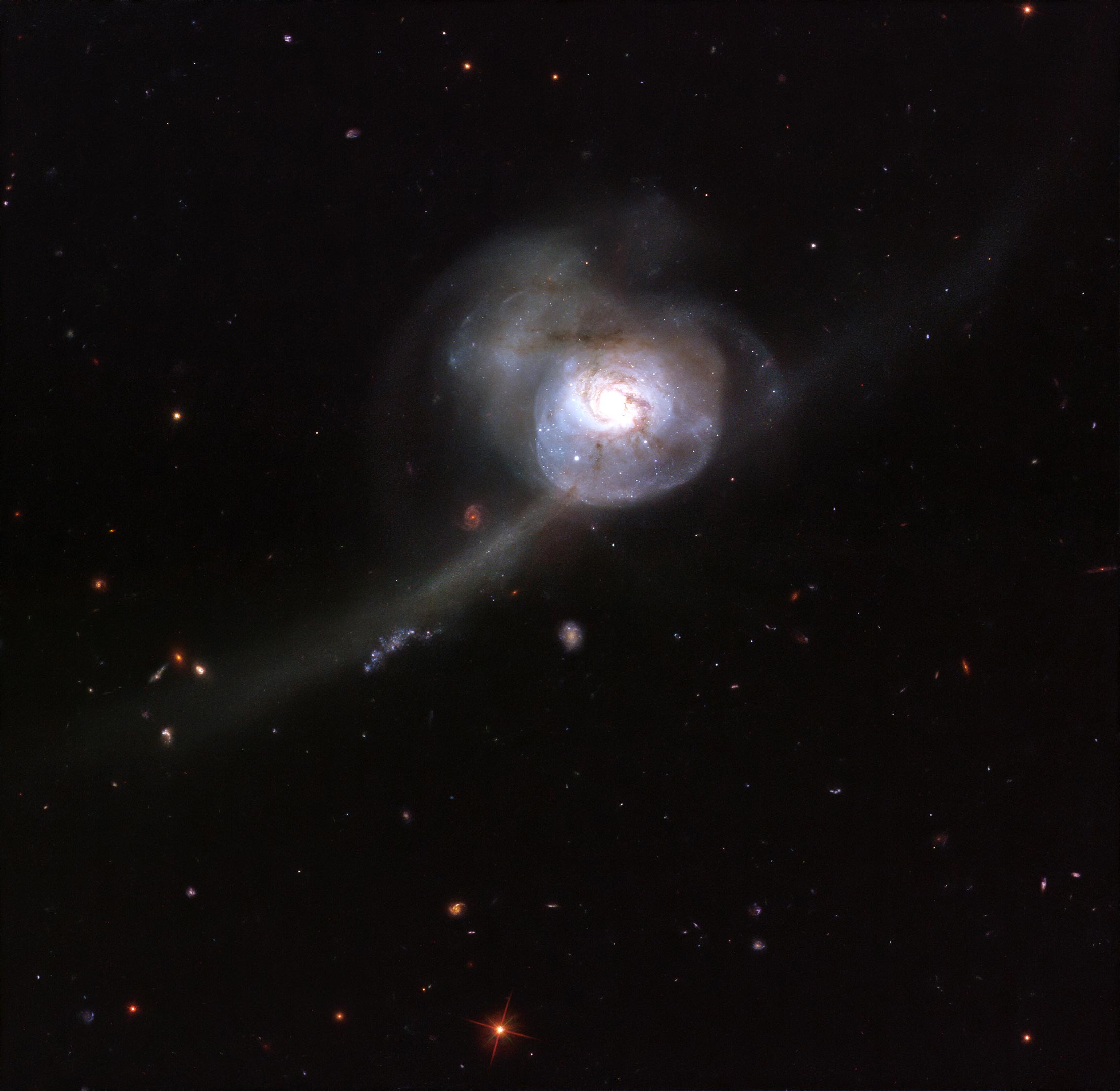
    Hubble NGC 34
    NGC 34 in the Cetus constellation appears unique due to a past collision of two spiral galaxies. Their collision disrupted their patterns and created the galaxy’s distinct appearance. Credit: ESA/Hubble & NASA, A. Adamo et al.

    Appearing within the boundless darkness of space, the NASA/ESA Hubble Space Telescope’s snapshot of NGC 34 looks more like an otherworldly, bioluminescent creature from the deep oceans than a galaxy. Lying in the constellation Cetus (The Sea Monster), the galaxy’s outer region appears almost translucent, pinpricked with stars and strange wispy tendrils.

    The main cause for this galaxy’s odd appearance lies in its past. If we were able to reverse time by a few million years, we would see two beautiful spiral galaxies on a direct collision course. When these galaxies collided into one another, their intricate patterns and spiral arms were permanently disturbed. This image shows the galaxy’s bright center, a result of this merging event that has created a burst of new star formation and lit up the surrounding gas. As the galaxies continue to intertwine and become one, NGC 34’s shape will become more like that of a peculiar galaxy, devoid of any distinct shape.

    In the vastness of space, collisions between galaxies are quite rare events, but they can be numerous in mega-clusters containing hundreds or even thousands of galaxies.

    Never miss a breakthrough: Join the SciTechDaily newsletter.
    Follow us on Google and Google News.

    Astronomy European Space Agency Hubble Space Telescope NASA
    Share. Facebook Twitter Pinterest LinkedIn Email Reddit

    Related Articles

    Hubble’s Newest Discovery Isn’t a Star, It’s a Window Into the Dark Universe

    This Nearby Galaxy Shows How Frozen Clouds Ignite Into Stars

    This Chaotic Spiral Galaxy Is Still Recovering From a Cosmic Collision

    This Strange Spiral Galaxy Is Hiding a Massive Black Hole

    Hubble Zooms In on a Galaxy That Maps the Universe’s Expansion

    Hubble Captures a Dazzling Spiral Galaxy Alive With Birth and Destruction

    Hubble Spots a Glowing “Ring of Fire” in a Distant Spiral Galaxy

    Dust, Light & Ancient Collisions: The Sombrero Galaxy Like You’ve Never Seen It

    Star Formation in Motion: Hubble Reveals Spiraling Stars and Sculpted Nebulae

    Leave A Reply Cancel Reply

    • Facebook
    • Twitter
    • Pinterest
    • YouTube

    Don't Miss a Discovery

    Subscribe for the Latest in Science & Tech!

    Trending News

    Walking for Just 20 Minutes Caused an Immediate Change in the Gut

    Scientists Have Uncovered Previously Hidden Microbial Activity on Human Skin

    Stacked Mummies Reveal 700 Years of Changing Burial Rituals in Ancient Egypt

    Scientists Discover a Butterfly That Barely Seems To Age

    Astronomers Detect a Faint Hydrogen Signal From Billions of Light-Years Away

    Fighting Fire With Fire Could Save Giant Sequoias

    Scientists Just Found a Hidden Factor That Could Trigger an Atlantic Ocean Collapse

    Scientists Find a Berry Compound That Helps Muscle Cells Burn Fat

    Follow SciTechDaily
    • Facebook
    • Twitter
    • YouTube
    • Pinterest
    • Newsletter
    • RSS
    SciTech News
    • Biology News
    • Chemistry News
    • Earth News
    • Health News
    • Physics News
    • Science News
    • Space News
    • Technology News
    Recent Posts
    • A Pompeii-Like Volcanic Disaster Preserved a 22-Million-Year-Old Landscape
    • One of Earth’s Oldest Animal Fossils Found in a Norwegian Sheep Field
    • Ancient DNA Rewrites the Story of the “American Cheetah”
    • Biggest Supernova Dataset Yet Challenges Dark Energy Theory
    • 1,000x Speedup: Scientists Just Broke Through a Major Quantum Computing Bottleneck
    Copyright © 1998 - 2026 SciTechDaily. All Rights Reserved.
    • Science News
    • About
    • Contact
    • Editorial Board
    • Privacy Policy
    • Terms of Use

    Type above and press Enter to search. Press Esc to cancel.