

Close Menu
    Facebook X (Twitter) Instagram
    SciTechDaily
    • Biology
    • Chemistry
    • Earth
    • Health
    • Physics
    • Science
    • Space
    • Technology
    Facebook X (Twitter) Pinterest YouTube RSS
    SciTechDaily
    Home»Chemistry»Time for a New Contender in Energy Conversion and Storage
    Chemistry

    Time for a New Contender in Energy Conversion and Storage

    By KAUSTOctober 31, 20201 Comment3 Mins Read
    Facebook Twitter Pinterest Telegram LinkedIn WhatsApp Email Reddit
    Share
    Facebook Twitter LinkedIn Pinterest Telegram Email Reddit
    Energy Conversion Abstract
    Scientists used evolutionary search to predict the lowest energy structure of a two-dimensional material, B2P6, with unique features like anisotropy and Janus geometry.

    Combining distinctive properties of two-dimensional materials inspires research to reveal a new frontrunner.

    Evolutionary search has helped scientists predict the lowest energy structure of a two-dimensional (2D) material, B2P6, with some remarkable features, including structural anisotropy and Janus geometry.

    Janus materials—named after the two-faced Greek god of duality—have two surfaces with distinct physical properties. As such, they offer unique benefits, such as high solar-to-hydrogen efficiency.

    Anisotropic materials exhibit different properties when measured along different directions. In the case of B2P6, the ionic diffusion is strongly anisotropic, a feature that can be potentially useful in affordable energy storage solutions, such as metal-ion batteries.

    Unlike antecedents, such as graphene, another 2D material, this new material has a widely tunable band gap that makes it a better candidate for use in electronic devices.
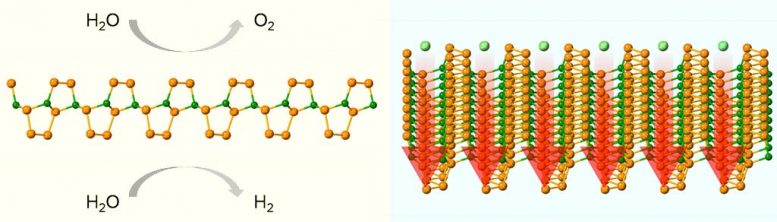
    B2P6 Structure
    The KAUST team used state-of-the-art evolutionary search and first-principles calculations to predict the structure of B2P6. Credit: © 2020 KAUST

    Udo Schwingenschlögl, a professor of applied physics at KAUST, and Minglei Sun, a postdoc, performed a detailed search for the most stable 2D crystal structure of binary compounds comprising boron and phosphorus atoms until they arrived at B2P6.

    “We used state-of-the-art evolutionary search and first-principles calculations to predict this structure,” says Sun.

    Based on biological evolution, evolutionary search is a computational method by which the scientists can search for a crystal structure within thousands of candidates. Using this structure as input in first-principles calculations, they can then determine the physical properties according to the principles of quantum theory.

    “The extraordinary features endowed by anisotropy and Janus geometry inspired us to search for a 2D material that combines these merits,” explains Sun. This combination allows for new properties, and in turn, wider applications.

    In preliminary research, B2P6 showed excellent promise in the field of electronics and for application in energy conversion and storage.

    The new material demonstrates strong light absorption, making it potentially useful in clean-fuel production from photocatalytic water splitting—a process that uses natural or artificial light to produce hydrogen from water. It is more efficient than traditional photocatalysts, mainly due to the low recombination rate of photogenerated carriers.

    “For B2P6, the recombination of photogenerated carriers is significantly suppressed by the intrinsic electric field induced by its Janus structure,” explains Sun. “That means more photogenerated carriers will take part in the redox reactions for water splitting. The efficiency of carrier utilization is as high as 45.1 percent.”

    Next, the researchers plan to “predict more anisotropic Janus 2D materials with extraordinary properties and provide experimental guidelines for colleagues,” Schwingenschlögl says.

    Reference: “B2P6: A Two-Dimensional Anisotropic Janus Material with Potential in Photocatalytic Water Splitting and Metal-Ion Batteries” by Minglei Sun and Udo Schwingenschlögl, 27 May 2020, Chemistry of Materials.
    DOI: 10.1021/acs.chemmater.0c01536

    Never miss a breakthrough: Join the SciTechDaily newsletter.
    Follow us on Google and Google News.

    2D Materials Energy KAUST Materials Science
    Share. Facebook Twitter Pinterest LinkedIn Email Reddit

    Related Articles

    This Wonder Material Could Revolutionize Renewable Energy

    Scientists Unlock Secret to Safer, More Powerful Batteries – And It’s in Your Closet

    Metallic Glass: One Step Closer to Solving a Major Problem of Hydrogen Energy

    New Material Can Generate Hydrogen From Fresh, Salt, or Polluted Water by Exposure to Sunlight

    Solar Flow Battery: Single Device Generates, Stores and Redelivers Renewable Electricity From the Sun

    Chemists Achieve Breakthrough in the Synthesis of Graphene Nanoribbons

    A Profound Leap Forward: Pushing the Limits of 2D Supramolecules

    New Efficiency Record Set by Novel Multi-Material Solar Cells

    Clean Energy Technology Revolutionized by “Needle in a Haystack” Discovery

    1 Comment

    1. Nordicup on November 2, 2020 11:36 am

      Very interesting; these outside the box developments will result in an entirely new energy paradigm.

      I’m holding out for the “organic” solution… something with a C; not only for energy and storage, but for all electronics, circuits, computer “chips”, etc. No heat!
      ,

      Reply
    Leave A Reply Cancel Reply

    • Facebook
    • Twitter
    • Pinterest
    • YouTube

    Don't Miss a Discovery

    Subscribe for the Latest in Science & Tech!

    Trending News

    Breakthrough Bowel Cancer Trial Leaves Patients Cancer-Free for Nearly 3 Years

    Natural Compound Shows Powerful Potential Against Rheumatoid Arthritis

    100,000-Year-Old Neanderthal Fossils in Poland Reveal Unexpected Genetic Connections

    Simple “Gut Reset” May Prevent Weight Gain After Ozempic or Wegovy

    2.8 Days to Disaster: Scientists Warn Low Earth Orbit Could Suddenly Collapse

    Common Food Compound Shows Surprising Power Against Superbugs

    5 Simple Ways To Remember More and Forget Less

    The Atomic Gap That Could Cost the Semiconductor Industry Billions

    Follow SciTechDaily
    • Facebook
    • Twitter
    • YouTube
    • Pinterest
    • Newsletter
    • RSS
    SciTech News
    • Biology News
    • Chemistry News
    • Earth News
    • Health News
    • Physics News
    • Science News
    • Space News
    • Technology News
    Recent Posts
    • ADHD Isn’t Just a Deficit: Study Reveals Powerful Hidden Strengths
    • Scientists Uncover “Astonishing” Hidden Property of Light
    • Scientists Discover Stem Cells That Could Regrow Teeth and Bone
    • Scientists Discover Natural Molecule That Stops Alzheimer’s Protein Clumps From Forming
    • Early Cannabis Use May Stall Key Brain Skills in Teens
    Copyright © 1998 - 2026 SciTechDaily. All Rights Reserved.
    • Science News
    • About
    • Contact
    • Editorial Board
    • Privacy Policy
    • Terms of Use

    Type above and press Enter to search. Press Esc to cancel.