
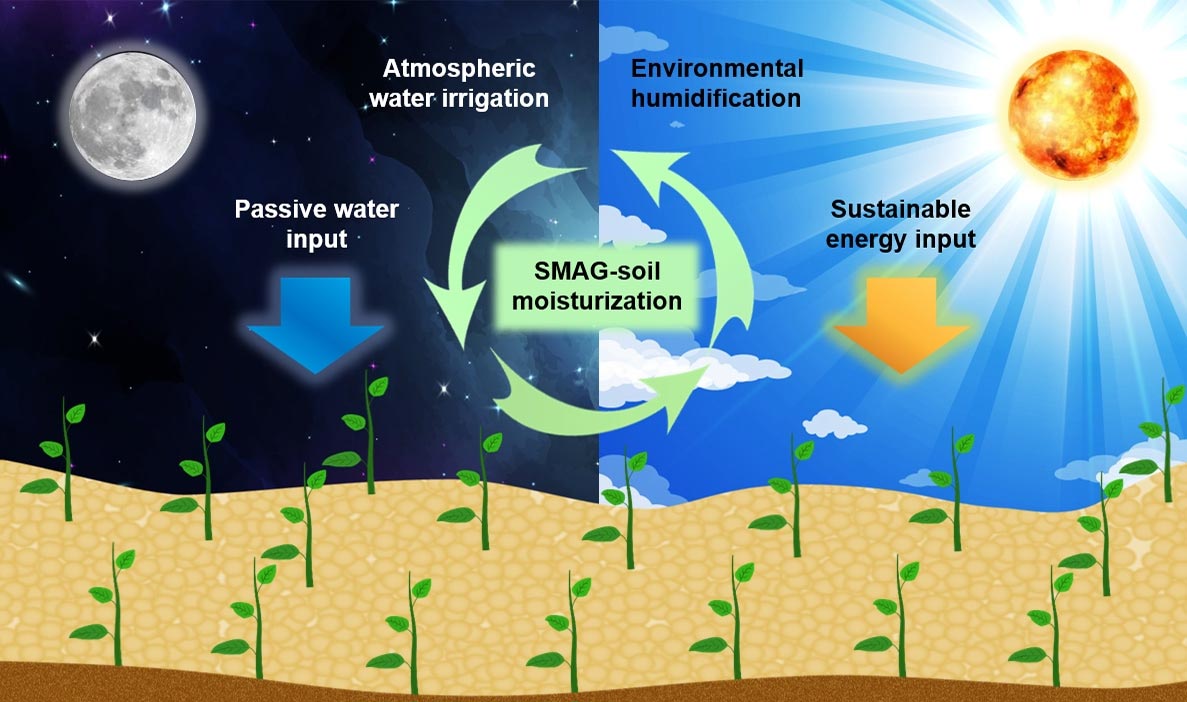
A new type of soil created by engineers at The University of Texas at Austin can pull water from the air and distribute it to plants, potentially expanding the map of farmable land around the globe to previously inhospitable places and reducing water use in agriculture at a time of growing droughts.
As published in ACS Materials Letters, the team’s atmospheric water irrigation system uses super-moisture-absorbent gels to capture water from the air. When the soil is heated to a certain temperature, the gels release the water, making it available to plants. When the soil distributes water, some of it goes back into the air, increasing humidity and making it easier to continue the harvesting cycle.
“Enabling free-standing agriculture in areas where it’s hard to build up irrigation and power systems is crucial to liberating crop farming from the complex water supply chain as resources become increasingly scarce,” said Guihua Yu, associate professor of materials science in the Walker Department of Mechanical Engineering.
Each gram of soil can extract approximately 3-4 grams of water. Depending on the crops, approximately 0.1 to 1 kilogram (0.2 to 2.2 pounds) of the soil can provide enough water to irrigate about a square meter (11 square feet) of farmland.
The gels in the soil pull water out of the air during cooler, more humid periods at night. Solar heat during the day activates the water-containing gels to release their contents into soil.
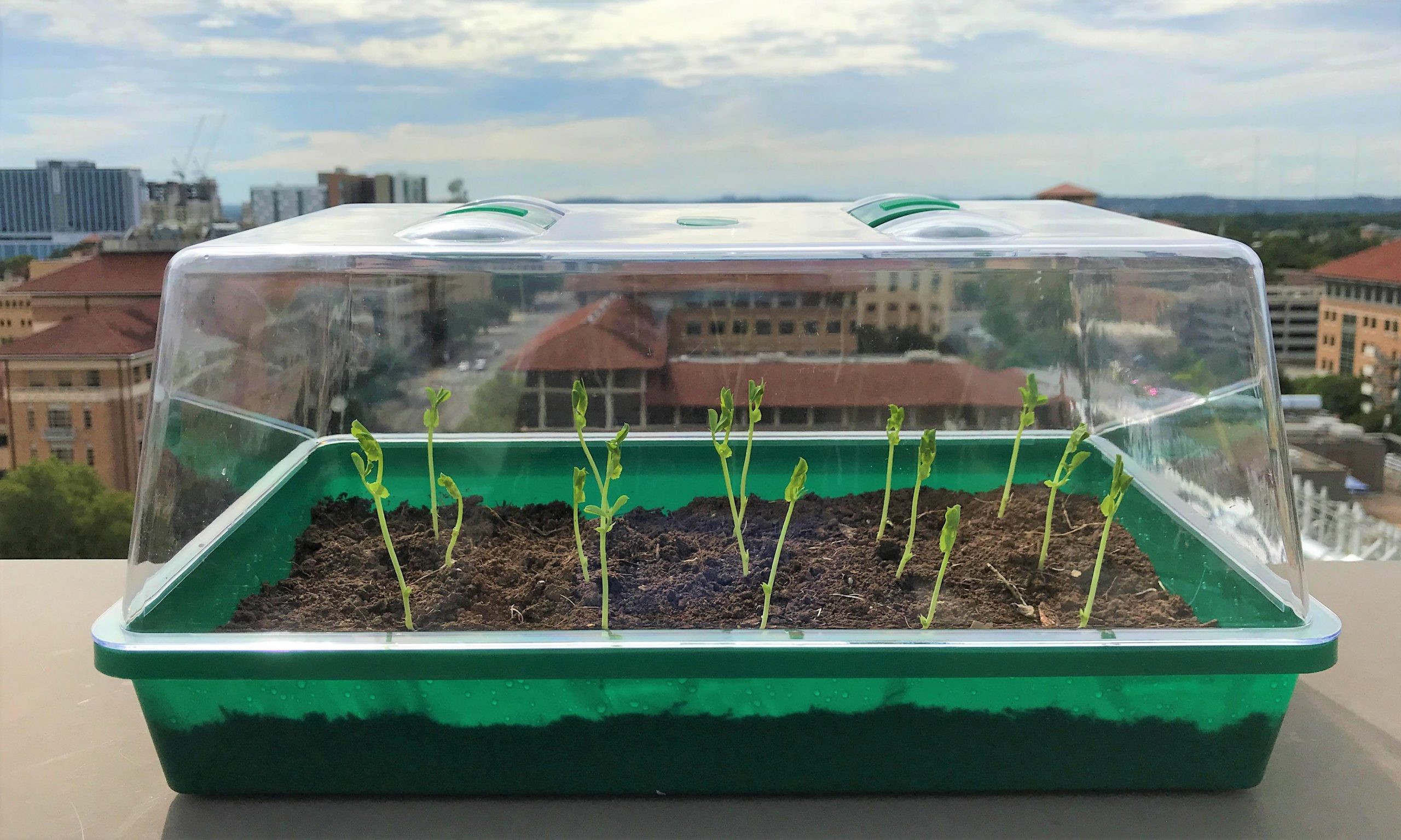
The team ran experiments on the roof of the Cockrell School’s Engineering Teaching Center building at UT Austin to test the soil. They found that the hydrogel soil was able to retain water better than sandy soils found in dry areas, and it needed far less water to grow plants.
During a four-week experiment, the team found that its soil retained approximately 40% of the water quantity it started with. In contrast, the sandy soil had only 20% of its water left after just one week.
In another experiment, the team planted radishes in both types of soil. The radishes in the hydrogel soil all survived a 14-day period without any irrigation beyond an initial round to make sure the plants took hold. Radishes in the sandy soil were irrigated several times during the first four days of the experiment. None of the radishes in the sandy soil survived more than two days after the initial irrigation period.
“Most soil is good enough to support the growth of plants,” said Fei Zhao, a postdoctoral researcher in Yu’s research group who led the study with Xingyi Zhou and Panpan Zhang. “It’s the water that is the main limitation, so that is why we wanted to develop a soil that can harvest water from the ambient air.”
The water-harvesting soil is the first big application of technology that Yu’s group has been working on for more than two years. Last year, the team developed the capability to use gel-polymer hybrid materials that work like “super sponges,” extracting large amounts of water from the ambient air, cleaning it and quickly releasing it using solar energy.
The researchers envision several other applications of the technology. It could potentially be used for cooling solar panels and data centers. It could expand access to drinking water, either through individual systems for households or larger systems for big groups such as workers or soldiers.
Reference: “Super Moisture Absorbent Gels for Sustainable Agriculture via Atmospheric Water Irrigation” by Xingyi Zhou, Panpan Zhang, Fei Zhao and Guihua Yu, 1 October 2020, ACS Materials Letters.
DOI: 10.1021/acsmaterialslett.0c00439
Never miss a breakthrough: Join the SciTechDaily newsletter.
Follow us on Google and Google News.
4 Comments
“gel-polymer hybrid” sounds like it’s a plastic, from petroleum. It most likely has a life-span after which does it get removed from the soil or does it become another, externality for the corporations?
I agree with the above comment entirely. Also how does the gel effect the structure and oxygen absorption of the soil, and what about its effect on microscopic soil biology which is crucial to nutrient uptake?
This research holds a great promise for dryland farming.vast tracks of unirrigated land can become productive using this soilgel technology.
I’m a bit worried that instead of humanity focusing on fixing the core contributors of greenhouse gas emissions, now they’re building weird stuff to change the soil in the earth to support plantation in dry areas. To me these things sound like a good idea but aren’t we changing the earth system beyond our own understanding? Same thing with atmospheric geoengineering, we’re playing with too many parameters that we don’t fully understand that might change the one planet we have and then later on, now what?