
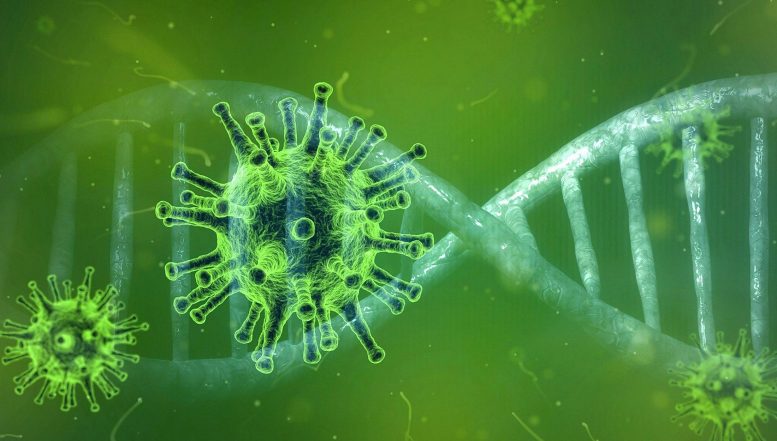
Discovery of shape of the SARS-CoV-2 genome after infection could inform new COVID-19 treatments.
Scientists at the University of Cambridge, in collaboration with Justus-Liebig University, Germany, have uncovered how the genome of SARS-CoV-2 — the coronavirus that causes COVID-19 — uses genome origami to infect and replicate successfully inside host cells. This could inform the development of effective drugs that target specific parts of the virus genome, in the fight against COVID-19.
SARS-CoV-2 is one of many coronaviruses. All share the characteristic of having the largest single-stranded RNA genome in nature. This genome contains all the genetic code the virus needs to produce proteins, evade the immune system, and replicate inside the human body. Much of that information is contained in the 3D structure adopted by this RNA genome when it infects cells.
The researchers say most current work to find drugs and vaccines for COVID-19 is focused on targeting the proteins of the virus. Because the shape of the RNA molecule is critical to its function, targeting the RNA directly with drugs to disrupt its structure would block the lifecycle and stop the virus replicating.
In a study published recently in the journal Molecular Cell, the team uncovered the entire structure of the SARS-CoV-2 genome inside the host cell, revealing a network of RNA-RNA interactions spanning very long sections of the genome. Different functional parts along the genome need to work together despite the great distance between them, and the new structural data shows how this is accomplished to enable the coronavirus life cycle and cause disease.
“The RNA genome of coronaviruses is about three times bigger than an average viral RNA genome – it’s huge,” said lead author Dr. Omer Ziv at the University of Cambridge’s Wellcome Trust/Cancer Research UK Gurdon Institute.
He added: “Researchers previously proposed that long-distance interactions along coronavirus genomes are critical for their replication and for producing the viral proteins, but until recently we didn’t have the right tools to map these interactions in full. Now that we understand this network of connectivity, we can start designing ways to target it effectively with therapeutics.”
In all cells, the genome holds the code for the production of specific proteins, which are made when a molecular machine called a ribosome runs along the RNA reading the code until a ‘stop sign’ tells it to terminate. In coronaviruses, there is a special spot where the ribosome only stops 50% of the time in front of the stop sign. In the other 50% of cases, a unique RNA shape makes the ribosome jump over the stop sign and produce additional viral proteins. By mapping this RNA structure and the long-range interactions involved, the new research uncovers the strategies by which coronaviruses produce their proteins to manipulate our cells.
“We show that interactions occur between sections of the SARS-CoV-2 RNA that are very long distances apart, and we can monitor these interactions as they occur during early SARS-CoV-2 replication,” said Dr. Lyudmila Shalamova, a co-lead investigator at Justus-Liebig University, Germany.
Dr. Jon Price, a postdoctoral associate at the Gurdon Institute and co-lead of this study, has developed a free, open-access interactive website hosting the entire RNA structure of SARS-CoV-2. This will enable researchers worldwide to use the new data in the development of drugs to target specific regions of the virus’s RNA genome.
The genome of most human viruses is made of RNA rather than DNA. Ziv developed methods to investigate such long-range interactions across viral RNA genomes inside the host cells, in work to understand the Zika virus genome. This has proved a valuable methodological basis for understanding SARS-CoV-2.
Reference: “The short- and long-range RNA-RNA Interactome of SARS-CoV-2” by Omer Ziv, Jonathan Price, Lyudmila Shalamova, Tsveta Kamenova, Ian Goodfellow, Friedemann Weber and Eric A. Miska, 5 November 2020, Molecular Cell.
DOI: 10.1016/j.molcel.2020.11.004
This research is a collaborative study between the group of Professor Eric Miska at the University of Cambridge’s Gurdon Institute and Department of Genetics, and the group of Professor Friedemann Weber from the Institute for Virology, Justus-Liebig University, Gießen, Germany. The authors are grateful for the support of the Biochemistry Department at the University of Cambridge, who provided specialist laboratory facilities for performing part of this research.
The work was funded by Cancer Research UK, Wellcome, and Deutsche Forschungsgemeinschaft (DFG).
Never miss a breakthrough: Join the SciTechDaily newsletter.
Follow us on Google and Google News.