
Close Menu
    Facebook X (Twitter) Instagram
    SciTechDaily
    • Biology
    • Chemistry
    • Earth
    • Health
    • Physics
    • Science
    • Space
    • Technology
    Facebook X (Twitter) Pinterest YouTube RSS
    SciTechDaily
    Home»Space»Discovery Solves Decades Old Discrepancies
    Space

    Discovery Solves Decades Old Discrepancies

    By Australian National UniversityJuly 10, 2012No Comments3 Mins Read
    Facebook Twitter Pinterest Telegram LinkedIn WhatsApp Email Reddit
    Share
    Facebook Twitter LinkedIn Pinterest Telegram Email Reddit
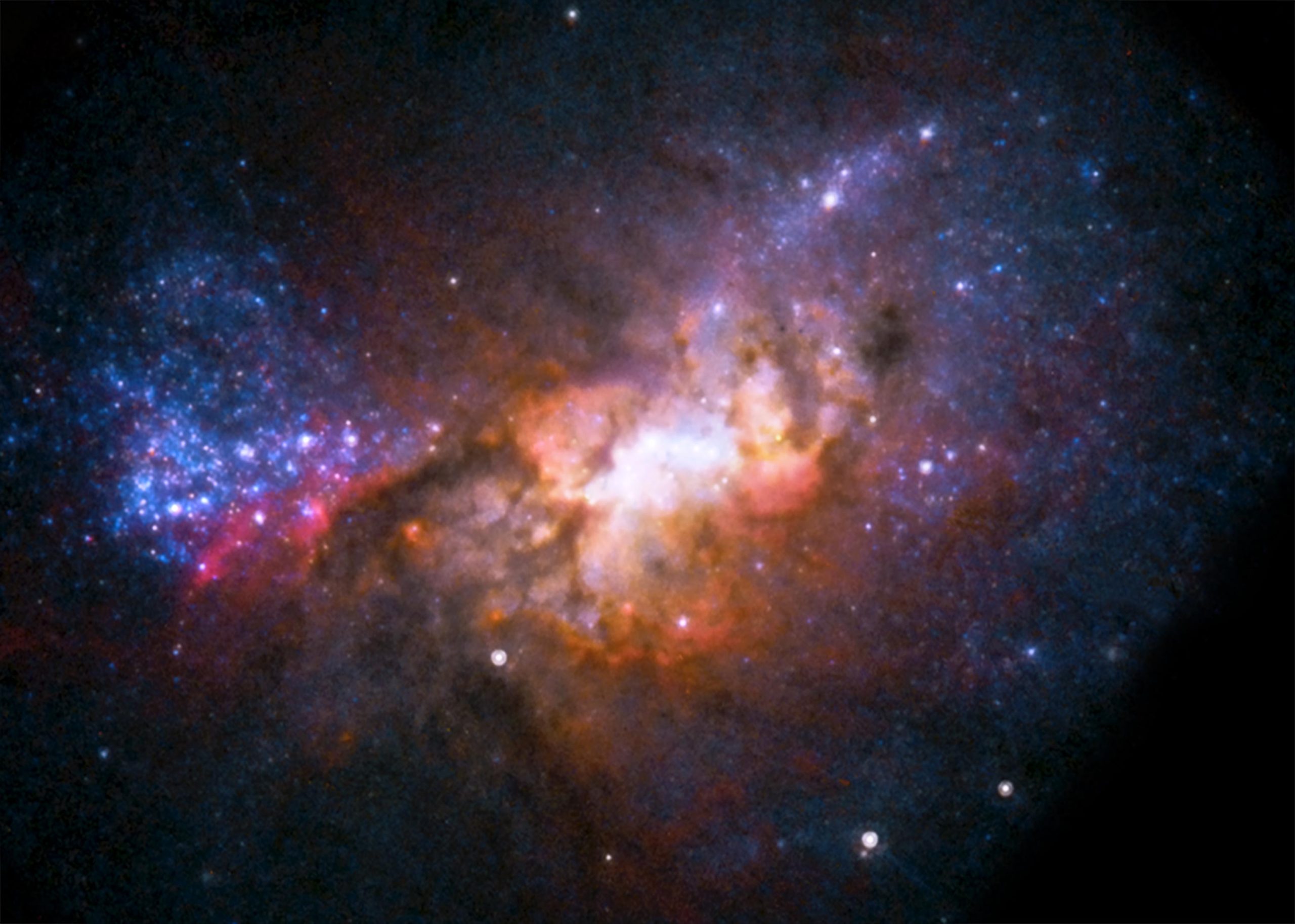
    Henize 2-10 Chandra
    The dwarf starburst galaxy Henize 2-10, located about 30 million light-years from Earth. Credit: X-ray (NASA/CXC/Virginia/A.Reines et al); Radio (NRAO/AUI/NSF); Optical (NASA/STScI)

    While studying dwarf galaxies, David Nicholls from the Research School of Astronomy and Astrophysics discovered that that the energies of the electrons in the gas clouds were not distributed the way people had previously thought, solving a problem that had remained unexplained for over 40 years.

    The mysteries of the evolution of the universe since the Big Bang are one step closer to being solved, thanks to research from The Australian National University.

    Astrophysics PhD candidate Mr. David Nicholls from the Research School of Astronomy and Astrophysics, part of the ANU College of Physical and Mathematical Sciences, used the ANU 2.3 meter telescope at the Siding Spring Observatory to study distant dwarf galaxies. The galaxies are regarded as ideal ‘laboratories’ for finding out how the Universe has evolved since the Big Bang.

    “At the beginning of the Universe, the only elements around were hydrogen and helium. Big stars formed from these elements and, as they evolved, burned the hydrogen and helium into an ‘ash’ of heavier elements. This ash included nitrogen, carbon and oxygen, which are essential for life,” Mr. Nicholls said.

    “When these big stars ran out of fuel, they blew up in the form of supernovae and mixed the heavier elements back into the hydrogen clouds. New stars grew from the enriched gas. But in Dwarf galaxies, this process has happened very slowly,” he said.

    “Dwarf galaxies are the equivalent of historical villages. They still have most of their ‘old buildings’ intact, so we know what they were like when they were first built. On the other hand, in huge cities like Beijing, nearly all the old buildings have been ripped up and you can’t tell what they were like originally – just like larger galaxies.

    “By studying dwarf galaxies, we can see what the Universe was like long ago. To do this, we measure the light from the various elements mixed into the hydrogen clouds in the dwarf galaxies, which tells us how enriched they are and how they have evolved since the Universe began.”

    But when he started to analyze his measurements, Mr. Nicholls discovered that the data didn’t fit the conventional theories. He set out to solve the mystery, and made an unexpected discovery.

    “I found that the energies of the electrons in the gas clouds were not distributed the way people had always thought they should be,” he said.

    “I used similar measurements of electron energies made by space probes in our Solar System as the basis for a new theory about how gases behave in distant galaxies.

    “To my surprise, it explained my data and also solved other problems that had remained unexplained for over 40 years.”

    Mr. Nicholls said his research will allow more accurate measurements of the elements in distant galaxies and help to explain the evolution of the Universe.

    The research is published in The Astrophysical Journal and is available online.

    Reference: “Resolving the Electron Temperature Discrepancies in H II Regions and Planetary Nebulae: κ-Distributed Electrons” by David C. Nicholls, Michael A. Dopita and Ralph S. Sutherland, 6 June 2012, The Astrophysical Journal.
    DOI: 10.1088/0004-637X/752/2/148

    Never miss a breakthrough: Join the SciTechDaily newsletter.
    Follow us on Google and Google News.

    Astronomy Astrophysics Australian National University Galaxy Galaxy Evolution
    Share. Facebook Twitter Pinterest LinkedIn Email Reddit

    Related Articles

    Dwarf Galaxies’ Big Secret: New Study Reveals How They Transform Into Ultra-Compact Dwarfs

    New Discovery Provides a Clearer Picture of How Galaxies Form and Grow in the Early Universe

    New Discovery Challenges Popular Theory About Dwarf Galaxies

    Centaurus a Hides a Gaseous Spiral at Its Core

    Using Infrared Images from Hubble & Spitzer, Scientists Discover 25 Distant Galaxies

    Researchers find Evidence that Dwarf Galaxy NGC 4449 is Swallowing Smaller Companion

    Study of X-Shaped Radio Galaxy NGC 326 Shows Outburst History and Active Galactic Nucleus Feedback

    Lasers Mimic Supernova to Explain Cosmic Magnetic Fields

    Hubble Observes Rare Blue Stars in Andromeda’s Core

    Leave A Reply Cancel Reply

    • Facebook
    • Twitter
    • Pinterest
    • YouTube

    Don't Miss a Discovery

    Subscribe for the Latest in Science & Tech!

    Trending News

    A Billion Years Before the Grand Canyon, a Giant Cliff May Have Stretched Across America

    The Immune Systems of 110-Year-Olds Are Hiding a Remarkable Secret

    Common Osteoarthritis Treatment Fails a Major Test

    Dark Stars May Have Left a Gravitational-Wave Signal We Can Detect Today

    Blackbirds Somehow Know When a Snake Is Too Dangerous To Attack

    A Hidden Gut Reaction May Explain Why Vegetables Are So Good for You

    New “Invisible” Cell Therapy Could Provide Side-Effect-Free Diabetes Treatment

    Nanoscale “Defects” Unlock a Major Heat Transfer Breakthrough

    Follow SciTechDaily
    • Facebook
    • Twitter
    • YouTube
    • Pinterest
    • Newsletter
    • RSS
    SciTech News
    • Biology News
    • Chemistry News
    • Earth News
    • Health News
    • Physics News
    • Science News
    • Space News
    • Technology News
    Recent Posts
    • “Zombie” Cells Reveal a Surprising New Driver of Chronic Inflammation
    • The Rare Vision Side Effect of Ozempic and Wegovy You Should Know About
    • NASA’s New Space Telescope Could Map the Entire Sky With Hubble-Like Detail
    • Hidden Deep Beneath Mars, Scientists Find Evidence of a Vast Magmatic System
    • One Tiny Chemical Difference in RNA Could Help Explain the Origins of Life
    Copyright © 1998 - 2026 SciTechDaily. All Rights Reserved.
    • Science News
    • About
    • Contact
    • Editorial Board
    • Privacy Policy
    • Terms of Use

    Type above and press Enter to search. Press Esc to cancel.