
Scientists are finding new mysteries since the geophysics mission landed two years ago.
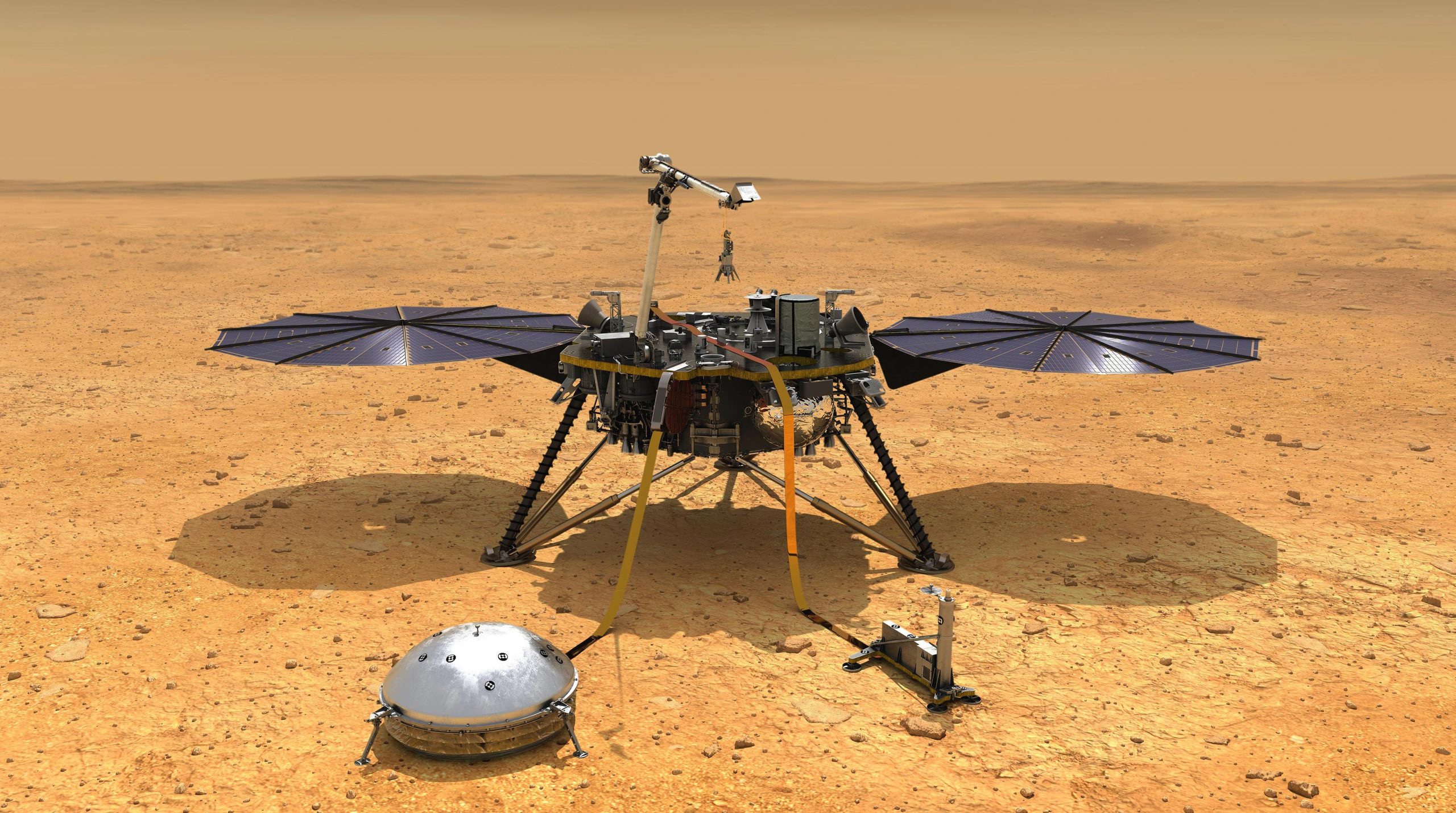
NASA’s InSight spacecraft touched down November 26, 2018, on Mars to study the planet’s deep interior. A little more than one Martian year later, the stationary lander has detected more than 480 quakes and collected the most comprehensive weather data of any surface mission sent to Mars. InSight’s probe, which has struggled to dig underground to take the planet’s temperature, has made progress, too.
There was a time when the surfaces of Mars and Earth were very similar. Both were warm, wet, and shrouded in thick atmospheres. But 3 or 4 billion years ago, these two worlds took different paths. The mission of InSight (short for Interior Exploration using Seismic Investigations, Geodesy and Heat Transport) has been to help scientists to compare Earth to its rusty sibling. Studying what the depths of Mars is made of, how that material is layered, and how quickly heat seeps out of it could help scientists better understand how a planet’s starting materials make it more or less likely to support life.
While there’s more science to come from InSight, here are three findings about our red neighbor in the sky.
Faint Rumblings Are the Norm
InSight’s seismometer, which was provided by the French space agency, Centre National d’Études Spatiales (CNES), is sensitive enough to detect slight rumblings from great distances. But it wasn’t until April 2019 that seismologists with the Marsquake Service, coordinated by ETH Zurich, detected their first marsquake. Since then, Mars has more than made up for lost time by shaking frequently, albeit gently, with no quakes larger than magnitude 3.7.
The lack of quakes larger than magnitude 4 poses something of a mystery, considering how frequently the Red Planet shakes due to smaller quakes.
“It’s a little surprising we haven’t seen a bigger event,” said seismologist Mark Panning of NASA’s Jet Propulsion Laboratory in Southern California, which leads the InSight mission. “That may be telling us something about Mars, or it may be telling us something about luck.”
Put another way: It could be that Mars is just more static than anticipated – or that InSight landed in an especially quiet period.
Seismologists will have to keep waiting patiently for those larger quakes in order to study layers deep below the crust. “Sometimes you get big flashes of amazing information, but most of the time you’re teasing out what nature has to tell you,” said InSight Principal Investigator Bruce Banerdt of JPL. “It’s more like trying to follow a trail of tricky clues than having the answers presented to us in a nicely wrapped-up package.”
The Wind May Hide Quakes
Once InSight started detecting quakes, they became so regular that, at one point, they were happening every day. Then, in late June of this year, the detections essentially stopped. Only five quakes have been detected since then, all of them since September.
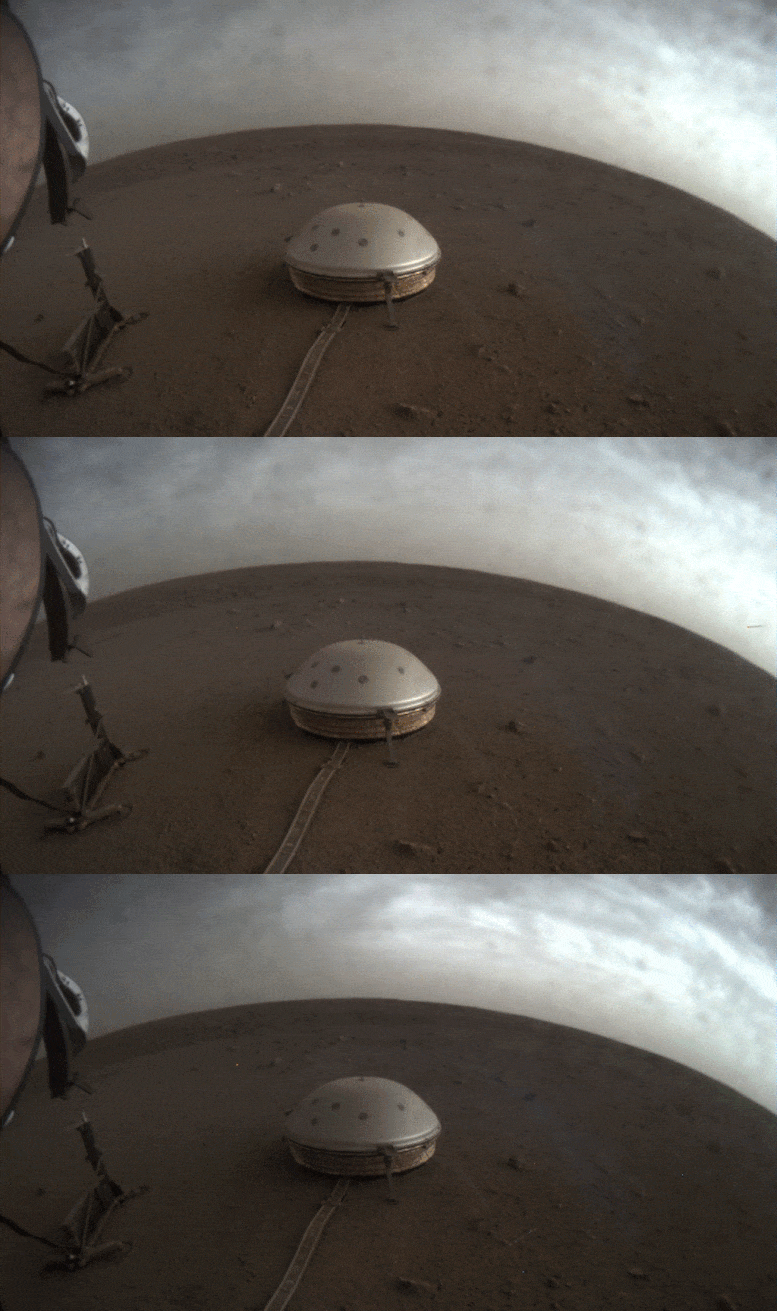
Scientists believe Mars’ wind is responsible for these seismically blank periods: The planet entered the windiest season of the Martian year around June. The mission knew that winds could affect InSight’s sensitive seismometer, which is equipped with a domed wind and heat shield. But the wind still shakes the ground itself and creates literal noise that covers up quakes. This could also have contributed to what seems like the long seismic silence before InSight’s first quake, since the spacecraft landed while a regional dust storm was settling down.
“Before landing, we had to guess at how the wind would affect surface vibrations,” Banerdt said. “Since we’re working with events that are much smaller than what we’d pay attention to on Earth, we find that we have to pay much closer attention to the wind.”
Surface Waves Are Missing
All quakes have two sets of body waves, which are waves that travel through the planet’s interior: primary waves (P-waves) and secondary waves (S-waves). They also ripple along the top of the crust as part of a third category, called surface waves.
On Earth, seismologists use surface waves to learn more about the planet’s internal structure. Before getting to Mars, InSight’s seismologists expected these waves to offer glimpses as deep as 250 miles (about 400 kilometers) below the surface, into a sub-crustal layer called the mantle. But Mars continues to offer mysteries: Despite hundreds of quakes, none has included surface waves.
“It’s not totally unheard of to have quakes without surface waves, but it has been a surprise,” Panning said. “For instance, you can’t see surface waves on the Moon. But that’s because the Moon has far more scattering than Mars.”
The dry lunar crust is more fractured than Earth and Mars, causing seismic waves to bounce around in a more diffuse pattern that can last for over an hour. The lack of surface waves on Mars may be linked to extensive fracturing in the top 6 miles (10 kilometers) below InSight. It could also mean that the quakes InSight detected are coming from deep within the planet, since those wouldn’t produce strong surface waves.
Of course, untangling such mysteries is what science is all about, and there’s more to come with InSight.
More About the Mission
JPL manages InSight for NASA’s Science Mission Directorate. InSight is part of NASA’s Discovery Program, managed by the agency’s Marshall Space Flight Center in Huntsville, Alabama. Lockheed Martin Space in Denver built the InSight spacecraft, including its cruise stage and lander, and supports spacecraft operations for the mission.
A number of European partners, including France’s Centre National d’Études Spatiales (CNES) and the German Aerospace Center (DLR), are supporting the InSight mission. CNES provided the Seismic Experiment for Interior Structure (SEIS) instrument to NASA, with the principal investigator at IPGP (Institut de Physique du Globe de Paris). Significant contributions for SEIS came from IPGP; the Max Planck Institute for Solar System Research (MPS) in Germany; the Swiss Federal Institute of Technology (ETH Zurich) in Switzerland; Imperial College London and Oxford University in the United Kingdom; and JPL. DLR provided the Heat Flow and Physical Properties Package (HP3) instrument, with significant contributions from the Space Research Center (CBK) of the Polish Academy of Sciences and Astronika in Poland. Spain’s Centro de Astrobiología (CAB) supplied the temperature and wind sensors.
Never miss a breakthrough: Join the SciTechDaily newsletter.
Follow us on Google and Google News.
2 Comments
Mars will surprise us more than we can imagine! Mars has no moon big enough to keep its tilt stable and yet it’s spin is around 24 hrs, Mars is not dead it is sleeping, over time the poles move closer to the equator because of no stable influence like our own moon, as this happens the water and carbon dioxide ice melts causing the atmosphere to thicken and pressure to rise, as this happens the the planets temperature rises and the day and night temperature remain within certain limits. As this is happening the rest of the ice under the fine dust cover also begins to melt and water pools on the surface! This state of balance only lasts as long as the planet is in this position, once it starts back on its way to where it is now the pressure will start to drop the temperature will start to fall and eventually back to how we see it today!! How long between these states!! Only time will tell, but humans may be able to speed this process up in years to come!
All the planets have relatively stable tilts, though of course Mars may easily wobble more.
Mars may have seen thaw periods, especially in the past, but if the atmosphere has been thick enough to support surface water is arguable. Many or most ancient water flows are now identified as may have happened under ice cover.
“A large number of the valley networks scarring Mars’s surface were carved by water melting beneath glacial ice, not by free-flowing rivers as previously thought, according to new research. The findings effectively throw cold water on the dominant ‘warm and wet ancient Mars’ hypothesis, which postulates that rivers, rainfall and oceans once existed on the red planet.” [Science Daily, August 3, 2020]