
Close Menu
    Facebook X (Twitter) Instagram
    SciTechDaily
    • Biology
    • Chemistry
    • Earth
    • Health
    • Physics
    • Science
    • Space
    • Technology
    Facebook X (Twitter) Pinterest YouTube RSS
    SciTechDaily
    Home»Physics»Scientists Make Pivotal Discovery in Quantum and Classical Information Processing
    Physics

    Scientists Make Pivotal Discovery in Quantum and Classical Information Processing

    By Argonne National LaboratoryJanuary 16, 2021No Comments3 Mins Read
    Facebook Twitter Pinterest Telegram LinkedIn WhatsApp Email Reddit
    Share
    Facebook Twitter LinkedIn Pinterest Telegram Email Reddit
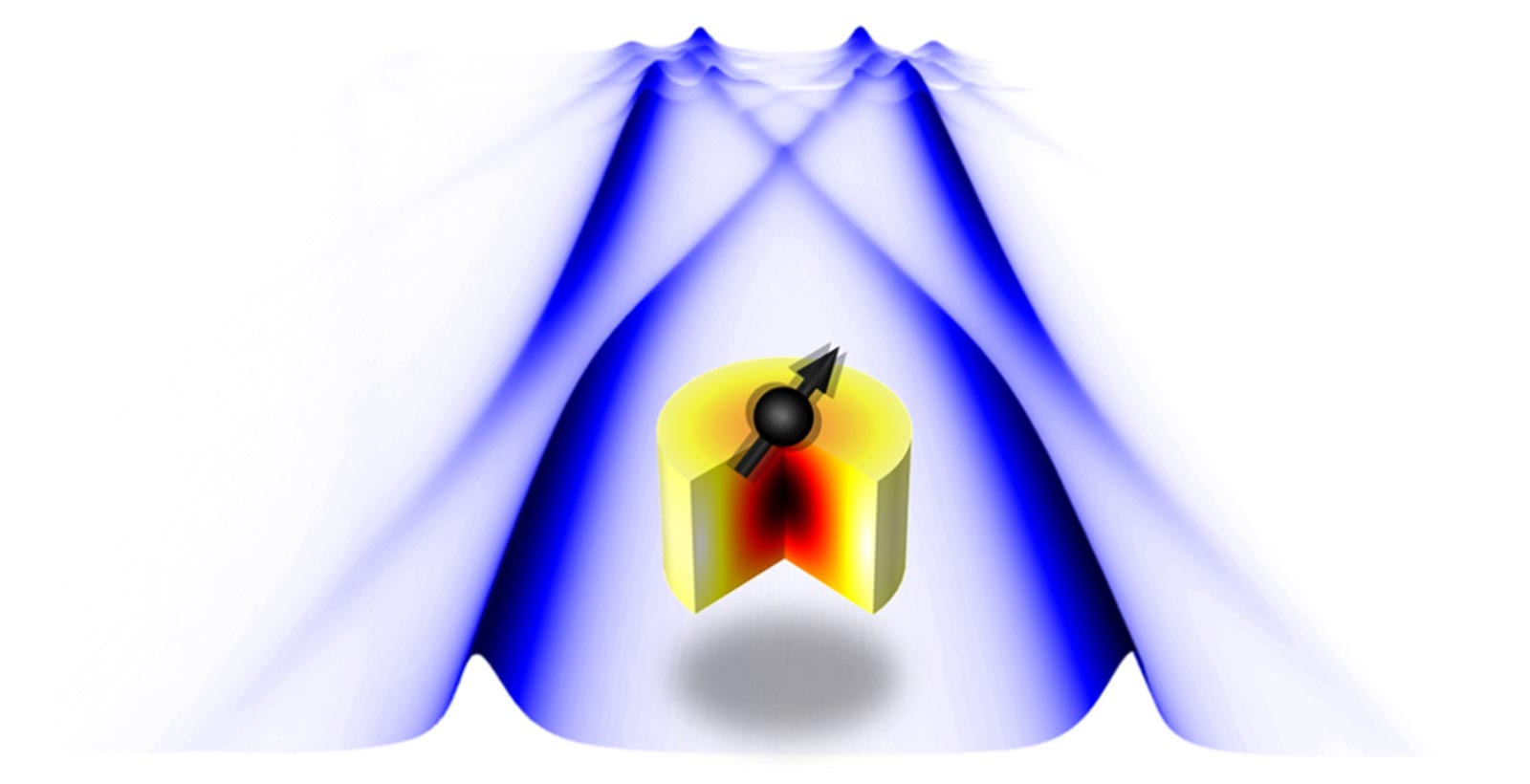
    Tuned Photon-Magnon Interactions
    Tuned photon-magnon interactions. The team’s device is in the center. The arrow indicates the direction of spin excitation for magnons. The purplish shroud represents reflectance measurements. The separated darker lines on each side that intersect at the top indicate tunable strong photon-magnon coupling. Credit: Argonne National Laboratory

    Scientists Tame Photon-Magnon Interaction

    Working with theorists in the University of Chicago’s Pritzker School of Molecular Engineering, researchers in the U.S. Department of Energy’s (DOE) Argonne National Laboratory have achieved a scientific control that is a first of its kind. They demonstrated a novel approach that allows real-time control of the interactions between microwave photons and magnons, potentially leading to advances in electronic devices and quantum signal processing.

    Microwave photons are elementary particles forming the electromagnetic waves that we use for wireless communications. On the other hand, magnons are the elementary particles forming what scientists call “spin waves” — wave-like disturbances in an ordered array of microscopic aligned spins that can occur in certain magnetic materials.

    “Before our discovery, controlling the photon-magnon interaction was like shooting an arrow into the air. One has no control at all over that arrow once in flight.” Xufeng Zhang, assistant scientist in Argonne’s Center for Nanoscale Materials

    Microwave photon-magnon interaction has emerged in recent years as a promising platform for both classical and quantum information processing. Yet, this interaction had proved impossible to manipulate in real time, until now.

    “Before our discovery, controlling the photon-magnon interaction was like shooting an arrow into the air,” said Xufeng Zhang, an assistant scientist in the Center for Nanoscale Materials, a DOE User Facility at Argonne, and the corresponding author of this work. “One has no control at all over that arrow once in flight.”

    The team’s discovery has changed that. “Now, it is more like flying a drone, where we can guide and control its flight electronically,” said Zhang.

    Engineering a Tunable Microwave-Magnonic Device

    By smart engineering, the team employs an electrical signal to periodically alter the magnon vibrational frequency and thereby induce effective magnon-photon interaction. The result is a first-ever microwave-magnonic device with on-demand tunability.

    The team’s device can control the strength of the photon-magnon interaction at any point as information is being transferred between photons and magnons. It can even completely turn the interaction on and off. With this tuning capability, scientists can process and manipulate information in ways that far surpass present-day hybrid magnonic devices.

    “Researchers have been searching for a way to control this interaction for the past few years,” noted Zhang. The team’s discovery opens a new direction for magnon-based signal processing and should lead to electronic devices with new capabilities. It may also enable important applications for quantum signal processing, where microwave-magnonic interactions are being explored as a promising candidate for transferring information between different quantum systems.

    Reference: “Floquet Cavity Electromagnonics” by Jing Xu, Changchun Zhong, Xu Han, Dafei Jin, Liang Jiang and Xufeng Zhang, 1 December 2020, Physical Review Letters.
    DOI: 10.1103/PhysRevLett.125.237201

    The DOE Office of Basic Energy Sciences supported this research, which was published in Physical Review Letters. Aside from Zhang, authors include Jing Xu, Changchun Zhong (University of Chicago), Xu Han, Dafei Jin and Liang Jiang (University of Chicago).

    Never miss a breakthrough: Join the SciTechDaily newsletter.
    Follow us on Google and Google News.

    Argonne National Laboratory DOE Nanotechnology Quantum Physics
    Share. Facebook Twitter Pinterest LinkedIn Email Reddit

    Related Articles

    Quantum Dots Rebuilt by Light in a Trillionth of a Second

    Science Simplified: What Is Quantum Mechanics?

    Inspired by Einstein and De Haas: Scientists Discover Unusual Ultrafast Motion in Layered Magnetic Materials

    For the Very First Time: Scientists Analyze a Single Atom With X-Rays

    Directly Imaging Quantum States in Two-Dimensional Materials

    Quantum Breakthrough: How To Transform Vacancies Into Quantum Information

    Ultrafast Electron Microscopy Leads to Pivotal Discovery for the Development of New Quantum Devices

    New Quantum Dots Design for Solotronics

    PEPs Might Make Quantum Condensation Possible at Room Temperature

    Leave A Reply Cancel Reply

    • Facebook
    • Twitter
    • Pinterest
    • YouTube

    Don't Miss a Discovery

    Subscribe for the Latest in Science & Tech!

    Trending News

    AI Could Detect Early Signs of Alzheimer’s in Under a Minute – Far Before Traditional Tests

    What if Dark Matter Has Two Forms? Bold New Hypothesis Could Explain a Cosmic Mystery

    This Metal Melts in Your Hand – and Scientists Just Discovered Something Strange

    Beef vs. Chicken: Surprising Results From New Prediabetes Study

    Alzheimer’s Breakthrough: Scientists Discover Key Protein May Prevent Toxic Protein Clumps in the Brain

    Quantum Reality Gets Stranger: Physicists Put a Lump of Metal in Two Places at Once

    Scientists May Have Found the Key to Jupiter and Saturn’s Moon Mystery

    Scientists Uncover Brain Changes That Link Pain to Depression

    Follow SciTechDaily
    • Facebook
    • Twitter
    • YouTube
    • Pinterest
    • Newsletter
    • RSS
    SciTech News
    • Biology News
    • Chemistry News
    • Earth News
    • Health News
    • Physics News
    • Science News
    • Space News
    • Technology News
    Recent Posts
    • What if Your Memories Never Happened? Physicists Take a New Look at the Boltzmann Brain Paradox
    • Students Found an Ancient Star That Shouldn’t Be in the Milky Way
    • Astronomers Solve 50-Year Mystery and Reveal Hidden Culprit Behind Strange X-Ray Emissions
    • One of the Universe’s Largest Stars May Be Getting Ready To Explode
    • Scientists Discover Enzyme That Could Supercharge Ozempic-Like Weight Loss Drugs
    Copyright © 1998 - 2026 SciTechDaily. All Rights Reserved.
    • Science News
    • About
    • Contact
    • Editorial Board
    • Privacy Policy
    • Terms of Use

    Type above and press Enter to search. Press Esc to cancel.