

Astronomers have finally identified the source of unusual X-rays from the bright star gamma-Cas, resolving a decades-long mystery.
Astronomers have finally solved a decades-old puzzle surrounding the bright star gamma-Cas, identifying an unseen companion as the source of its unusual X-rays. This hidden object is pulling in material from the visible star, generating powerful high-energy emissions in the process. The discovery brings closure to a mystery that has challenged researchers for more than 50 years.
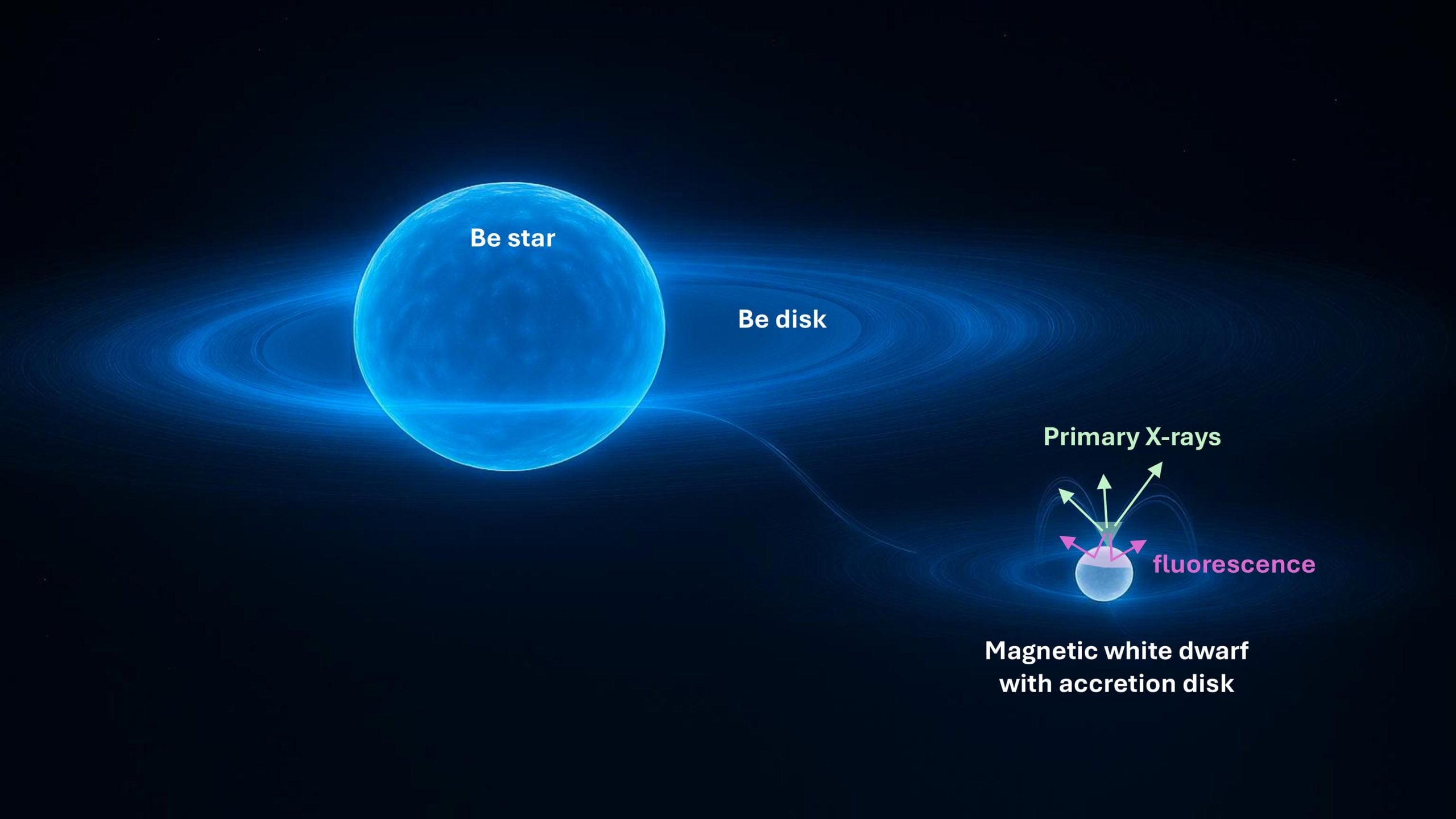
Using high-resolution data from the X-Ray Imaging and Spectroscopy Mission (XRISM), scientists linked the X-ray signals to the orbit of a companion white dwarf star. The findings, led by Yaël Nazé of the University of Liège in Belgium, provide the clearest evidence yet of what is happening in this system.
“There has been an intense effort to solve the mystery of gamma-Cas across many research groups for many decades. And now, thanks to the high-precision observations of XRISM, we have finally done it,” says Yaël.
A mystery steeped in history
The star gamma-Cas (γ-Cas) is visible to Europeans on clear nights and forms the central point of the familiar W-shaped constellation Cassiopeia.
Despite its brightness, the star has puzzled astronomers since 1866, when Italian astronomer Angelo Secchi noticed an unusual feature in its light. Its hydrogen “fingerprint” appeared bright, while in stars like the Sun this feature is typically seen as a dark line.
This unexpected behavior led to the definition of a new category of stars known as “Be” stars. The name combines the “B” for hot, blue-white massive stars with the “e” for their distinctive hydrogen emission.
It took decades to understand that this emission comes from a rotating disk of material expelled by the star as it spins rapidly. These disks can grow and dissipate over time, causing changes in brightness that still attract amateur astronomers today.

As observations improved, astronomers tracked subtle movements in gamma-Cas and concluded it must have a low-mass companion. Because this companion cannot be seen directly, researchers suspect it is a white dwarf, an extremely dense object with the mass of the Sun compressed into a size similar to Earth.
In the mid-1970s, another mystery emerged when gamma-Cas was found to emit unusually strong high-energy X-rays. Later studies showed these X-rays come from plasma heated to about 150 million degrees (270 million degrees Fahrenheit), with a brightness roughly 40 times higher than expected for a star of this type.
With advanced X-ray observatories such as ESA’s XMM-Newton, NASA’s Chandra, and Germany’s eROSITA, scientists have identified about two dozen similar gamma-Cas-like stars. These objects now form a distinct subgroup within Be stars.
The final two theories
For years, astronomers debated two main explanations for the X-rays. One idea suggested that magnetic interactions between the star and its surrounding disk create the hot plasma. The other proposed that material from the disk falls onto a white dwarf companion, producing the X-rays.
XRISM’s high-resolution spectrometer Resolve has now provided the decisive evidence. Observations show that the hot plasma’s signals shift in sync with the orbit of the unseen companion. This confirms that the white dwarf is pulling in material from gamma-Cas and emitting X-rays as it does so.
“The previous work using XMM-Newton really cleared the way for XRISM, enabling us to eliminate numerous theories and prove which of the last two competing theories was correct,” says Yaël. “It’s extremely satisfying to have direct evidence to solve this mystery at long last!”
Identifying gamma-Cas systems as pairs of Be stars and accreting white dwarfs resolves the X-ray puzzle, but it also raises new questions about how these binary systems form and evolve.
Such systems were once expected to be common, especially among low-mass stars. However, recent findings suggest they are less frequent than predicted and are more often associated with high-mass Be stars.
“We think the key is in understanding how exactly the interactions take place between the two stars,” says Yaël. “Now that we know the true nature of gamma-Cas, we can create models specifically for this class of stellar systems, and update our understanding of binary evolution accordingly.”
“It’s incredible to see how this mystery has slowly unfolded over the years,” says Alice Borghese, an ESA Research Fellow specializing in high-energy astrophysics. “XMM-Newton did so much of the groundwork in ruling out various theories about gamma-Cas. And now with the next generation of advanced instrumentation, XRISM has brought us over the finish line.”
“This wonderful result underlines the strong collaboration between XRISM’s Japanese, European and American teams,” adds Matteo Guainazzi, ESA’s XRISM Project Scientist. “This international team combines the technical and scientific expertise needed to solve the X-ray Universe’s biggest mysteries and open new avenues for research.”
Reference: “Orbital motion detected in γ Cas Fe K emission lines” by Yaël Nazé, Masahiro Tsujimoto, Gregor Rauw and Sean J. Gunderson, 24 March 2026, Astronomy & Astrophysics.
DOI: 10.1051/0004-6361/202558284
Never miss a breakthrough: Join the SciTechDaily newsletter.
Follow us on Google and Google News.