

XRISM revealed the structure, motion, and temperature of the material around a supermassive black hole and in a supernova remnant in unprecedented detail.
The XRISM space telescope has illuminated the complex dynamics of celestial phenomena such as supernovas and black holes by revealing the temperature, velocity, and three-dimensional structures of their surrounding materials. Notably, the supernova remnant N132D in the Large Magellanic Cloud and a supermassive black hole in NGC 4151 were studied, offering unprecedented details about their internal movements and structures.
Celestial Phenomena and XRISM’s First Discoveries
What do a gigantic black hole and the remains of a massive, exploded star have in common? These are both dramatic celestial phenomena where extremely hot gas produces highly energetic X-ray light that the X-Ray Imaging and Spectroscopy Mission (XRISM) can see.
In its first published results, XRISM, a mission led by the Japan Aerospace Exploration Agency (JAXA) with participation from the European Space Agency (ESA), shows its unique capabilities to reveal the speed and temperature of sizzling hot gas, called plasma, and the three-dimensional structures of material surrounding a black hole and an exploded star.
“These new observations provide crucial information in understanding how black holes grow by capturing surrounding matter, and offer a new insight into the life and death of massive stars. They showcase the mission’s exceptional capability in exploring the high-energy Universe,” says ESA XRISM Project Scientist Matteo Guainazzi.
Insights From Supernova Remnant N132D
In one of its “first light” observations, XRISM focused on N132D, a supernova remnant located in the Large Magellanic Cloud about 160,000 light-years from Earth. This interstellar ‘bubble’ of hot gas was expelled by the explosion of a very massive star approximately 3000 years ago.
Using its Resolve instrument, XRISM uncovered the structure around N132D in detail. Contrary to prior assumptions of a simple spherical shell, scientists found out that the remnant of N132D is shaped like a doughnut. Using the Doppler effect, they measured the speed (velocity) at which the hot plasma in the remnant is moving towards or away from us, and established that this is expanding at the apparent speed of around 1200 km/s.
Resolve also revealed that the remnant contains iron that has an extraordinary temperature of 10 billion degrees Kelvin. The iron atoms were heated during the supernova explosion through violent shock waves spreading inwards, a phenomenon that had been predicted by theory, but never observed before.
Supernova remnants like N132D hold important clues into how stars evolve and how (heavy) elements that are essential to our life, like iron, are generated and spread out in interstellar space. Yet, previous X-ray observatories have always had difficulty revealing how the plasma’s velocity and temperature were distributed.

At the top of the image, the supernova remnant is shown in X-ray light. The yellow circle depicts the area where XRISM’s instrument Resolve measured extremely hot iron (10 billion degrees Kelvin). The pink line shows the rim of the remnant, where the blast wave interacts with the interstellar medium, and the hot gas (plasma) is cooler (around 10 million degrees Kelvin).
The spectrum shows many chemical elements that are present in N132D. XRISM can identify each element by measuring the energy of the X-ray photon specific to different atoms. The label ‘keV’ on the x-axis of the graph refers to kiloelectronvolts, a unit of energy. The ‘energy resolution’ of XRISM, that is its capability to distinguish X-ray light with different wavelengths, is ground-breaking. With 30 times the resolution of its predecessors, XRISM’s advanced spectroscopic capabilities enable scientists to measure the motion and temperature of the hot plasma with unprecedented precision.
Credit: JAXA
Unveiling the Secrets of a Supermassive Black Hole
XRISM has also shed new light on the mysterious structure surrounding a supermassive black hole. Focusing on the spiral galaxy NGC 4151, located 62 million light-years away from us, XRISM’s observations offer an unprecedented view of the material very close to the galaxy’s central black hole, which has a mass 30 million times that of the Sun.
XRISM captured the distribution of the matter circling and ultimately falling into the black hole over a wide radius, spanning from 0.001 to 0.1 light-years, that is from about a distance comparable to the Sun–Uranus separation to 100 times that.

By determining the motions of iron atoms from their X-ray signature, scientists mapped out a sequence of structures surrounding the giant black hole: from the disk ‘feeding’ the black hole all the way out to the doughnut-shaped torus.
These findings provide a vital piece of the puzzle in understanding how black holes grow by gobbling up surrounding matter.
Although radio and infrared observations have revealed the presence of a doughnut-shaped torus around black holes in other galaxies, XRISM’s spectroscopic technique is the first, and currently only way to track down how the gas near the central ‘monster’ is shaped and moves.
Looking Ahead: Future Observations and Discoveries
In the last months, the XRISM science team has diligently worked on establishing the instruments’ performance and refining the data analysis methods by observing 60 key targets. In parallel, 104 new sets of observations were selected from the over 300 proposed submissions from scientists worldwide.
XRISM will conduct observations based on the successful proposals over the next year; thanks to its exceptional performance in orbit, surpassing even initial expectations, this promises many more exciting discoveries to come.
About XRISM
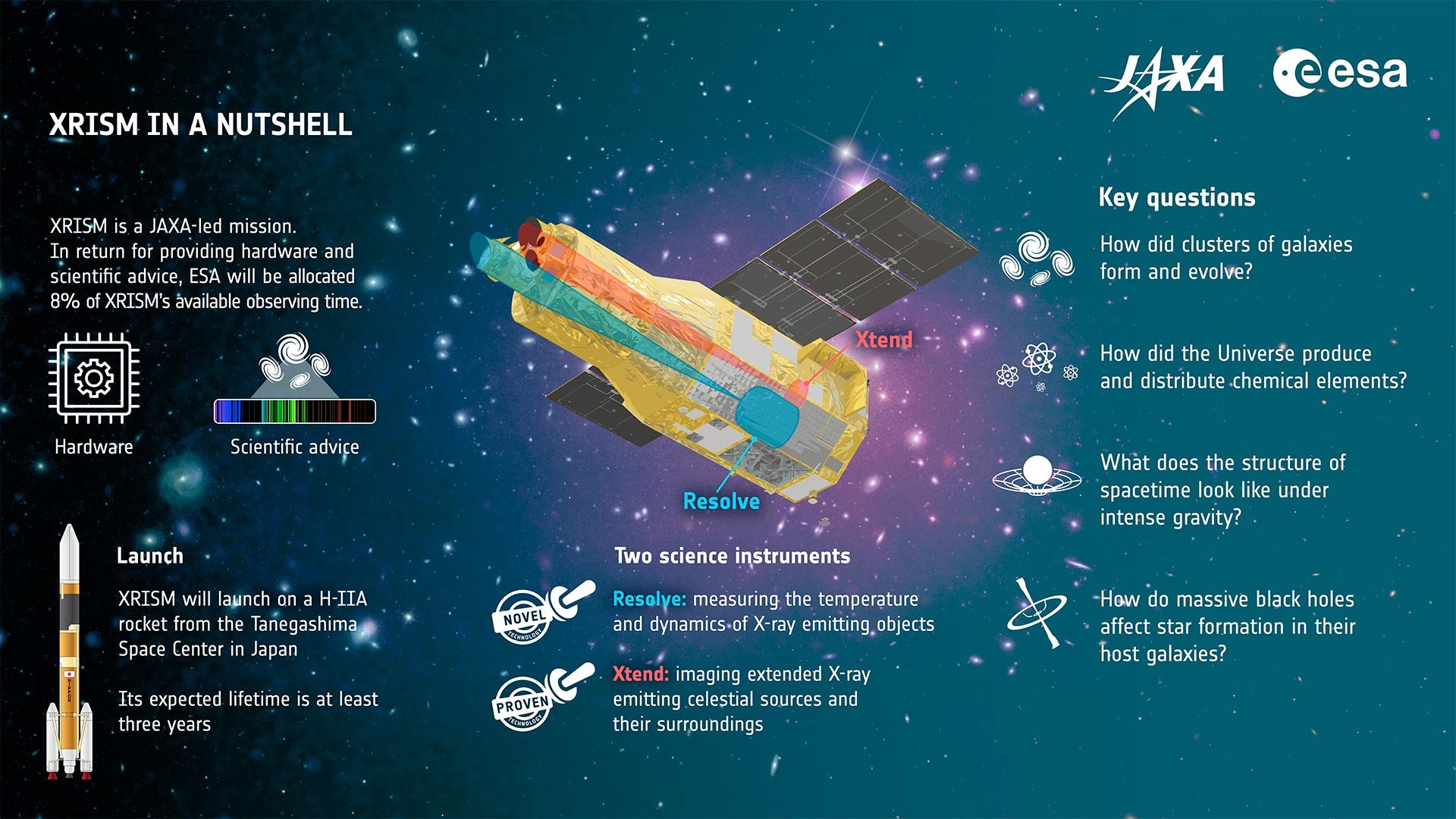
The X-Ray Imaging and Spectroscopy Mission (XRISM) launched on September 7, 2023. It is a collaboration between the Japan Aerospace Exploration Agency (JAXA) and NASA, with significant participation from ESA. In return for providing hardware and scientific advice, ESA is allocated 8% of XRISM’s available observing time.
Observations made using XRISM will complement those from ESA’s XMM-Newton X-ray telescope, and will be an excellent foundation for observations planned with ESA’s future large-class mission NewAthena. The latter is being designed to significantly exceed the scientific performance of existing spectroscopic and survey X-ray observatories.
These results by the XRISM Collaboration are accepted for publication in the Astronomical Society of Japan and The Astrophysical Journal.
References:
“XRISM Spectroscopy of the Fe Kα Emission Line in the Seyfert Active Galactic Nucleus NGC 4151 Reveals the Disk, Broad-line Region, and Torus” by Marc Audard, Hisamitsu Awaki, Ralf Ballhausen, Aya Bamba, Ehud Behar, Rozenn Boissay-Malaquin, Laura Brenneman, Gregory V. Brown, Lia Corrales, Elisa Costantini, Renata Cumbee, Maria Diaz Trigo, Chris Done, Tadayasu Dotani, Ken Ebisawa, Megan E. Eckart, Dominique Eckert, Teruaki Enoto, Satoshi Eguchi, Yuichiro Ezoe, Adam Foster, Ryuichi Fujimoto, Yutaka Fujita, Yasushi Fukazawa, Kotaro Fukushima, Akihiro Furuzawa, Luigi Gallo, Javier A. García, Liyi Gu, Matteo Guainazzi, Kouichi Hagino, Kenji Hamaguchi, Isamu Hatsukade, Katsuhiro Hayashi, Takayuki Hayashi, Natalie Hell, Edmund Hodges-Kluck, Ann Hornschemeier, Yuto Ichinohe, Manabu Ishida, Kumi Ishikawa, Yoshitaka Ishisaki, Jelle Kaastra, Timothy Kallman, Erin Kara, Satoru Katsuda, Yoshiaki Kanemaru, Richard Kelley, Caroline Kilbourne, Shunji Kitamoto, Shogo Kobayashi, Takayoshi Kohmura, Aya Kubota, Maurice Leutenegger, Michael Loewenstein, Yoshitomo Maeda, Maxim Markevitch, Hironori Matsumoto, Kyoko Matsushita, Dan McCammon, Brian McNamara, François Mernier, Eric D. Miller, Jon M. Miller, Ikuyuki Mitsuishi, Misaki Mizumoto, Tsunefumi Mizuno, Koji Mori, Koji Mukai, Hiroshi Murakami, Richard Mushotzky, Hiroshi Nakajima, Kazuhiro Nakazawa, Jan-Uwe Ness, Kumiko Nobukawa, Masayoshi Nobukawa, Hirofumi Noda, Hirokazu Odaka, Shoji Ogawa, Anna Ogorzalek, Takashi Okajima, Naomi Ota, Stephane Paltani, Robert Petre, Paul Plucinsky, Frederick S. Porter, Katja Pottschmidt, Kosuke Sato, Toshiki Sato, Makoto Sawada, Hiromi Seta, Megumi Shidatsu, Aurora Simionescu, Randall Smith, Hiromasa Suzuki, Andrew Szymkowiak, Hiromitsu Takahashi, Mai Takeo, Toru Tamagawa, Keisuke Tamura, Takaaki Tanaka, Atsushi Tanimoto, Makoto Tashiro, Yukikatsu Terada, Yuichi Terashima, Yohko Tsuboi, Masahiro Tsujimoto, Hiroshi Tsunemi, Takeshi Tsuru, Hiroyuki Uchida, Nagomi Uchida, Yuusuke Uchida, Hideki Uchiyama, Yoshihiro Ueda, Shinichiro Uno, Jacco Vink, Shin Watanabe, Brian J. Williams, Satoshi Yamada, Shinya Yamada, Hiroya Yamaguchi, Kazutaka Yamaoka, Noriko Yamasaki, Makoto Yamauchi, Shigeo Yamauchi, Tahir Yaqoob, Tomokage Yoneyama, Tessei Yoshida, Mihoko Yukita, Irina Zhuravleva, Xin Xiang, Takeo Minezaki, Margaret Buhariwalla, Dimitra Gerolymatou and Scott Hagen, 19 September 2024, The Astrophysical Journal Letters.
DOI: 10.3847/2041-8213/ad7397
“The XRISM First Light Observation: Velocity Structure and Thermal Properties of the Supernova Remnant N132D” by XRISM Collaboration, 26 August 2024, Astrophysics > High Energy Astrophysical Phenomena.
arXiv:2408.14301
Never miss a breakthrough: Join the SciTechDaily newsletter.
Follow us on Google and Google News.
1 Comment
Memo 2409271024
Observations of the black hole and its surroundings are being collected. The black hole vixer is transformed from the surrounding debris of the vixer. The way the black hole grows in size is due to the equatorial sequence accumulated in the black hole vixer.n. For example, the strongest of the six types of black holes is the 3,2,1 number of coherent quantum entanglement in the position relative to the z’ of the vixer, which is the location of the vixer. Unlimited microgravity fractals of quantum entanglement generate the number of types of black holes, depending on the order. Uh-huh.
The heavy vicer.blackhole arises only from zz’ and controls the space-time of the universe on the diagonal x.bar .
Source 1. Edit
What do giant black holes and the remnants of giant exploded stars have in common? Both are dramatic celestial phenomena in which very hot gases produce high-energy X-rays, which can be seen in X-ray imaging and spectroscopic missions (XRISM).
In its first published results, XRISM showed a unique ability to uncover the speed and temperature of hot gas called plasma, as well as the three-dimensional structure of matter surrounding black holes and exploded stars.
“These new observations provide important information for understanding how black holes grow by capturing the surrounding matter and provide new insights into the life and death of giant stars. This demonstrates the mission’s outstanding capabilities to explore high-energy space.
1.
When a black hole vixer collapses, it turns into a neutron star vixer. If a neutron star doesn’t work, it creates smolas debris. Uh-huh. Of course, more details are possible. One billion terabytes of data comes out easily. Huh.
ㅡㅡㅡㅡㅡㅡㅡㅡㅡㅡㅡㅡㅡ
Source 1.
https://scitechdaily.com/xrisms-x-ray-insights-uncover-the-hidden-structures-of-black-holes-and-supernovas/
X-ray insights from XRISM discover hidden structures of black holes and supernovae