
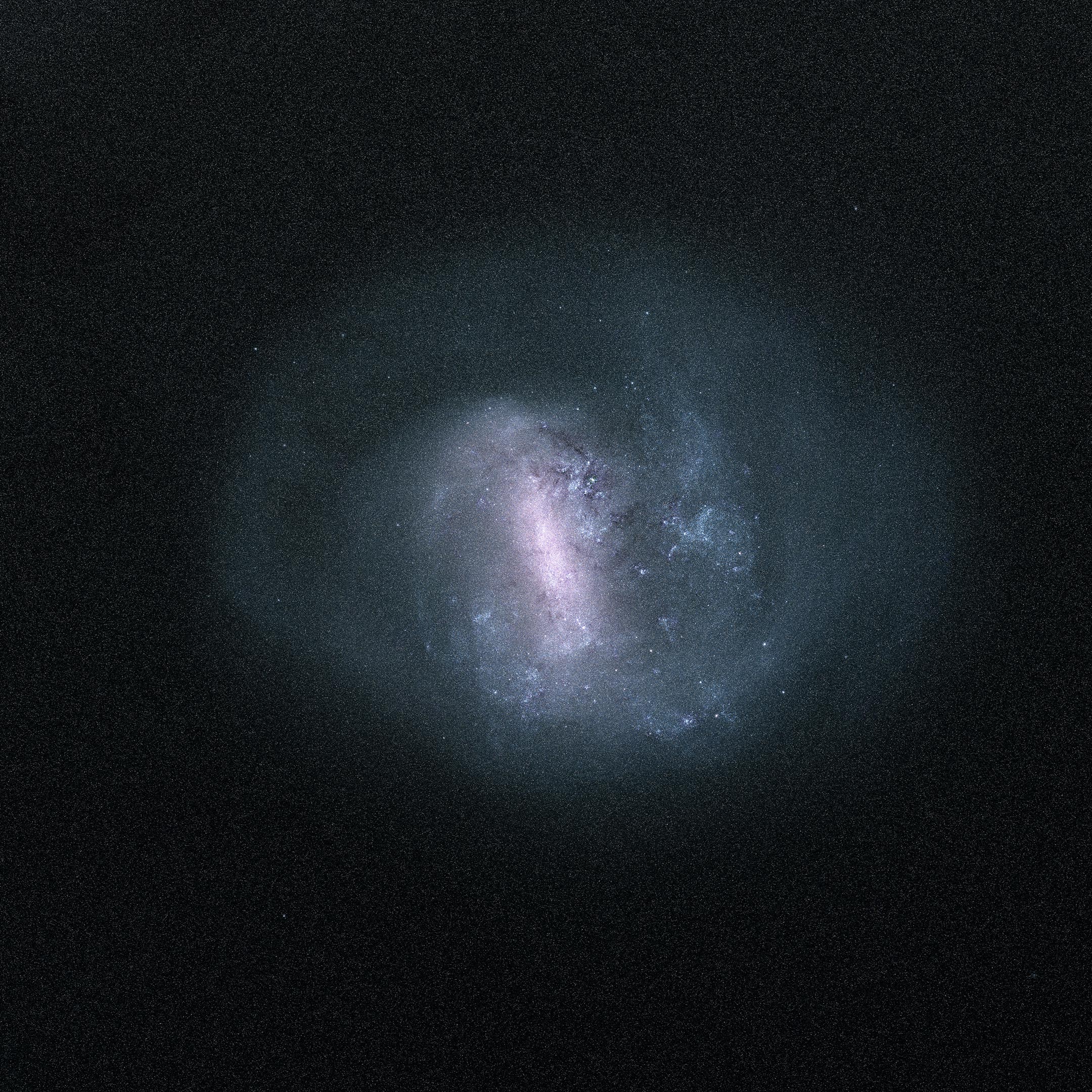
The Large Magellanic Cloud is intricately mapped by ESA’s Gaia, focusing on its brightest stars and significant areas like the 30 Doradus, using advanced imaging techniques.
The Large Magellanic Cloud (LMC), one of the nearest galaxies to our Milky Way, as viewed by the European Space Agency’s Gaia satellite using information from the mission’s second data release.
This view is not a photograph but has been compiled by mapping the total amount of radiation detected by Gaia in each pixel, combined with measurements of the radiation taken through different filters on the spacecraft to generate color information.
The image is dominated by the brightest, most massive stars, which greatly outshine their fainter, lower-mass counterparts. In this view, the bar of the LMC is outlined in great detail, along with individual regions of star formation like the giant 30 Doradus, visible just above the center of the galaxy.
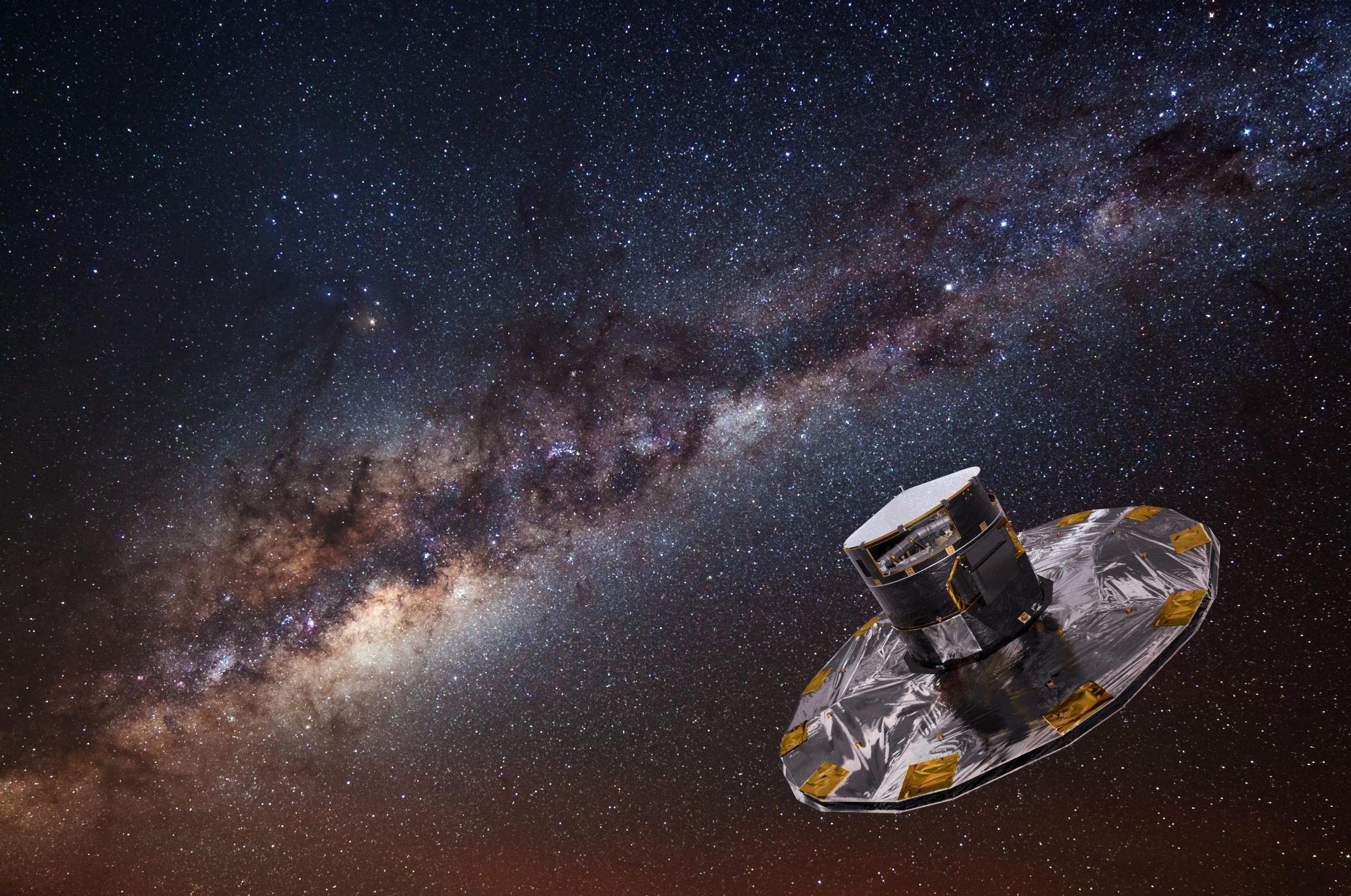
The European Space Agency’s Gaia mission is an ambitious project designed to create the most accurate and comprehensive 3D map of the Milky Way galaxy. Launched in December 2013, Gaia operates from a stable position approximately 1.5 million kilometers from Earth, in the direction opposite the Sun, known as the second Lagrange point (L2). Its mission is crucial for understanding the composition, formation, and evolution of our galaxy.
Gaia’s sophisticated instruments measure the positions, distances, and motions of stars with unprecedented precision. The spacecraft is equipped with two optical telescopes and a billion-pixel camera, the largest ever flown in space, which enables it to observe over a billion stars, approximately 1% of the Milky Way’s total. These observations help scientists piece together the galactic puzzle, providing insights into the physical properties of stars such as luminosity, temperature, and composition.
The data collected by Gaia has immense scientific value, contributing to a wide range of astronomical fields. Beyond charting stars, Gaia also detects and catalogs thousands of exoplanets, asteroids within our solar system, and distant galaxies. Additionally, it tests Einstein’s theory of general relativity by measuring the bending of starlight by the Sun’s gravity. Gaia’s mission, originally slated to run until 2020, has been extended, promising even more detailed surveys and discoveries that continue to shape our understanding of the cosmos.
Never miss a breakthrough: Join the SciTechDaily newsletter.
Follow us on Google and Google News.