

The Einstein Probe, using its innovative lobster-eye X-ray telescope, has captured an ultra-rare celestial event — a bright X-ray flare from a system where a white dwarf and a massive Be star orbit in a complex dance of stellar evolution.
Scientists have long suspected such systems existed, but this is the first time one has been observed from its initial outburst. The discovery provides crucial clues about how massive stars transfer material, explode, and evolve, shedding new light on the cosmic forces shaping our universe.
Lobster-Eye Satellite Captures a Rare X-ray Flash
The Einstein Probe satellite, equipped with its innovative lobster-eye X-ray telescope, has detected a rare and fleeting X-ray flash from an elusive celestial duo. This discovery offers a new way to study how massive stars interact and evolve, highlighting the satellite’s ability to uncover short-lived X-ray sources in space.
The unusual pair consists of a large, hot star — more than ten times the size of our Sun — and a small but incredibly dense white dwarf, with a mass comparable to the Sun. Only a few such systems have been identified, and this is the first time scientists have been able to track the X-ray emission from one of these rare duos, capturing its evolution from the initial burst to its gradual fading.
A Sudden X-ray Signal
On May 27, 2024, the Wide-field X-ray Telescope (WXT) on the Einstein Probe detected X-rays coming from the Small Magellanic Cloud (SMC), a neighboring galaxy. To determine the source of this newfound celestial beacon, labeled EP J0052, scientists turned Einstein Probe’s Follow-up X-ray Telescope toward the object.
This discovery also triggered follow-up observations from NASA’s Swift and NICER X-ray telescopes, which quickly focused on the source. ESA’s XMM-Newton telescope conducted additional observations 18 days later, helping astronomers piece together the nature of this rare cosmic event.
“We were chasing fleeting sources, when we came across this new spot of X-ray light in the SMC. We realised that we were looking at something unusual, that only Einstein Probe could catch,” says Alessio Marino, a postdoctoral researcher at the Institute of Space Sciences (ICE-CSIC), Spain, and lead author of the new study published today.
“This is because, among current telescopes monitoring the X-ray sky, WXT is the only one that can see lower energy X-rays with sufficient sensitivity to catch the novel source.”
Initially, the scientists thought EP J0052 might be a well-known type of binary system that shines in X-rays. These pairs consist of a neutron star devouring up material from a massive star companion. Yet, there was something in the data telling a different story…

A Rare Celestial Encounter
Thanks to Einstein Probe catching the novel source right from its initial flash, scientists could analyze batches of data from different instruments. They examined how the light varied across a range of X-ray wavelengths, over six days, and teased out some of the elements present in the exploding material, such as nitrogen, oxygen, and neon. The analysis delivered crucial clues.
“We soon understood that we were dealing with a rare discovery of a very elusive celestial couple,” explains Alessio. “The unusual duo consists of a massive star that we call a Be star, weighting 12 times the Sun, and a stellar ‘corpse’ known as a white dwarf, a compact and hyper-dense object, with a mass similar to that of our star.”
The two stars closely orbit each other, and the white dwarf’s intense gravitational field pulls matter from its companion. As more and more material (mainly hydrogen) rains down on the compact object, its strong gravitation compresses it, until a runaway nuclear explosion is initiated. This creates a bright flash of light across a wide range of wavelengths from visible light to UVs and X-rays.
A Puzzling Stellar Pair
At first sight, the existence of this duo is puzzling. Massive stars of type Be burn fast through their reserve of nuclear fuel. Their lives are fierce and short, spanning about 20 million years. Its companion is (usually) the collapsed remnant of a star similar to our Sun that in isolation would live for several billions of years.
Since binary stars typically form together, how can the supposedly short-lived star still be shining bright, while the alleged long-lived one has already died?
There is an explanation.
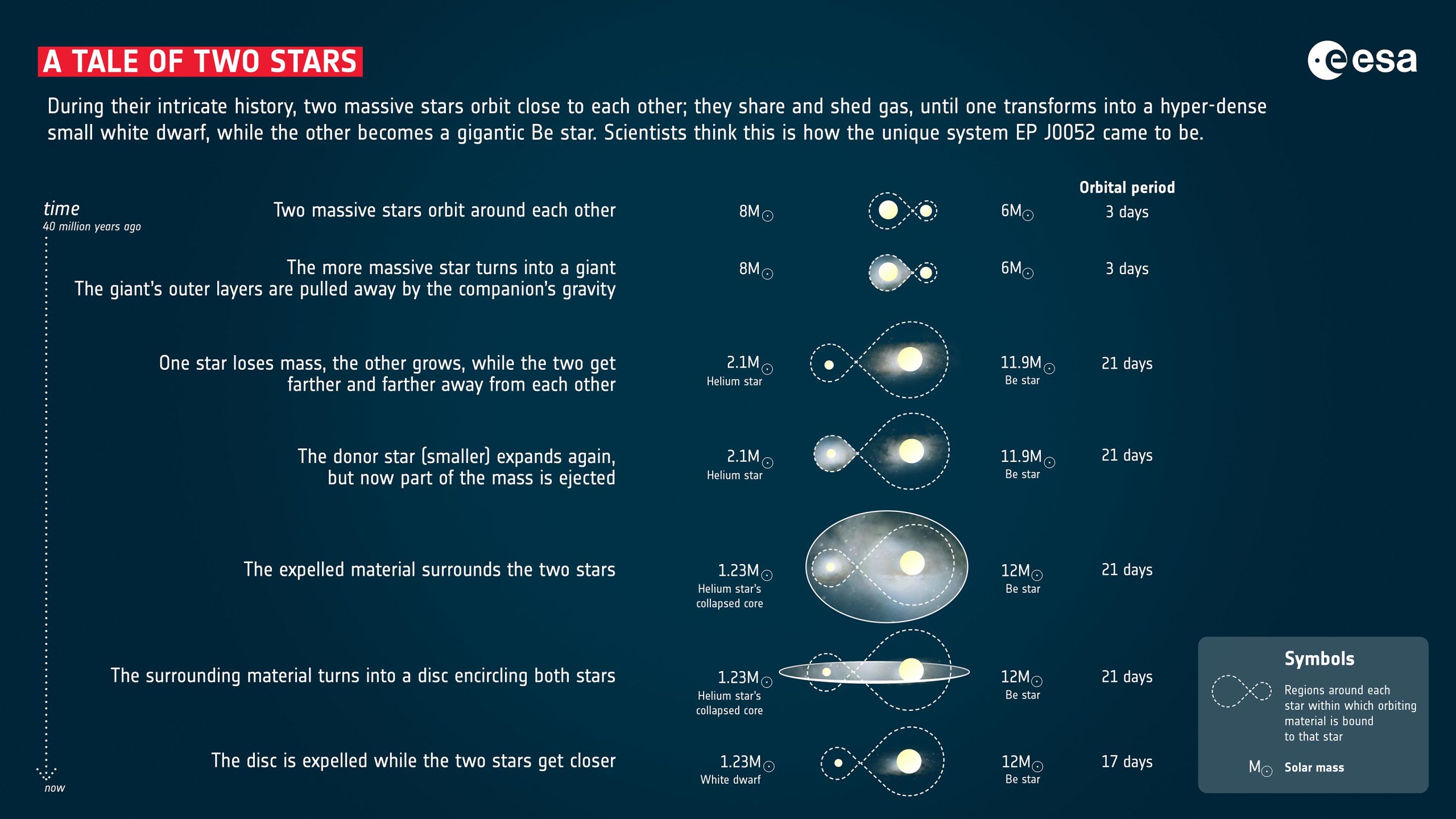
A Tale of Two Stars
Scientists think that the couple started off together, as a better-matched binary pair consisting of two rather big stars, six and eight times more massive than our Sun.
The bigger star exhausted its nuclear fuel earlier and started to expand, shedding matter to its companion. First, gas in its puffed-up outer layers got pulled in by the companion; then its remaining outer shells got ejected, forming an envelope around the two stars, which later became a disc, and finally dissolved.
By the end of this drama, the companion star had grown to be 12 times the mass of the Sun, while the outstripped core of the other had collapsed to become a white dwarf of just over one solar mass. Now, it is the turn of the white dwarf to steal and gobble up material from the outer layers of the Be star.
The Evolutionary Mystery
“This study gives us new insights into a rarely observed phase of stellar evolution, which is the result of a complex exchange of material that must have happened among the two stars,” remarks Ashley Chrimes, research fellow and X-ray astronomer at ESA. “It’s fascinating to see how an interacting pair of massive stars can produce such an intriguing outcome.”
ESA’s XMM-Newton mission’s follow-up observation in the direction of EP J0052, 18 days after Einstein Probe’s first look, did not see the signal anymore. This sets a limit on the duration of the flare, showing it to be relatively brief.
The duration of the short burst, and the presence of neon and oxygen, hint at a rather heavy type of white dwarf, likely 20% more massive than the Sun. Its mass is close to the level, called Chandrasekhar limit, above which the star would continue to implode, and become an even denser neutron star, or explode as a supernova.
A Game-Changer for X-ray Astronomy
“Outbursts from a Be-white dwarf duo have been extraordinarily hard to catch, as they are best observed with low energy X-rays. The advent of Einstein Probe offers the unique chance to spot these fleeting sources and test our understanding of how massive stars evolve,” remarks Erik Kuulkers, ESA Project Scientist for Einstein Probe.
“This discovery showcases the game-changing capabilities of this mission.”
Reference: “Einstein Probe Discovery of EP J005245.1−722843: A Rare Be–White Dwarf Binary in the Small Magellanic Cloud?” by A. Marino, H. N. Yang, F. Coti Zelati, N. Rea, S. Guillot, G. K. Jaisawal, C. Maitra, J.-U. Ness, F. Haberl, E. Kuulkers, W. Yuan, H. Feng, L. Tao, C. Jin, H. Sun, W. Zhang, W. Chen, E. P. J. van den Heuvel, R. Soria, B. Zhang, S.-S. Weng, L. Ji, G. B. Zhang, X. Pan, Z. Lv, C. Zhang, Z. X. Ling, Y. Chen, S. Jia, Y. Liu, H. Q. Cheng, D. Y. Li, K. Gendreau, M. Ng and T. Strohmayer, 18 February 2025, The Astrophysical Journal Letters.
DOI: 10.3847/2041-8213/ad9580
Never miss a breakthrough: Join the SciTechDaily newsletter.
Follow us on Google and Google News.