
Close Menu
    Facebook X (Twitter) Instagram
    SciTechDaily
    • Biology
    • Chemistry
    • Earth
    • Health
    • Physics
    • Science
    • Space
    • Technology
    Facebook X (Twitter) Pinterest YouTube RSS
    SciTechDaily
    Home»Health»High-Intensity Focused Ultrasound Treats Prostate Cancer With Minimal Side Effects
    Health

    High-Intensity Focused Ultrasound Treats Prostate Cancer With Minimal Side Effects

    By Radiological Society of North AmericaFebruary 2, 20211 Comment6 Mins Read
    Facebook Twitter Pinterest Telegram LinkedIn WhatsApp Email Reddit
    Share
    Facebook Twitter LinkedIn Pinterest Telegram Email Reddit
    Ultrasound Treats Prostate Cancer
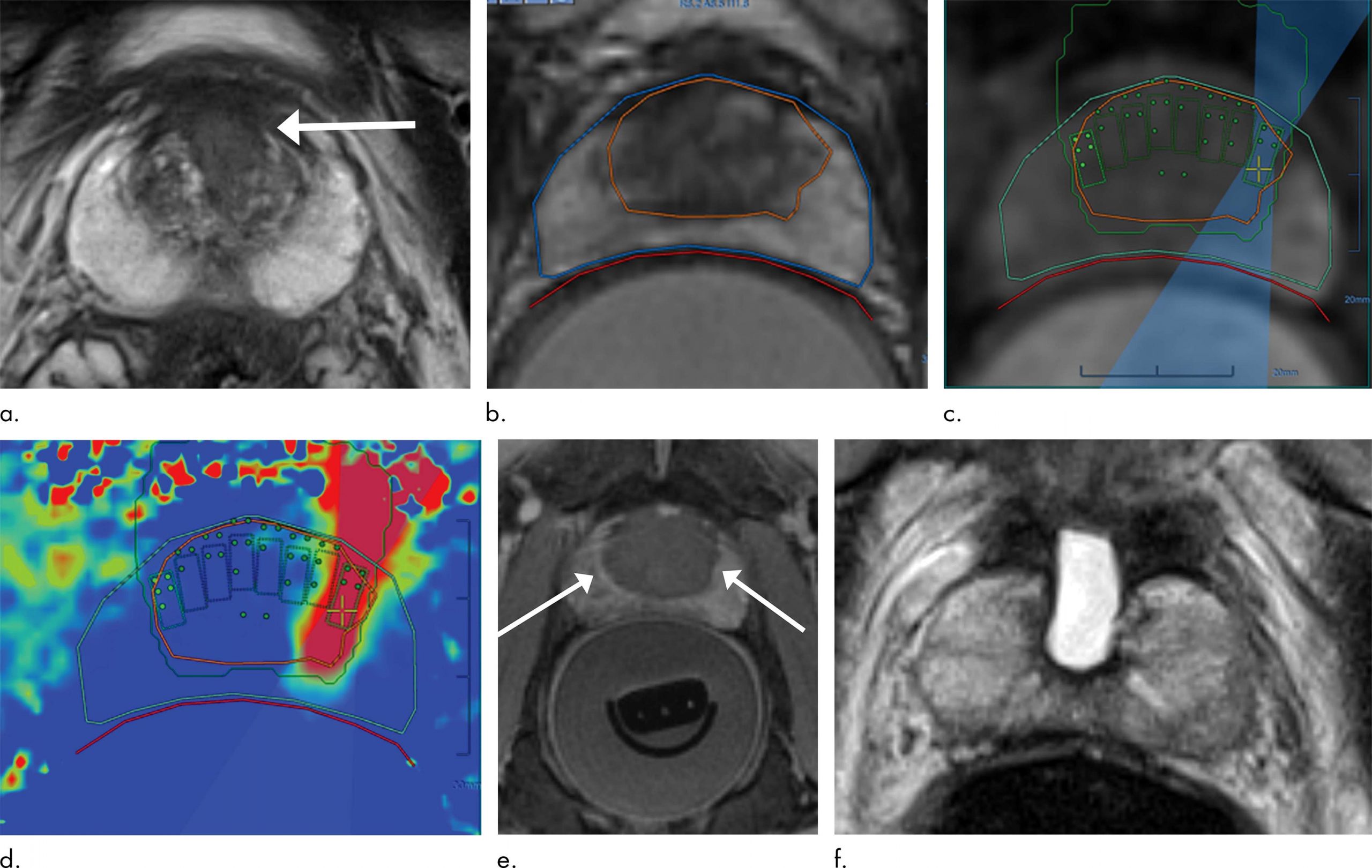
    Images in 69-year-old man with biopsy-confirmed Gleason score 7 (3+4) prostate cancer. (a) Pretreatment axial T2-weighted fast spin-echo MRI scan (repetition time msec/echo time msec, 3820/97) shows tumor in midline anterior transition zone (arrow). (b) Intraoperative MRI scan shows contoured rectal wall (red line), prostate margin (blue outline), and region of interest (orange outline). Because the urethra was included in planned treatment volume, a suprapubic catheter was placed for continuous bladder drainage during treatment. (c) Intraoperative MRI scan shows focused ultrasound beam path (blue) overlaid on treatment plan. Rectangles illustrate each sonication spot. (d) Thermal map image obtained during treatment with heat deposition color coded in red overlaid on sonication spot. (e) Axial gadopentetate dimeglumine-enhanced MRI scan (230/2.97) obtained immediately after treatment shows devascularized ablated volume (arrows). (f) Corresponding T2-weighted fast spin-echo MRI scan (3820/97) at 5 months after ablation shows complete involution of transition zone. All seven cores from treatment area margins were negative for cancer at biopsy. Credit: Radiological Society of North America

    MRI-guided high-intensity focused ultrasound (MRgFUS) effectively treats prostate cancer while preserving urinary and sexual function.

    A technique that delivers high-intensity focused ultrasound to targeted tissue under MRI guidance effectively treats intermediate-risk prostate cancer with minimal side effects, according to a study published in Radiology.

    Prostate cancer is the most common cancer among men, aside from non-melanoma skin cancers. Common treatments to the entire gland, such as surgery and radiation therapy, are effective in eliminating the cancer, but they often leave patients with incontinence and sexual dysfunction.

    A class of treatments called focal therapy offers an alternative for some men with intermediate-risk disease that is still confined to the prostate. In focal therapy, the cancer is ablated, or destroyed, by either heating or freezing the target tissue. Since the treatment is targeted to a small area within the prostate, side effects are generally less significant than those associated with surgery and radiation therapy.

    High-intensity focused ultrasound is an example of focal therapy in which an ultrasound transducer focuses sound waves to generate heat at a single point within the body and destroy the target tissue. In the past, it has been performed under ultrasound guidance, but ultrasound does not visualize the site of cancer within the prostate gland well enough to allow for a targeted approach.
    Ultrasound Technique Treats Prostate Cancer
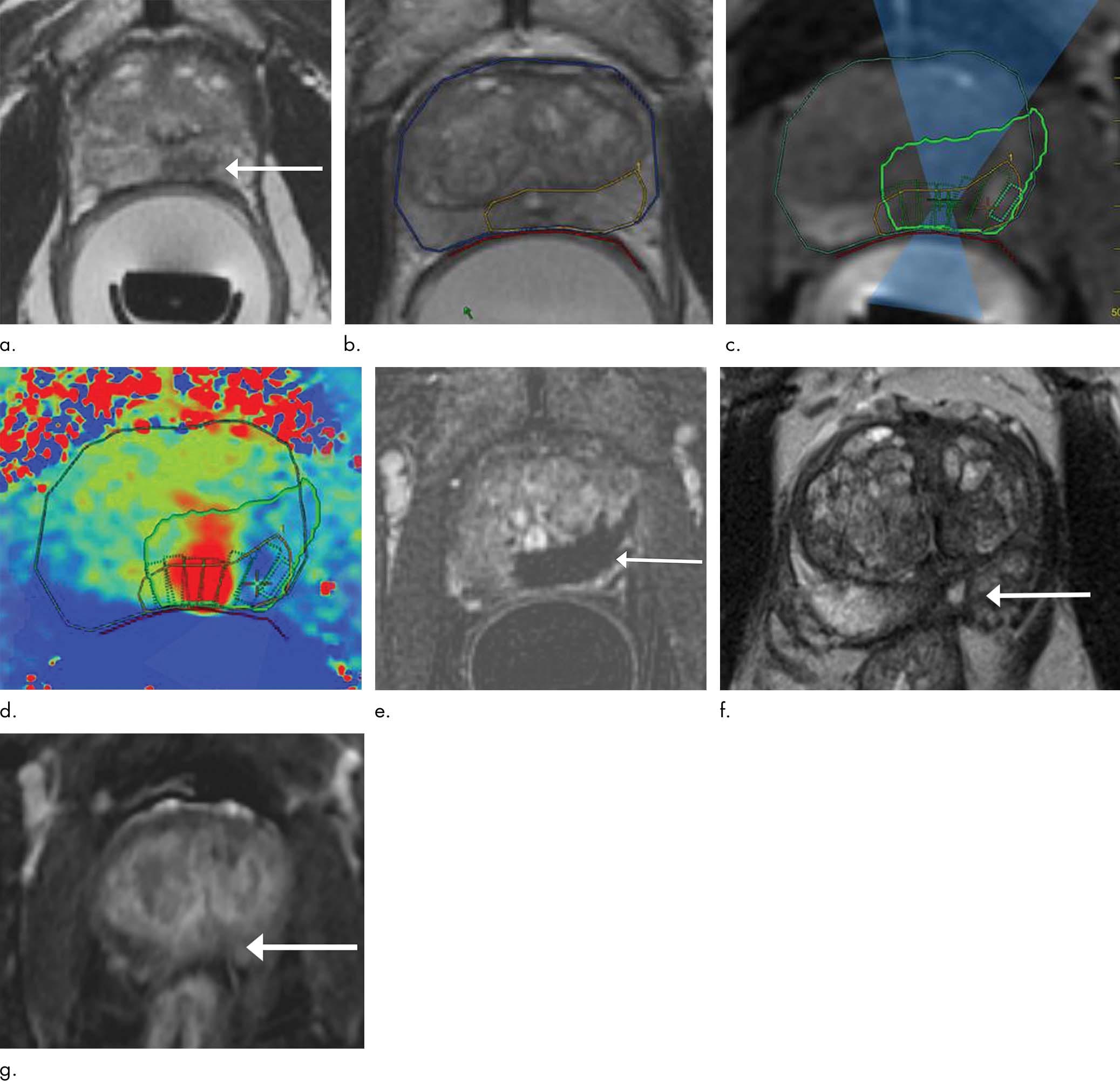
    Images in 75-year-old man with biopsy-confirmed Gleason score 7 (4+3) prostate cancer. (a) Pretreatment axial T2-weighted fast spin-echo MRI scan on day of treatment (repetition time msec/echo time msec, 4416/81) shows tumor in left posteromedial peripheral zone at midgland (arrow). Endorectal treatment probe with degassed water is seen in rectum. (b) Intraoperative MRI scan shows contoured rectal wall (red line), prostate margin (blue outline), and region of interest (yellow outline). Because urethra was included in planned treatment volume, a suprapubic catheter was placed for continuous bladder drainage during treatment. (c) Intraoperative MRI scan shows focused ultrasound beam path (blue) overlaid on treatment plan. Rectangles illustrate each sonication spot. (d) Thermal map image obtained during treatment with heat deposition color coded in red overlaid on sonication spot. (e) Axial gadopentetate dimeglumine-enhanced subtraction MRI scan (200/5.4) obtained immediately after treatment shows devascularized ablated volume (arrow). Note that devascularized area does not extend into transition zone anteriorly. (f) Corresponding axial T2-weighted fast spin-echo MRI scan (4140/97) at 5 months after ablation shows scarring at ablation site (arrow). (g) Axial gadopentetate dimeglumine-enhanced subtraction MRI scan (5.39/1.88) does not show any early enhancement on dynamic contrast-enhanced images at treatment area (arrow). All six cores from treatment area, including margins, were negative for cancer at biopsy. Credit: Radiological Society of North America

    MRI in Precision Cancer Treatment

    For the new study, researchers studied a device that delivers MRI-guided focused ultrasound (MRgFUS). While the patient is under general anesthesia, a probe is placed in the rectum that focuses high-frequency ultrasonic waves to the site of the cancer. The procedure takes approximately four hours to perform.

    “By combining the high-intensity focused ultrasound device with MRI, we can target our treatment to the exact location, because we’re able to pinpoint precisely where the tumor is,” said the study’s principal investigator and lead author Sangeet Ghai, M.D., at Toronto’s Joint Department of Medical Imaging, part of the University Health Network (UHN) Sinai Health and Women’s College Hospital.

    Dr. Ghai and colleagues from UHN and Sinai Health performed MRgFUS on 44 men with prostate cancer and tracked their outcomes using MRI, biopsies, and surveys of erectile and urinary function.

    Treatment was successfully completed in all the men. There were no major treatment-related adverse events, and 41 of 44 participants, or 93%, were disease-free at the treatment site on five-month biopsy.

    Minimal Side Effects and Preserved Function

    Scores for erectile function and prostate symptoms were similar at baseline and five months.

    “The results so far have been very good,” Dr. Ghai said. “We treated a smaller area using this device, yet still had very good results. At the same time the patients preserved their erectile and urinary function.”

    Although MRgFUS requires additional expertise, resources, and cost, it has several key advantages over other approaches. Use of MRI allows for thermal feedback during treatment, an important consideration since killing the cancerous tissue requires a temperature of more than 60 degrees Celsius.

    Real-Time Temperature Feedback for Better Accuracy

    “MRI almost instantaneously gives feedback as to the temperature that we’ve been able to achieve at the site,” Dr. Ghai said. “If the temperature was not what I wanted to get, I can reheat that area so that chances for successful treatment increase.”

    An additional benefit of MRI is that it can show if there is any remaining vascularity in the treatment area, a sign that not all the cancer has been eradicated.

    Pending approval from the U.S Food and Drug Administration and Health Canada, MRgFUS has promise as an option for intermediate-risk patients who want their prostate cancer eradicated without diminishing their quality of life, a group that makes up a potentially significant number of patients. Dr. Ghai estimates that of all the prostate cancer patients who go on to get surgery or radiation therapy, approximately 20% to 30% would be eligible for some type of focal therapy like MRgFUS.

    As part of the study, the researchers are collecting two-year follow-up data from all patients in the study group and plan to publish the results in another manuscript.

    Reference: “MRI-guided Focused Ultrasound Ablation for Localized Intermediate-Risk Prostate Cancer: Early Results of a Phase II Trial” by Sangeet Ghai, Antonio Finelli, Kateri Corr, Rosanna Chan, Sarah Jokhu, Xuan Li, Stuart McCluskey, Anna Konukhova, Eugen Hlasny, Theodorus H. van der Kwast, Peter F. Incze, Alexandre R. Zlotta, Robert J. Hamilton, Masoom A. Haider, Walter Kucharczyk and Nathan Perlis, 2 February 2021, Radiology.
    DOI: 10.1148/radiol.2021202717

    Collaborating with Dr. Ghai were Antonio Finelli, M.D., FRCSC, Kateri Corr, B.Sc., Rosanna Chan, M.R.T.(MR)(N), Sarah Jokhu, H.B.Sc., C.C.R.P., Xuan Li, Ph.D., Stuart McCluskey, M.D., Ph.D., FRCPC, Anna Konukhova, Ph.D., Eugen Hlasny, M.R.T.(MR), Theodorus H. van der Kwast, M.D., Ph.D., FRCPC, Peter F. Incze, M.D., FRCSC, Alexandre R. Zlotta, M.D., Ph.D., FRCSC, Robert J. Hamilton, M.D., M.P.H., FRCSC, Masoom A. Haider, M.D., FRCPC, Walter Kucharczyk, M.D., FRCPC, and Nathan Perlis, M.D., M.Sc., FRCSC

    Never miss a breakthrough: Join the SciTechDaily newsletter.
    Follow us on Google and Google News.

    Cancer Prostate Cancer Radiological Society of North America Surgery Ultrasound
    Share. Facebook Twitter Pinterest LinkedIn Email Reddit

    Related Articles

    Artificial Intelligence Identifies Prostate Cancer With Near-Perfect Accuracy

    Multinational Consortium Reports “Encouraging News” for Some Cancer Patients With COVID-19

    Blood Test Accurately Detects Over 50 Types of Cancer and Where It Originated, Often Before Any Symptoms

    Destroying Prostate Cancer With Novel Noninvasive MRI-Guided Ultrasound Treatment

    Simple Home Urine Test Could Revolutionize Diagnosis of Prostate Cancer

    Increased Risk of Prostate Cancer for Fathers That Used IVF/ICSI Assisted Reproduction

    Incredible New Imaging Technology Could ‘Revolutionize’ Cancer Surgery

    Eating Mushrooms May Help Prevent Prostate Cancer

    Accurate Cancer Detection During Surgery with ‘MasSpec Pen’

    1 Comment

    1. Patrick on February 2, 2021 8:23 am

      This procedure has been FDA approved since 2016.

      Reply
    Leave A Reply Cancel Reply

    • Facebook
    • Twitter
    • Pinterest
    • YouTube

    Don't Miss a Discovery

    Subscribe for the Latest in Science & Tech!

    Trending News

    Scientists Warn That This Common Pet Fish Can Wreck Entire Ecosystems

    Scientists Make Breakthrough in Turning Plastic Trash Into Clean Fuel Using Sunlight

    This Popular Supplement May Interfere With Cancer Treatment, Scientists Warn

    Scientists Finally Solved One of Water’s Biggest Mysteries

    Could This New Weight-Loss Pill Disrupt the Entire Market? Here’s What You Should Know About Orforglipron

    Earth’s Crust Is Tearing Open in Africa, and It Could Form a New Ocean

    Breakthrough Bowel Cancer Trial Leaves Patients Cancer-Free for Nearly 3 Years

    Natural Compound Shows Powerful Potential Against Rheumatoid Arthritis

    Follow SciTechDaily
    • Facebook
    • Twitter
    • YouTube
    • Pinterest
    • Newsletter
    • RSS
    SciTech News
    • Biology News
    • Chemistry News
    • Earth News
    • Health News
    • Physics News
    • Science News
    • Space News
    • Technology News
    Recent Posts
    • Kratom Use Explodes in the US, With Life-Changing Consequences
    • Scientists Uncover Fatal Weakness in “Zombie Cells” Linked to Cancer
    • World-First Study Reveals Human Hearts Can Regenerate After a Heart Attack
    • Why Your Dreams Feel So Real Sometimes and So Strange Other Times
    • Scientists Debunk 100-Year-Old Belief About Brain Cells, Rewriting Textbooks
    Copyright © 1998 - 2026 SciTechDaily. All Rights Reserved.
    • Science News
    • About
    • Contact
    • Editorial Board
    • Privacy Policy
    • Terms of Use

    Type above and press Enter to search. Press Esc to cancel.