
Close Menu
    Facebook X (Twitter) Instagram
    SciTechDaily
    • Biology
    • Chemistry
    • Earth
    • Health
    • Physics
    • Science
    • Space
    • Technology
    Facebook X (Twitter) Pinterest YouTube RSS
    SciTechDaily
    Home»Space»Puzzling Astrophysics of Quasars in the Early Universe
    Space

    Puzzling Astrophysics of Quasars in the Early Universe

    By Harvard-Smithsonian Center for AstrophysicsFebruary 5, 2021No Comments3 Mins Read
    Facebook Twitter Pinterest Telegram LinkedIn WhatsApp Email Reddit
    Share
    Facebook Twitter LinkedIn Pinterest Telegram Email Reddit
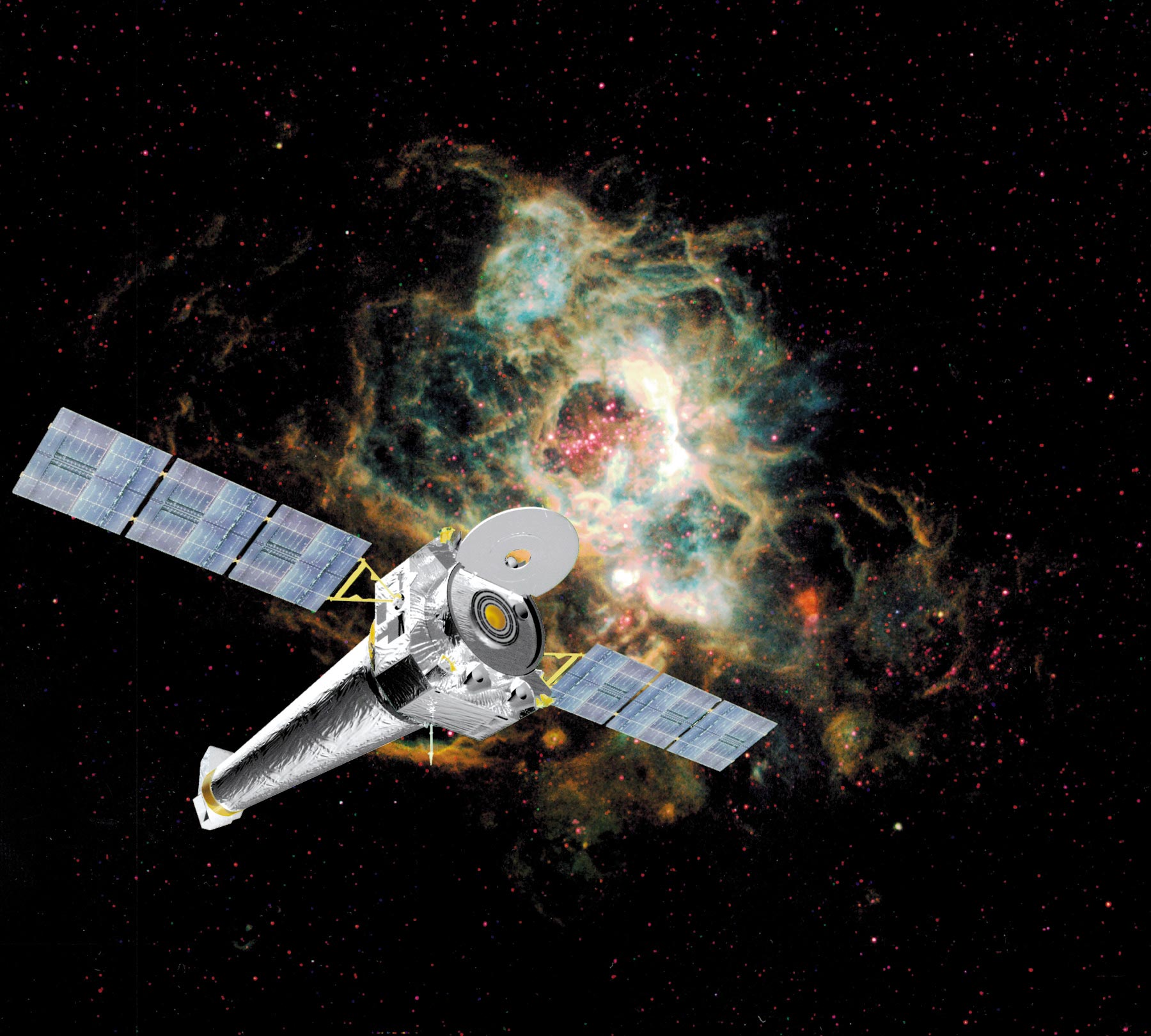
    Chandra Spacecraft in Orbit
    An artist’s illustration of the Chandra spacecraft in orbit. Credit: MSFC

    Chandra X-ray data from 15 early quasars show no major evolutionary trends over 150 million years. One rare quasar, J1606+3124, shows unusually dense gas, hinting at complex early galactic environments.

    Quasars are perhaps the best-known kinds of active galactic nuclei (AGN), galaxies whose central supermassive black holes are luminous, sometimes brighter than the rest of the galaxy. In an AGN, material accretes onto a surrounding torus of gas and dust, heating it to thousands of degrees and prompting the ejection of jets of charged particles.

    In the case of quasars, our viewing angle is such that these dusty tori do not obscure the light and the bright core of a quasar dominates the galaxy’s emission. The most distant known quasar dates from the era only about 700 million years after the Big Bang, with dozens more known dating from the first few billion years.

    The Mystery of Early Supermassive Black Holes

    One outstanding puzzle is how the supermassive black holes in these young quasars could have formed in the short time available since the universe existed. The very hot material and the fast-moving particles produce X-ray emission, especially from the inner region of the accretion. Although X-ray emission is difficult to detect from such distant objects, CfA astronomers Bradford Snios, Aneta Siemiginowska, Malgosia Sobolewska, Vinay Kashyap, and Dan Schwarz led a team that has obtained X-ray spectra from fifteen quasars that date from roughly a billion years after the Big Bang and that individually span a period of about one hundred and fifty million years.
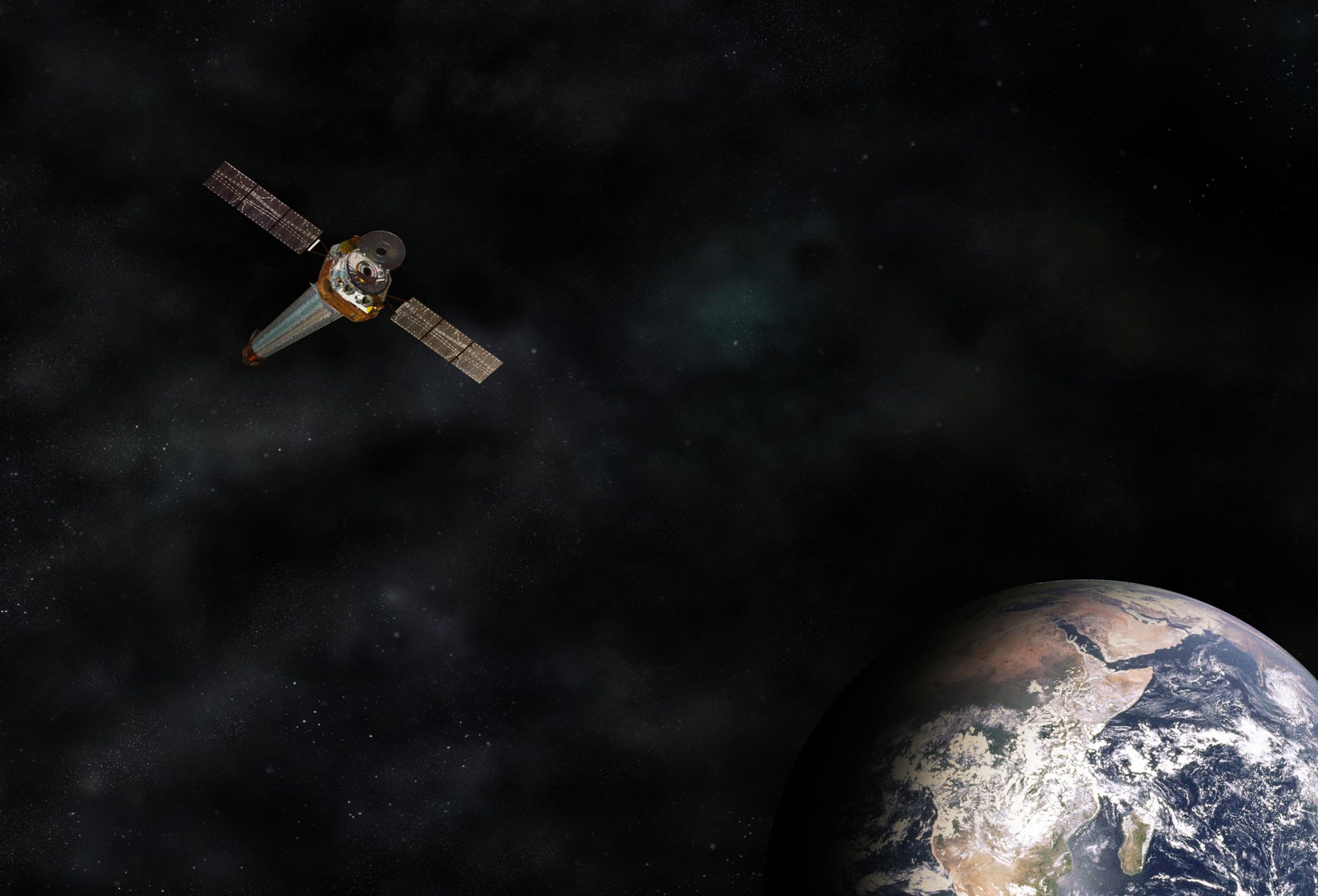
    Chandra X-ray Observatory in Earth Orbit
    The Chandra X-ray Observatory in Earth orbit. Astronomers have used Chandra to study the X-ray emission from fifteen quasars dating from an era only about one billion years after the Big Bang, in an effort to understand how the supermassive black holes in this early epoch evolved. Credit: NASA/CXC/D.Berry & M.Weiss

    The astronomers used the Chandra X-ray Observatory to look at targets selected from a catalog of quasars whose characters and distances were already known from their radio emission and optical emission. In particular, the team selected quasars whose radio emission appears (based on its spectral shape) to arise from a small volume within the galaxy.

    The astronomers analyzed the X-ray emission from these quasars with other data to infer how these objects and their emission may have evolved in comparison with quasars in the nearby universe. The most significant conclusion from this ongoing work is that there does not appear to be any clear evolutionary trends during this era. They also identified several outlier quasars, one of them named J1606+3124 with an extremely high gas density along the line-of-sight, only the fourth known quasar in the early universe known to have as much dense material.

    Reference: “X-ray Properties of Young Radio Quasars at z > 4.5” by Bradford Snios, Aneta Siemiginowska, Małgosia Sobolewska, C. C. Cheung, Vinay Kashyap, Giulia Migliori, Daniel A. Schwartz, Łukasz Stawarz and Diana M. Worrall, 20 August 2020, The Astrophysical Journal.
    DOI: 10.3847/1538-4357/aba2ca
    arXiv: 2007.01342

    Never miss a breakthrough: Join the SciTechDaily newsletter.
    Follow us on Google and Google News.

    Astronomy Astrophysics Harvard-Smithsonian Center for Astrophysics Quasars
    Share. Facebook Twitter Pinterest LinkedIn Email Reddit

    Related Articles

    Massive X-ray Jet – Extending for 160,000 Light-Years – Spied From Supermassive Black Hole in Early Universe

    Astronomers Detect Time Delays between Flaring Events in a Quasar

    NuSTAR Reveals the Active Galactic Nucleus of a Quasar

    Astronomers Record Detailed Measurements of the Inner Region of a Quasar Nucleus

    Study Challenges Prevailing Ideas About How Supermassive Black Holes Grow

    Calculations Show the Ideal Time to Study the Cosmos

    Using Infrared Images from Hubble & Spitzer, Scientists Discover 25 Distant Galaxies

    Supernova Shock Wave Breaks Through a Cocoon of Gas

    Origins of Type Ia Supernovae

    Leave A Reply Cancel Reply

    • Facebook
    • Twitter
    • Pinterest
    • YouTube

    Don't Miss a Discovery

    Subscribe for the Latest in Science & Tech!

    Trending News

    This Copper Drug Clears Alzheimer’s Brain Toxins and Boosts Memory

    Adults Over 65 Lost Massive Amounts of Weight With Ozempic

    How Flocking Birds “Defy” One of Physics’ Most Fundamental Laws

    Physicists Create a New Kind of Schrödinger’s Cat State From Exotic Quantum Building Blocks

    Your Diet Could Be Missing the Key Ingredient for Heart Protection

    Researchers Warn Widely Prescribed Blood Pressure Drugs Could Be Harming Diabetic Kidneys

    James Webb Spots Something Strange Between Day and Night on an Alien Planet

    How Ancient People Moved a 6-Ton Stone 700 Kilometers to Stonehenge

    Follow SciTechDaily
    • Facebook
    • Twitter
    • YouTube
    • Pinterest
    • Newsletter
    • RSS
    SciTech News
    • Biology News
    • Chemistry News
    • Earth News
    • Health News
    • Physics News
    • Science News
    • Space News
    • Technology News
    Recent Posts
    • Scientists Uncover Cause of Inflammatory Bowel Disease Solving Decades-Old Mystery
    • The Surprising Reason Swimming Could Be Better for Your Heart Than Running
    • Could Vitamin C Be the Secret to Keeping Your Brain Younger?
    • The Surprising Fix for Robot Traffic Jams
    • Near Absolute Zero, This Transistor Starts Acting Like a Brain Cell
    Copyright © 1998 - 2026 SciTechDaily. All Rights Reserved.
    • Science News
    • About
    • Contact
    • Editorial Board
    • Privacy Policy
    • Terms of Use

    Type above and press Enter to search. Press Esc to cancel.