
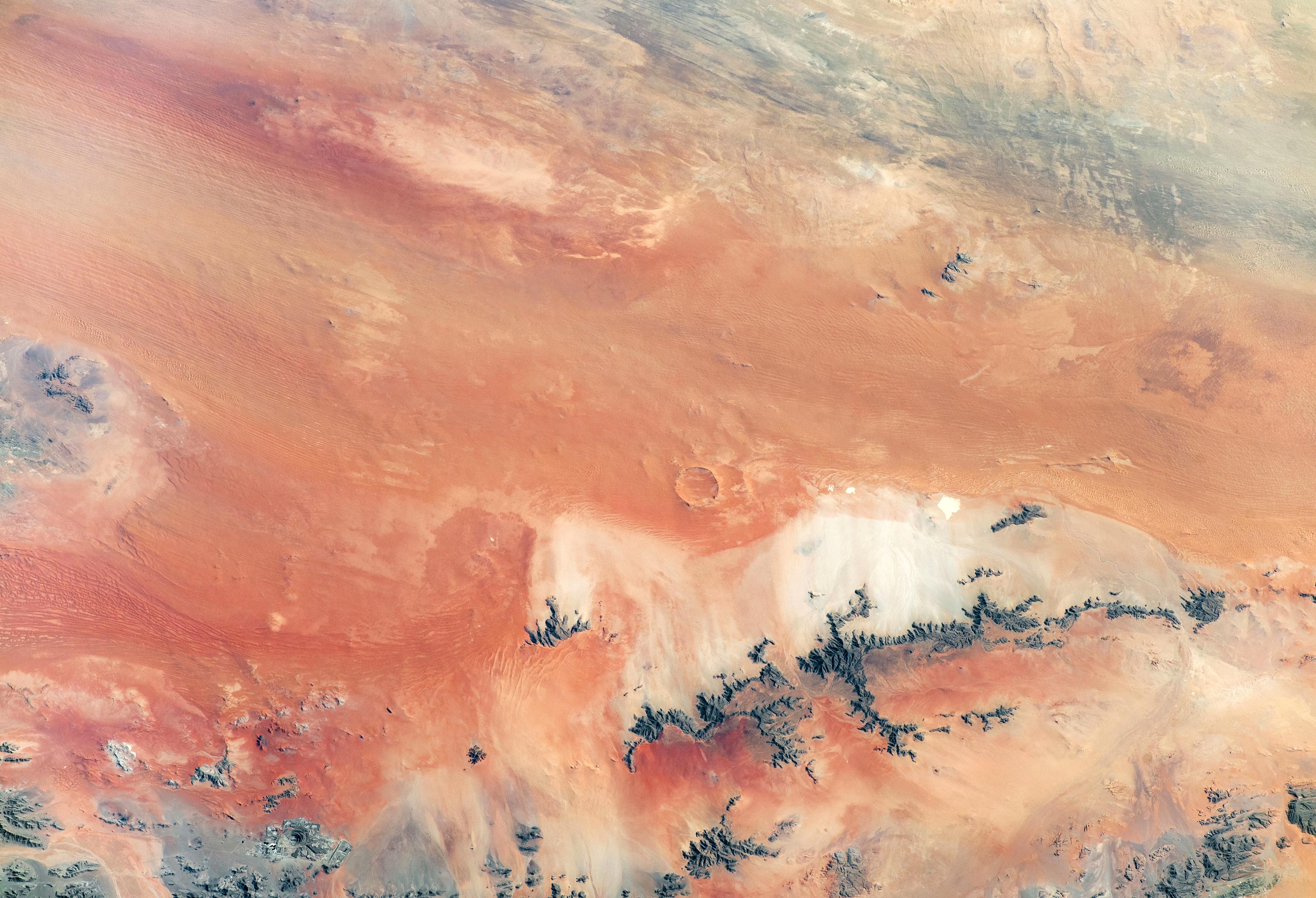
Roter Kamm Crater Reveals Earth’s Scarred Past in a Stunning Astronaut Photo
In the vastness of one of the world’s oldest deserts lies a relatively recent geologic feature: the Roter Kamm crater (“Red Comb” in German). An astronaut onboard the International Space Station photographed the crater while orbiting over the Namib Desert. It is approximately 130 meters (430 feet) deep and 2.5 kilometers (1.5 miles) in diameter.
Geologists estimate that a meteorite the size of a large motor vehicle soared across the sky and crashed into the sea of red sand dunes approximately 5 million years ago. It created an impact crater that has since been filled with orange and red sand carried in by winds.
Across millions and billions of years, many meteoroids, comets, and asteroids have passed through Earth’s atmosphere and left scars on the planet in the form of impact craters. More than 100 tons of material from near-Earth objects—particles and rock fragments from asteroids and comets ranging from dust-sized to 1 meter in diameter—bombard the Earth daily. Sometimes they visibly disintegrate as meteors or “shooting stars” in the mesosphere before reaching the ground.
A meteoroid capable of causing significant damage to Earth’s surface occurs far less often: about once every 2000 years. Impactors large enough to cause extinction-level events on Earth—such as the Cretaceous-Tertiary (KT) boundary mass extinction—reach the surface at the rate of once every few million years.
Astronaut photograph ISS062-E-103112 was acquired on March 20, 2020, with a Nikon D5 digital camera using a 200 millimeter lens and is provided by the ISS Crew Earth Observations Facility and the Earth Science and Remote Sensing Unit, Johnson Space Center. The image was taken by a member of the Expedition 62 crew. The image has been cropped and enhanced to improve contrast, and lens artifacts have been removed. The International Space Station Program supports the laboratory as part of the ISS National Lab to help astronauts take pictures of Earth that will be of the greatest value to scientists and the public, and to make those images freely available on the Internet. Additional images taken by astronauts and cosmonauts can be viewed at the NASA/JSC Gateway to Astronaut Photography of Earth. Caption by Amber Turner, Jacobs/JETS Contract at NASA-JSC.
Never miss a breakthrough: Join the SciTechDaily newsletter.
Follow us on Google and Google News.
5 Comments
Where are all of the Lunar meteorites? The earth should be covered with them. The Moon too should have thousands of earth meteorites. Maybe even frozen biological samples from earths past. We should be looking for those. Where are they. Why isn’t science talking about their absence?
Assume 1 ton is a measure of mass identified as 2000kg. The arrival of 100tons or 200 000kg per day arriving on Earth for the last 1 billion years comes to 2×10>5x365x10>9=7.3×10>16kg.The Earth’s mass is 10.68×10.24kg.So 2/3 of the Earth’s mass has been added since 1 billion years ago. This would no doubt have changed the acceleration due to gravity….and certainly would have given rise to an expanding Earth. Alternately, we have wasted a great deal of energy in not harnessing meteorite impact to run electrical generating utilities………..Or……..?
I’m glad this came up; becasue if the Earth’s mass in steadily increasing, doesn’t that change the relationships between the Sun and the Earth, and the Earth and the Moon? I would think we’d snuggle closer to eachother, and the weather would change accordingly.
A remark on Hob’s comment: 1Ton equals 1000kg not 2000kg, maybe you need to re-calculate all your numbers: 1 kg= 2.204 lbs, 1000kg= 2204lbs(2.204klbs), just so you can make correct comments…
Would these meteorites seasoning the earth have some record of their coming within the sediments studied across Pangea to present? Granted, landmass but a third of the earth’s surface, and much of it under ice or mountainous, but still, one-third of the earth mass in a billion years is one sixth of the earth mass since Pre-Cambrian. Pretty indestructible seasoning of meteorites should have left some noticed remnants throughout the known and studied sediments. I have not seen any evidence of their arrivals in the fifty years spent studying rocks. Maybe they only showered the polar regions?