
Close Menu
    Facebook X (Twitter) Instagram
    SciTechDaily
    • Biology
    • Chemistry
    • Earth
    • Health
    • Physics
    • Science
    • Space
    • Technology
    Facebook X (Twitter) Pinterest YouTube RSS
    SciTechDaily
    Home»Space»Several Oceans’ Worth of Ancient Water May Reside in Minerals Buried Below Mars’ Surface
    Space

    Several Oceans’ Worth of Ancient Water May Reside in Minerals Buried Below Mars’ Surface

    By American Association for the Advancement of ScienceMay 16, 2021No Comments3 Mins Read
    Facebook Twitter Pinterest Telegram LinkedIn WhatsApp Email Reddit
    Share
    Facebook Twitter LinkedIn Pinterest Telegram Email Reddit
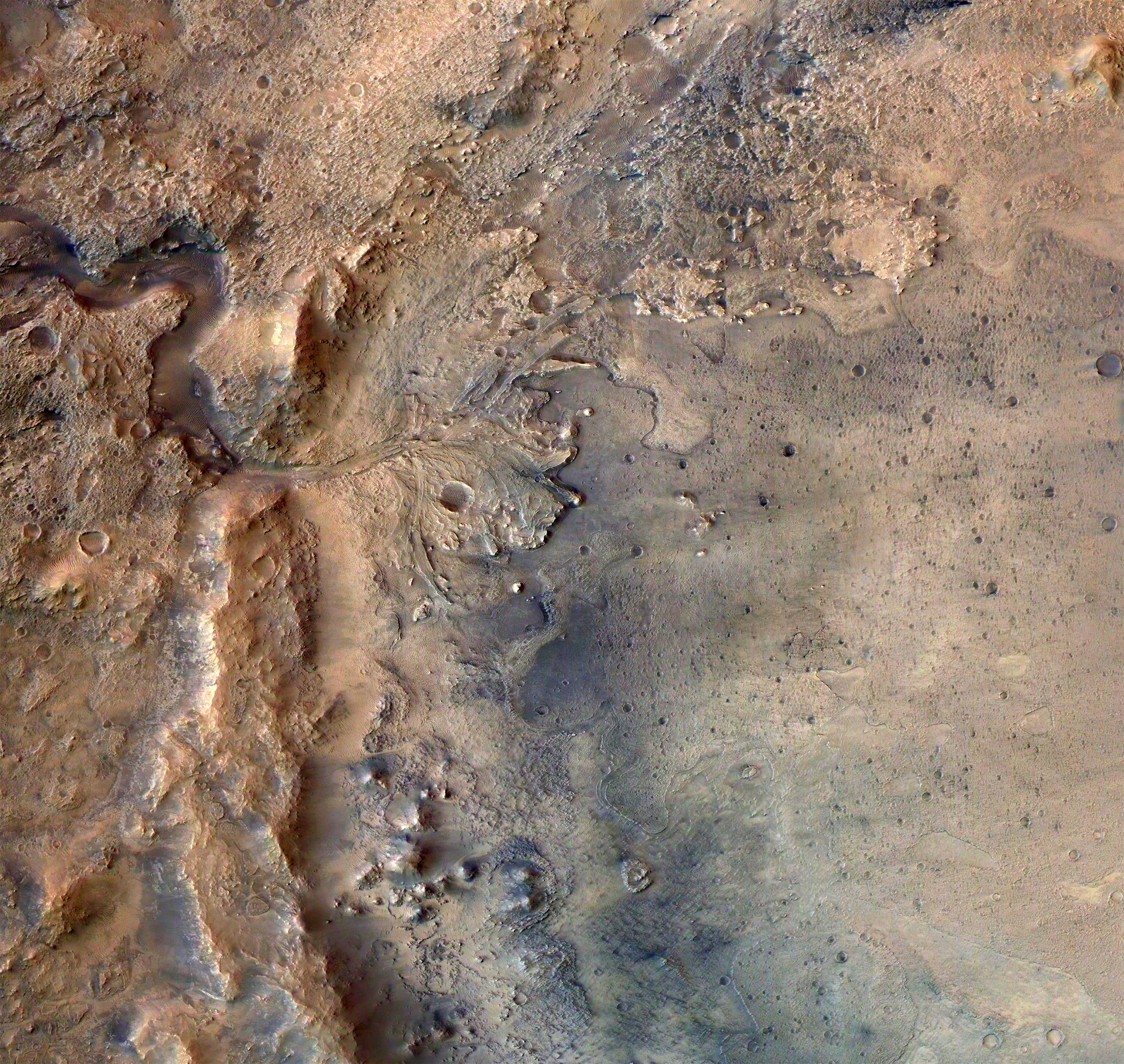
    Jezero Crater Mars Express Orbiter
    This image shows the remains of an ancient delta in Mars’ Jezero Crater, as seen by the High Resolution Stereo Camera aboard the ESA (European Space Agency) Mars Express orbiter. Credit: ESA/FU-Berlin

    Much of Mars’ ancient water was buried in the planet’s crust, not lost to space.

    Several oceans’ worth of ancient water may reside in minerals buried below Mars’ surface, report researchers. The new study, based on observational data and modeling, shows that much of the red planet’s initial water — up to 99% — was lost to irreversible crustal hydration, not escape to space.

    The findings help resolve the apparent contradictions between predicted atmospheric loss rates, the deuterium to hydrogen ratio (D/H) of present-day Mars, and the geological estimates of how much water once covered the Martian surface.

    Ancient Mars was a wet planet — dry riverbeds and relic shorelines record a time when vast volumes of liquid water flowed across the surface. Today, very little of that water remains, mostly frozen in the planet’s ice caps. Previous studies have assumed that the lost water escaped to space over several billion years, an assertion supported by the currently observed atmospheric D/H ratio. However, measurements of the current rate of atmospheric water loss are too low for atmospheric escape alone to explain all Martian water loss.

    A New Model for Mars’ Water Budget

    Eva Scheller and colleagues show how large volumes of water could have instead become incorporated into minerals that were buried in the planet’s crust. Using observational constraints from orbiting spacecraft, rovers, and Martian meteorites, Scheller et al. developed a water budget and D/H model that considers atmospheric escape, volcanic degassing, and crustal hydration through chemical weathering. By simulating Martian water loss through geological time and for a range of plausible conditions, the authors discovered that Mars had lost most of its water — between 40-95% — over the Noachian period (~4.1 – 3.7 billion years ago).

    The results suggest that between 30 and 99% of Mars’ initial water was incorporated into minerals and buried in the planet’s crust, with subsequent escape to space of the remainder accounting for the currently observed D/H ratio.

    For more on this discovery:

    • New Science Indicates Mars’ Water Didn’t Escape to Space – It’s Trapped in the Red Planet’s Crust
    • Up to 99% of Mars’ Water May Still Be Trapped in Planet’s Crust

    Reference: “Long-term drying of Mars by sequestration of ocean-scale volumes of water in the crust” by E. L. Scheller, B. L. Ehlmann, Renyu Hu, D. J. Adams and Y. L. Yung, 16 March 2021, Science.
    DOI: 10.1126/science.abc7717

    Never miss a breakthrough: Join the SciTechDaily newsletter.
    Follow us on Google and Google News.

    American Association for the Advancement of Science Mars Planets Water
    Share. Facebook Twitter Pinterest LinkedIn Email Reddit

    Related Articles

    Mars’ Gullies: How Axial Tilt and Ice Sculpted the Martian Landscape

    Planetary Scientists Discover That Water Was Once Present in Arabia Terra on Mars

    Scientists Use Seasonal Variations To Find Water for Future Mars Astronauts

    Interior of Mars Revealed by NASA InSight Lander’s Seismic Observations

    Up to 99% of Mars’ Water May Still Be Trapped in Planet’s Crust – Not Lost to Space As Long Theorized

    New Science Indicates Mars’ Water Didn’t Escape to Space – It’s Trapped in the Red Planet’s Crust

    New Research Shows Water on Mars Not As Widespread as Previously Thought

    Escape From Mars: Surprising Discovery in the Red Planet’s Atmosphere Helps Explain Martian Mystery

    Water on Ancient Mars: Analysis of a Martian Meteorite Reveals Evidence of Water 4.4 Billion Years Ago

    Leave A Reply Cancel Reply

    • Facebook
    • Twitter
    • Pinterest
    • YouTube

    Don't Miss a Discovery

    Subscribe for the Latest in Science & Tech!

    Trending News

    The Universe Is Expanding Too Fast and Scientists Can’t Explain Why

    “Like Liquid Metal”: Scientists Create Strange Shape-Shifting Material

    Early Warning Signals of Esophageal Cancer May Be Hiding in Plain Sight

    Common Blood Pressure Drug Shows Surprising Power Against Deadly Antibiotic-Resistant Superbug

    Scientists Uncover Dangerous Connection Between Serotonin and Heart Valve Disease

    Scientists Discover a “Protector” Protein That Could Help Reverse Hair Loss

    Bone-Strengthening Discovery Could Reverse Osteoporosis

    Scientists Uncover Hidden Trigger Behind Stem Cell Aging

    Follow SciTechDaily
    • Facebook
    • Twitter
    • YouTube
    • Pinterest
    • Newsletter
    • RSS
    SciTech News
    • Biology News
    • Chemistry News
    • Earth News
    • Health News
    • Physics News
    • Science News
    • Space News
    • Technology News
    Recent Posts
    • A Common Diabetes Drug May Hold the Key to Stopping HIV From Coming Back
    • Ancient “Syphilis-Like” Disease in Vietnam Challenges Key Scientific Assumptions
    • Drinking Alcohol To Cope in Your 20s Could Damage Your Brain for Life
    • Scientists Crack Alfalfa’s Chromosome Mystery After Decades of Debate
    • Ancient Ant-Plant Alliance Collapses As Predatory Wasps Move In
    Copyright © 1998 - 2026 SciTechDaily. All Rights Reserved.
    • Science News
    • About
    • Contact
    • Editorial Board
    • Privacy Policy
    • Terms of Use

    Type above and press Enter to search. Press Esc to cancel.