
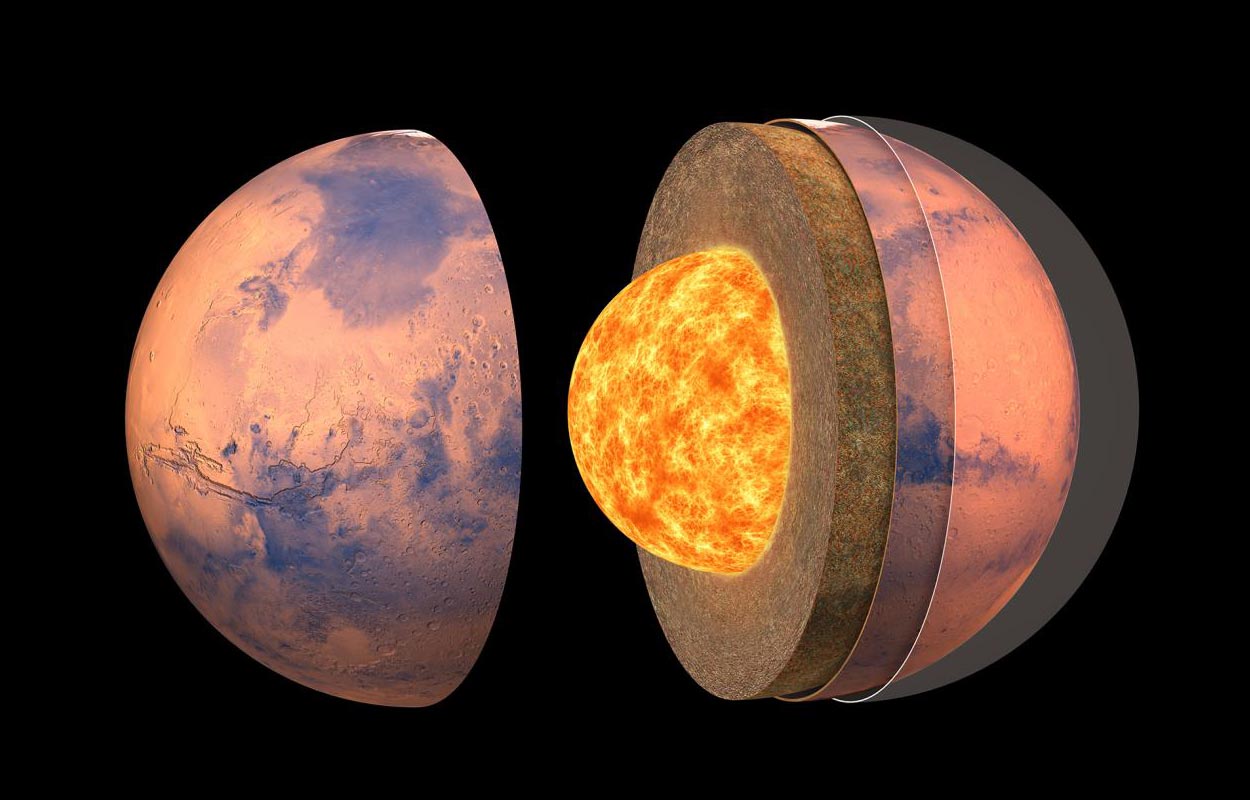
NASA’s InSight mission has revealed Mars’ interior structure, including a layered crust, a thick lithosphere, and a surprisingly large, liquid metal core, reshaping our understanding of the planet.
The first direct seismic observations from NASA’s InSight lander, presented in three studies in this issue, provide clues to the composition of Mars. Researchers across these studies report preliminary findings from the Insight mission and begin to map — for the first time — the interior of a planet apart from Earth.
“These three studies provide important constraints on the present-day structure of Mars and are also key for improving our understanding of how the planet formed billions of years ago and evolved through time,” write Sanne Cottaar and Paula Koelemeijer in a related Perspective.
Studying a planet’s interior layers — its crust, mantle and core — can reveal key insights into its formation and evolution, as well as uncovering any geomagnetic and tectonic activity it hosts. Such deep interior regions can be probed by measuring the waves that travel through the planet’s body following seismic events like a quake. Such methods have been instrumental in surveying the internal characteristics of Earth.
Marsquakes Reveal Crust Structure
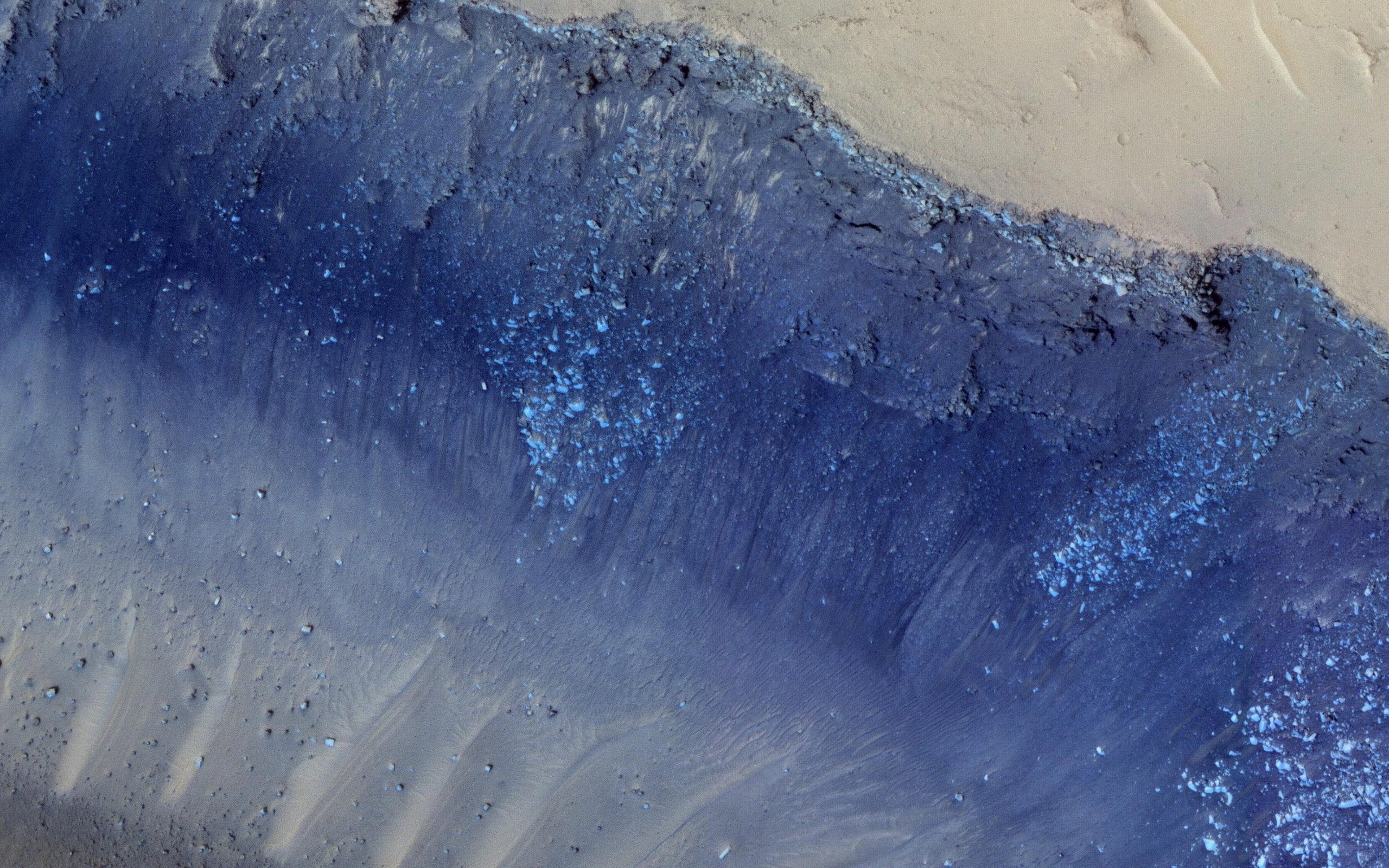
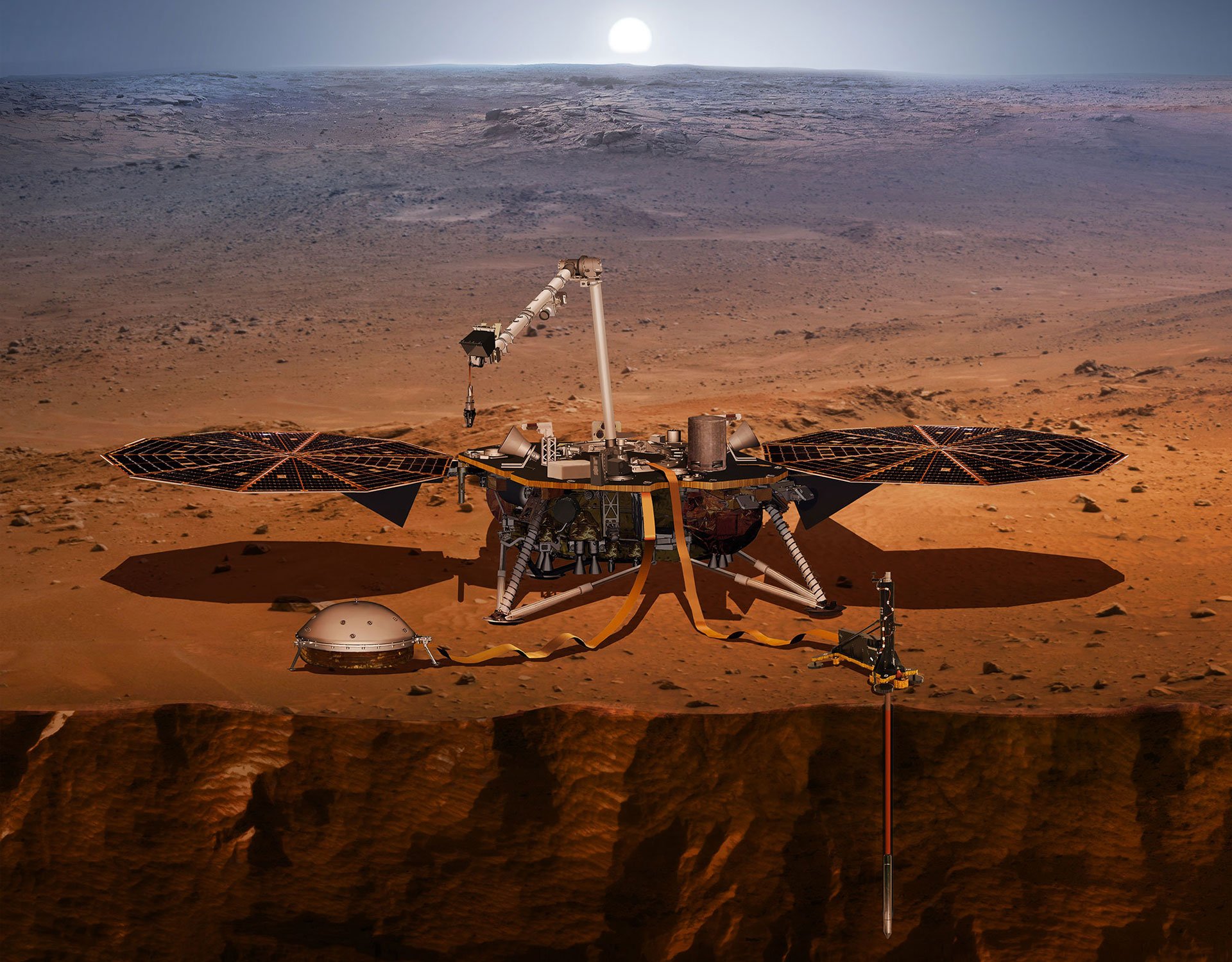
In early 2019, NASA’s Martian lander InSight (Interior Exploration using Seismic Investigations, Geodesy, and Heat Transport) began to detect and record marsquakes from its position on the surface of Mars, including several subcrustal quakes that resemble tectonic events on Earth. Brigitte Knapmeyer-Endrun and colleagues used marsquakes and ambient seismic noise to image the structure of the Martian crust below the InSight landing site, finding evidence for a multi-layered crust with either two or three interfaces. Extrapolating this data to the entire planet, Knapmeyer-Endrun et al. show how the average thickness of Mars’ crust lies between 24 and 72 kilometers (15 and 45 miles).
Amir Khan et al. used direct and surface reflected seismic waves from eight low-frequency marsquakes to probe deeper and reveal the structure of Mars’ mantle to a depth of nearly 800 km (500 mi). Their findings suggest that a thick lithosphere lies close to 500 km(310 mi) below the surface and, like the Earth, likely has a low-velocity layer beneath it. According to Khan et al., Mars’ crustal layer is likely highly enriched in heat-producing radioactive elements, which heats this region at the expense of the planet’s interior.
Mars’ Large Liquid Metal Core
Deeper still, Simon Stähler and colleagues used the faint seismic signals reflected off the Martian core-mantle boundary to investigate the Martian core. They found that Mars’ relatively large liquid metal core has a radius of nearly 1,830 kilometers (1,140 miles) and begins roughly halfway between the surface and the center of the planet, suggesting that the planet’s mantle consists of only one rocky layer, rather than two, like in Earth. According to Stähler et al., the findings indicate that the iron-nickel core is less dense than previously thought and enriched in lighter elements.
“Direct seismic observations on Mars represent a major leap forward in planetary seismology,” write Cottaar and Koelemeijer. “Over the coming years, as more marsquakes are measured, scientists will refine these models of the red planet and reveal more of Mars’ enigmatic mysteries.”
For more on this research:
- NASA’s InSight Mission Reveals the Detailed Internal Structure of Mars
- Scientists Analyze Marsquakes To Determine the Structure of Mars’ Crust
References:
“Upper mantle structure of Mars from InSight seismic data” by Amir Khan, Savas Ceylan, Martin van Driel, Domenico Giardini, Philippe Lognonné, Henri Samuel, Nicholas C. Schmerr, Simon C. Stähler, Andrea C. Duran, Quancheng Huang, Doyeon Kim, Adrien Broquet, Constantinos Charalambous, John F. Clinton, Paul M. Davis, Mélanie Drilleau, Foivos Karakostas, Vedran Lekic, Scott M. McLennan, Ross R. Maguire, Chloé Michaut, Mark P. Panning, William T. Pike, Baptiste Pinot, Matthieu Plasman, John-Robert Scholz, Rudolf Widmer-Schnidrig, Tilman Spohn, Suzanne E. Smrekar and William B. Banerdt, 23 July 2021, Science.
DOI: 10.1126/science.abf2966
“Seismic detection of the martian core” by Simon C. Stähler, Amir Khan, W. Bruce Banerdt, Philippe Lognonné, Domenico Giardini, Savas Ceylan, Mélanie Drilleau, A. Cecilia Duran, Raphaël F. Garcia, Quancheng Huang, Doyeon Kim, Vedran Lekic, Henri Samuel, Martin Schimmel, Nicholas Schmerr, David Sollberger, Éléonore Stutzmann, Zongbo Xu, Daniele Antonangeli, Constantinos Charalambous, Paul M. Davis, Jessica C. E. Irving, Taichi Kawamura, Martin Knapmeyer, Ross Maguire, Angela G. Marusiak, Mark P. Panning, Clément Perrin, Ana-Catalina Plesa, Attilio Rivoldini, Cédric Schmelzbach, Géraldine Zenhäusern, Éric Beucler, John Clinton, Nikolaj Dahmen, Martin van Driel, Tamara Gudkova, Anna Horleston, W. Thomas Pike, Matthieu Plasman and Suzanne E. Smrekar, 23 July 2021, Science.
DOI: 10.1126/science.abi7730
“Thickness and structure of the martian crust from InSight seismic data” by Brigitte Knapmeyer-Endrun, Mark P. Panning, Felix Bissig, Rakshit Joshi, Amir Khan, Doyeon Kim, Vedran Lekic, Benoit Tauzin, Saikiran Tharimena, Matthieu Plasman, Nicolas Compaire, Raphael F. Garcia, Ludovic Margerin, Martin Schimmel, Éléonore Stutzmann, Nicholas Schmerr, Ebru Bozdag, Ana-Catalina Plesa, Mark A. Wieczorek, Adrien Broquet, Daniele Antonangeli, Scott M. McLennan, Henri Samuel, Chloé Michaut, Lu Pan, Suzanne E. Smrekar, Catherine L. Johnson, Nienke Brinkman, Anna Mittelholz, Attilio Rivoldini, Paul M. Davis, Philippe Lognonné, Baptiste Pinot, John-Robert Scholz, Simon Stähler, Martin Knapmeyer, Martin van Driel, Domenico Giardini and W. Bruce Banerdt, 23 July 2021, Science.
DOI: 10.1126/science.abf8966
Never miss a breakthrough: Join the SciTechDaily newsletter.
Follow us on Google and Google News.
2 Comments
I knew the title was BS. All I read was “probably, maybe and should. All terms that indicate unknowns. So, your title does not match your article. You get a f*@king F. Stop with the crap headlines you losers. No one will come back here and you will all lose your jobs. Hows that for maybes.
The real reason for exploreing mars? It’s about money how much gold silver and any other rare ores they may find that will start our next big war