
What Are Nuclear Fusion Reactions?
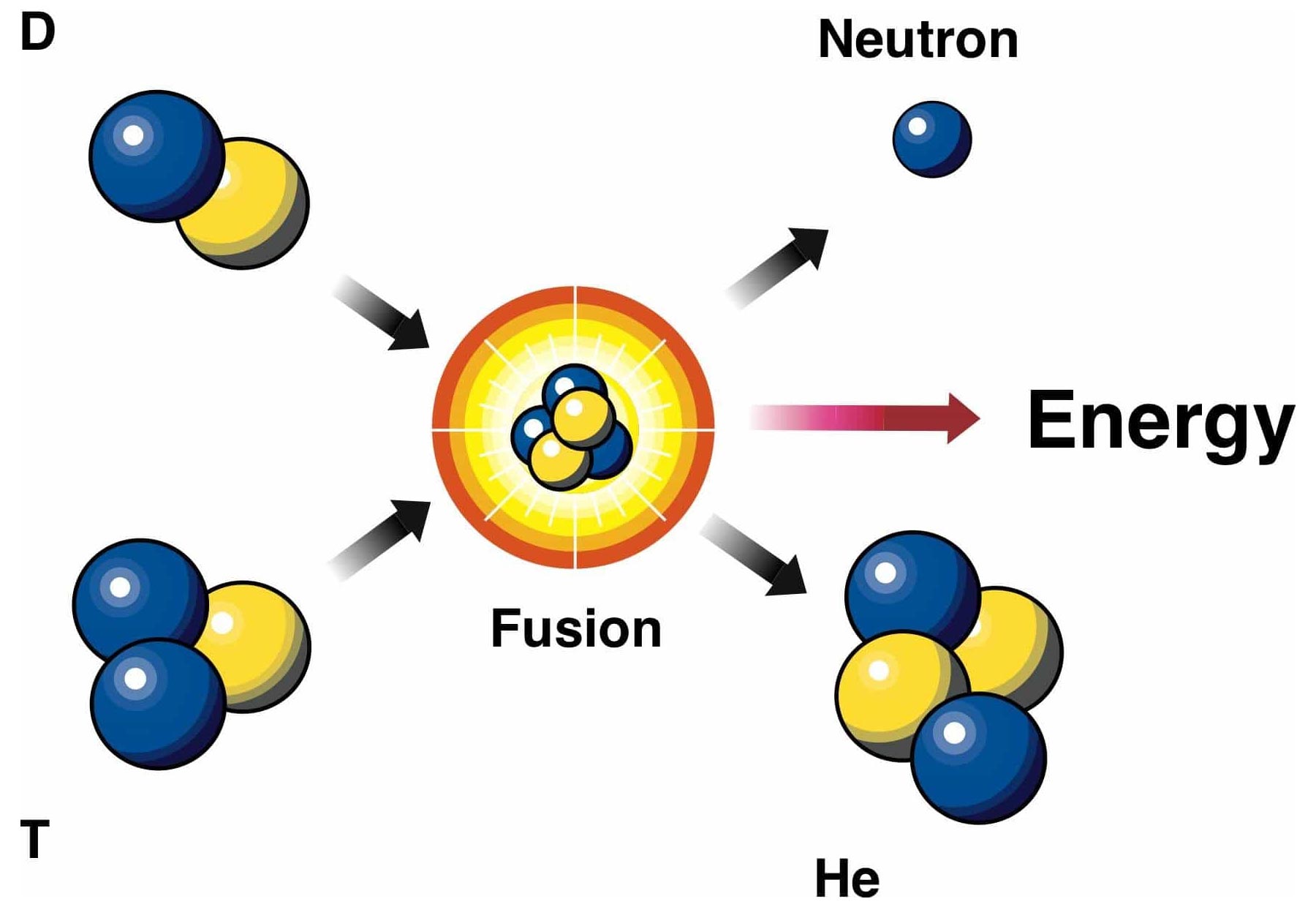
Nuclear Fusion reactions power the Sun and other stars. In a fusion reaction, two light nuclei merge to form a single heavier nucleus. The process releases energy because the total mass of the resulting single nucleus is less than the mass of the two original nuclei. The leftover mass becomes energy. Einstein’s equation (E=mc2), which says in part that mass and energy can be converted into each other, explains why this process occurs. If scientists develop a way to harness energy from fusion in machines on Earth, it could be an important method of energy production.
Fusion can involve many different elements in the periodic table. However, researchers working on fusion energy applications are especially interested in the deuterium-tritium (DT) fusion reaction. DT fusion produces a neutron and a helium nucleus. In the process, it also releases much more energy than most fusion reactions. In a potential future fusion power plant such as a tokamak or stellarator, neutrons from DT reactions would generate power for our use. Researchers focus on DT reactions both because they produce large amounts of energy and they occur at lower temperatures than other elements.
Fusion Reaction Facts
- The ITER international fusion energy experiment will be scientists’ first attempt at creating a self-sustained fusion reaction for long durations. “Burning plasmas” in ITER will be heated by the fusion reactions occurring in the plasma itself.
- Fusion reaction experiments at the DOE’s National Ignition Facility at the Lawrence Livermore National Laboratory require 192 laser beams to align on a DT target smaller than a pea. This is like throwing a perfect strike in baseball from a pitcher’s mound 350 miles away from the plate.
DOE Office of Science & Fusion Reactions
The Department of Energy Office of Science, Fusion Energy Sciences (FES) program seeks to develop a practical fusion energy source. To do so, FES partners with other Office of Science programs. They work with the Advanced Scientific Computing Research program to use scientific computing to advance fusion science as well as the Nuclear Physics program on nuclear reaction databases, generation of nuclear isotopes, and research in nucleosynthesis. FES also partners with the DOE’s National Nuclear Security Administration to pursue fundamental research on fusion reactions in support of DOE’s nuclear stockpile stewardship mission.
Acknowledgments
Matthew Lanctot (U.S. DOE Office of Science)
Never miss a breakthrough: Join the SciTechDaily newsletter.
Follow us on Google and Google News.
2 Comments
All larger stars (mass > few SOLs) are powered by the CNO cycle about 10,000 times more efficiennt than the slow process of PP that mostly powers the Sun and small stars. CNO also shortens the life of the star to millions of years instead of billions.
Pure speculation but I can’t help but wonder if LLNL could fire up their laser beams and proton beams at a diamond anvil made of pure carbon, would there be any detectable CNO energy release when every 4 protons could be turned into a helium atom. If it succeded, it would probably destroy the diamond anvil. So 2 of those protons need to positive beta decay to a neutron giving lots of tell tale signs and energy.
The Wikipedia article on stellar fusion is quite readable, it shows a dozen fusion equations possible.
Fission with Molten Salt Reactors are several orders more practical though. It’s interesting to see fusion programs taking an interest in using Molten Salt as a coolant loop and neutron shield though. The only remaining difference then is a simple fuel rod containing say Flibe salts and fission fuel vs the ever so complex plasma device both of which would be surrounded by salt coolant systems and similar electrical generation systems.
Did You mean 345 megawatt sodium-cooled fast reactor with molten salt-based energy storage which is going to deploy in Wyoming? It resembles SMR, multiple modules reactors and nuclear reactors designed for submarines. SMR designs may employ light water as a coolant or other non-light water coolants such as a gas, liquid metal, or molten salt. SMRs designed to burn plutonium can help the world get rid of weapon-grade plutonium, and those with breeding ability can sustain nuclear fuel production indefinitely. Do you believe that they have passive system of safety?