

Twenty-seven asteroids have been named in honor of African American, Hispanic, and Native American astronauts, and one cosmonaut, who have helped expand our horizons beyond Earth and to inspire the next generation of space explorers.
Among the 27 people who inspired these new asteroid names are Stephanie D. Wilson, Joan Higginbotham, and Ed Dwight Jr., a captain in the U.S. Air Force who became the first African American astronaut trainee in 1961. José Hernández, who developed the first full-field digital mammography imaging system, also inspired an asteroid name.
The full list of astronauts and their namesake asteroids was released on February 23 by the Minor Planet Center, an organization affiliated with the International Astronomical Union (IAU), that’s responsible for the identification, designation and orbit computation for minor planets and other objects. Up until now, these asteroids had provisional names indicating their time of discovery. All 27 are located in the asteroid belt between Mars and Jupiter.
(103738) Stephaniewilson and (103739) Higginbotham were named after women who have made significant contributions to space exploration. On top of distinguished engineering careers, both were selected in 1996 to join NASA’s Astronaut Group 16, nicknamed “The Sardines” because of its large class size of 44 candidates.
As an electrical engineer at NASA’s Kennedy Space Center in Florida, Higginbotham worked on 53 space shuttle launches between 1996 and 2007. As an astronaut, she launched from Kennedy aboard the space shuttle Discovery to the International Space Station (ISS), where she served as a mission specialist on an assembly mission.
Wilson, an aerospace engineer, worked for several years at NASA’s Jet Propulsion Laboratory in Pasadena, California, as a member of the Attitude and Articulation Control Subsystem team for NASA’s Galileo spacecraft. After becoming an astronaut, she traveled to the space station three times, logging more than 42 days in space. Today, Wilson is on NASA’s Artemis Team of astronauts, one of whom will become the first woman to set foot on the Moon.
NASA astronaut Stephanie Wilson is a member of the Artemis Team, a select group of astronauts charged with focusing on the development and training efforts for early Artemis missions. Credit: NASA
Consecutively named asteroids were chosen for Wilson and Higginbotham in a nod to the fact they were selected as astronaut candidates in the same class.
Asteroid (92579) Dwight was named after Ed Dwight Jr., who was born in 1933 in Kansas City, Kansas. He recounts in a media interview being stunned by a newspaper article profiling a black pilot, a revelation of unimagined possibility. This set him on his own pursuit of flight. After making it to the rank of captain in the U.S. Air Force, he was recruited to be the first African American astronaut trainee. In the astronaut program, he encountered deeply entrenched racism, was eventually forced out, and resigned from the Air Force in 1966. Dwight chose a wildly different path after this major setback, returning to his early love of the arts by reinventing himself as a sculptor of African American history. He created more than a hundred memorials globally and many thousands of other artworks.
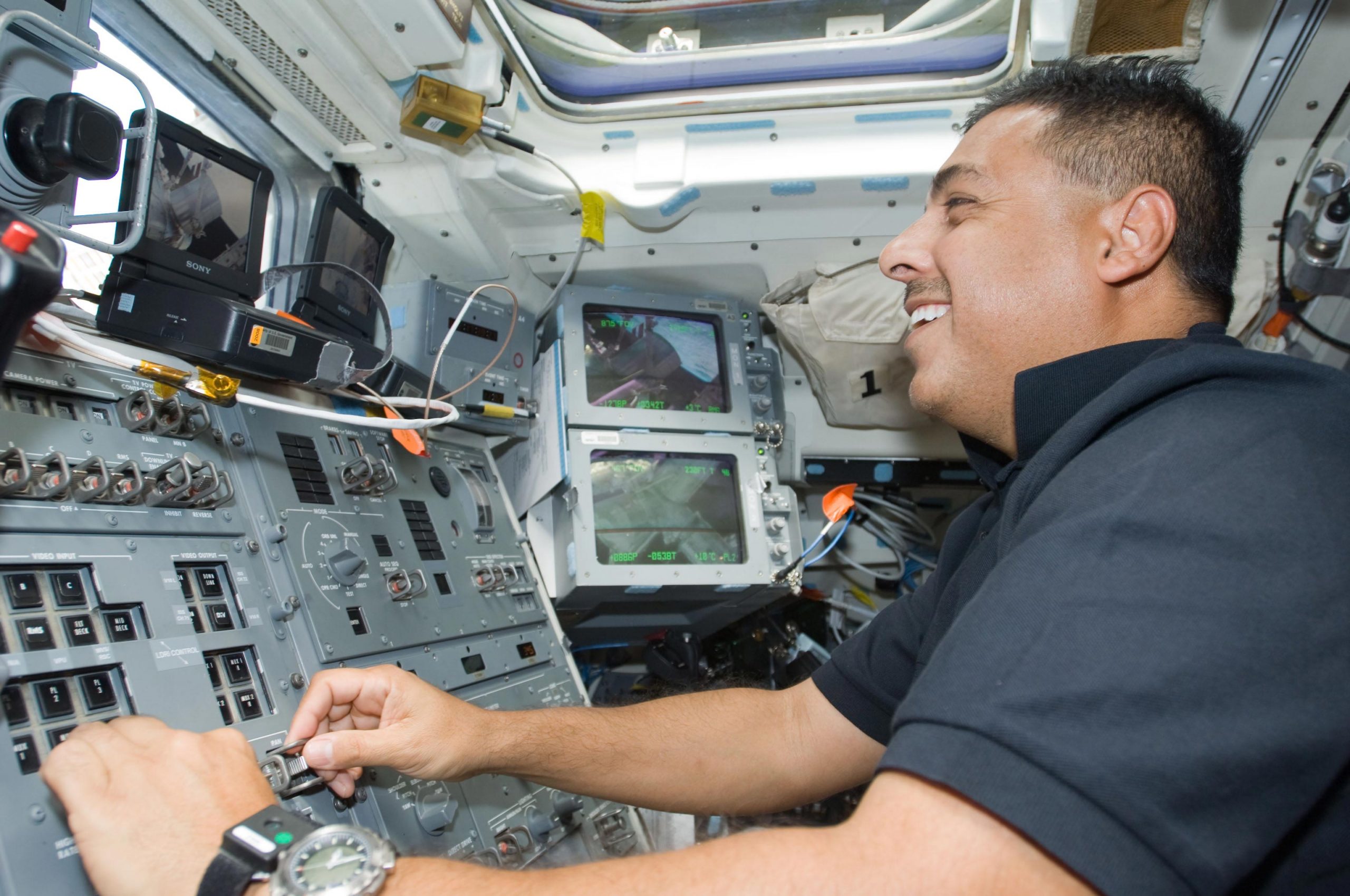
José Hernández, the astronaut behind asteroid (122554) Joséhernández, was born into a migrant farming family and spent his youth working in the fields. When he was in high school, Hernández was inspired by Franklin Chang-Díaz, a long-time astronaut who flew seven space shuttle missions from 1986 to 2002. Hernández went on to receive bachelor’s and master’s degrees in electrical engineering, worked on X-ray lasers, developed the first full-field digital mammography imaging system, and then became an astronaut. Hernández traveled on the space shuttle Discovery to the ISS in 2009 on a mission to deliver a Multi-Purpose Logistics Module. Now asteroids (122554) Joséhernández and (115015) Chang Díaz can inspire the next generation of space explorers.
“It’s an honor and a privilege to name these asteroids in recognition of fellow space explorers while also adding to the message of the power and value of diversity for all human endeavors,” said Marc W. Buie, an astronomer who discovered the 27 asteroids in the last couple of decades. Buie is a Boulder, Colorado-based astronomer at the Southwest Research Institute, which is headquartered in San Antonio, Texas.
Buie is also a co-investigator on NASA’s Lucy mission, which will launch atop the Atlas V 401 rocket from Cape Canaveral, Florida, on October 16, 2021. Its 12-year mission — the first of its kind — is to study seven Trojan asteroids that are among the two swarms of space rocks that circle the Sun, leading and following Jupiter in its orbit. Lucy will also fly by one main-belt asteroid.
The asteroid-naming proposal to the IAU, an organization that approves and certifies the names of astronomical objects and features, was a team effort by scientists and students involved with Lucy. It was led by Cathy Olkin, deputy principal investigator of the Lucy mission at Southwest Research Institute, and Keith S. Noll, a planetary astronomer at NASA’s Goddard Space Flight Center in Greenbelt, Maryland, who serves as Lucy project scientist.
“Last summer a group of us got together to honor a diverse group of astronauts who have traveled to space and the pioneers who paved the way for these explorers,” said Olkin. “But there are many more, and we hope to add their names to the sky in the future.”
Besides Olkin and Noll, the research and citation writing group included Katherine Kretke, Lucy communications lead; Carly Howett, Lucy instrument scientist; Donya Douglas-Bradshaw, Lucy project manager; Edward ‘Beau’ Bierhaus, Lucy scientist; Jake Olkin, graduate student at University of Michigan; and Zach Olkin, undergraduate student at Georgia Tech.
Here is the full list of newly named asteroids and the astronauts they honor:
(92579) Dwight
Edward (Ed) Joseph Dwight Jr. (b. 1933) was the first African American astronaut candidate. He served in the Air Force, working as test pilot before serving in the Aerospace Research Pilot School. After leaving the Air Force he went on to become an influential sculptor and author.
(92892) Robertlawrence
Robert H. Lawrence Jr. (1935-1967) was selected for the Manned Orbiting Laboratory (MOL) program. He was the first African American to be selected as an astronaut and was the only MOL astronaut with a doctorate. He perished in a plane crash before he had the opportunity to go to space.
(92894) Bluford
Guion Steward Bluford Jr. (b. 1942) was the first African American astronaut in space. He was a part of four space shuttle missions between 1983 and 1992, which included deploying satellites, testing robotic arms, and conducting research. Bluford logged a total of 688 hours in space.
(95449) Frederickgregory
Frederick Drew Gregory (b. 1941) is a retired astronaut who was the pilot on one space shuttle mission and commander on two other missions. In 1989, he was the first African American to command a space flight. He also served as deputy administrator of NASA.
(97508) Bolden
Charles Frank Bolden Jr. (b. 1946) is a former astronaut who flew on four space shuttle missions (two as the pilot and two as the commander). From 2009-2017, he was NASA’s administrator.
(97512) Jemison
Mae Carol Jemison (b. 1956) is a retired astronaut who flew on the space shuttle in 1992. There she conducted scientific experiments. She was the first African American woman to travel to space and the first African American woman admitted into the astronaut training program.
(103733) Bernardharris
Bernard Anthony Harris Jr. (b. 1956) is a former astronaut who flew on two space shuttle missions. In 1993, he was a mission specialist who carried out research as part of Spacelab D-2. As payload commander on the space shuttle Discovery in 1995, he became the first African American to conduct a spacewalk.
(103734) Winstonscott
Winston Elliott Scott (b. 1950) is a former astronaut who flew two missions to space. Scott completed three spacewalks to retrieve satellites and evaluate the assembly of the ISS. He also performed experiments on the effects of zero gravity on the human body.
(103737) Curbeam
Robert Lee Curbeam Jr. (b. 1962) is a retired astronaut and the first person to perform four spacewalks on a single mission. While in space, Curbeam helped fix a solar panel and install a new truss in the ISS. He spent more than 37 days in space and 45 hours on spacewalks.
(103738) Stephaniewilson
Stephanie Diana Wilson (b. 1966) is the second African American woman to fly in space. She has flown on three missions, and as of 2020, logged the most time in space of any African American astronaut (42 days). She also served as the ground commander for the first all-women spacewalk in 2019.
(103739) Higginbotham
Joan Higginbotham (b. 1964) is an electrical engineer and former astronaut. As an engineer at NASA’s Kennedy Space Center, she participated in 53 space shuttle launches before becoming an astronaut and was the third African American woman to go to space.
(104698) Alvindrew
Benjamin Alvin Drew (b. 1962) is an astronaut who flew two space shuttle missions to the ISS as a mission specialist. He logged more than 25 days in space. He also conducted two spacewalks.
(108096) Melvin
As an astronaut, Leland Devon Melvin (b. 1964) helped build the ISS, with flights aboard the space shuttle Atlantis in 2008 and 2009. Melvin is also an engineer with experience using sensors to assess damage of aerospace vehicles and was an NFL football player with the Detroit Lions.
(108097) Satcher
Robert Lee Satcher Jr. (b. 1965) is an orthopedic surgeon, chemical engineer and retired astronaut. He was the first orthopedic surgeon in space and participated in two spacewalks as part of a space shuttle flight to the ISS in 2009.
(114705) Tamayo
Arnaldo Tamayo Méndez (b. 1942) was the first person of African ancestry and the first Hispanic (Cuban) cosmonaut to travel into space with the crew of Soyuz 38 in September 1980. He received the first Hero of the Republic of Cuba medal and many other honors.
(115015) Chang Díaz
Franklin R. Chang Díaz (b. 1950) was an astronaut for 25 years and flew seven space shuttle missions from 1986 to 2002. He logged more than 1,600 hours in space and helped to deploy the Galileo spacecraft to Jupiter. He is the first Costa Rican astronaut and is also of Chinese descent.
(116162) Sidneygutierrez
Sidney M. Gutierrez (b. 1951) is a former astronaut. He was the pilot on the space shuttle Columbia in 1991. That mission was the first Spacelab mission dedicated to biological sciences. He was the commander of a space shuttle Endeavour mission in 1994 that used radar to study the Earth.
(117703) Ochoa
Ellen Ochoa (b. 1958) is a former astronaut. In 1993, she was the first Hispanic woman to go to space. She flew four space shuttle missions, logged nearly 1,000 hours in space, and became director of NASA’s Johnson Space Center in Houston.
(117704) Lopez-Alegria
Michael Lopez-Alegria (b. 1958) is a retired astronaut who flew on four NASA missions: three aboard the space shuttle, and one on the Soyuz spacecraft for a long-duration mission aboard the ISS. He has performed 10 spacewalks during his 257 days in space.While in space, he performed experiments on materials, biotechnology and combustion.
(118768) Carlosnoriega
Carlos I. Noriega was born in 1959 in Peru and became an astronaut in 1996. He was a mission specialist aboard the space shuttle Atlantis on NASA’s sixth mission to dock with the Russian Mir Space Station, and aboard the space shuttle Endeavour mission to deliver and install the first set of solar arrays to the ISS .
(118769) Olivas
John D. Olivas (b. 1966) is a former astronaut. Olivas flew two space shuttle missions, in 2007 and 2009, to assemble the ISS. He conducted five spacewalks during those two missions.
(119890) Zamka
George D. Zamka (b. 1962) is a retired astronaut. Zamka piloted the space shuttle Discovery in its October 2007 mission to the ISS. He was the commander of the space shuttle Endeavour mission in February 2010, an ISS assembly mission.
(119993) Acabá
Joseph Acabá (b. 1967) flew to the ISS in 2009, 2012 and 2018, aboard both the space shuttle and the Soyuz spacecraft. On his first flight, he participated in spacewalks to assemble the space station. As of July 2020, he has spent 306 days in space.
(122554) José M. Hernández
José M. Hernández (b. 1962) was born into a migrant farming family. He became an astronaut and was a mission specialist on space shuttle Discovery’s mission to the ISS in 2008. Prior to his time as an astronaut, Hernández helped to develop the first full-field digital mammography imaging system.
(122555) Auñón-Chancellor
Serena M. Auñón-Chancellor (b. 1976) is an engineer, physician, and astronaut. She has collected meteorites in Antarctica, served as an aquanaut on an undersea research station, and was a flight engineer on the ISS for six months in 2018.
(126965) Neri
Rodolfo Neri Vela (b. 1952) is the first Mexican person to travel to space. In 1985, he was a payload specialist on the space shuttle Atlantis. During the flight, he conducted experiments, including many on the subject of human physiology.
(127030) Herrington
John Herrington (b. 1958) is a former astronaut and a member of the Chickasaw Nation. Herrington was a mission specialist aboard space shuttle Endeavour for the 16th space shuttle flight to the ISS, performing three spacewalks during the mission.
Never miss a breakthrough: Join the SciTechDaily newsletter.
Follow us on Google and Google News.
1 Comment
” [Dwight] was recruited to be the first African American astronaut trainee. In the astronaut program, he encountered deeply entrenched racism, was eventually forced out, and resigned from the Air Force in 1966.”
This is ‘fake history’ at its worst. Dwight as an astronaut candidate [never inducted into NASA] earned honor for his inspirational role, as did full-fledged black astronaut Robert Lawrence picked on full merit a few years later. In my analysis as a space program veteran and spaceflight historian, Dwight had too many too heavy loads to struggle with that had nothing to do with bigotry, since the White House required him to take three day weekends DURING the USAF [not NASA] ‘aerospace research pilot’ training in 1963 for national speaking engagements promoting JFK policies, while the other pilots spent full time on classes, books, and flying [his final class standing was 8th out of 16]. Dwight’s expected White House backing failed to persuade NASA to pick him on public relations grounds [he admits he did not rate high enough on technical merit but blames this on the impact of his White-House-demanded publicity campaigns — a plausible explanation]. The AF put him on their list of nominees for the 1963 selection but after consideration NASA did not even invite him to Houston for final interviews [only the top 2 of his ARPS class were finally selected]. Kennedy’s death the following month obviously had nothing to do with the already-made NASA decision. In addition to his middle-of-the-road class standing and massive White-House-imposed public relations distractions, NASA’s decision could also have been based on physical stature: at 5’03” he was three inches shorter than the minimum design spec for pilot height for the Apollo Lunar Module, requiring he carry a footstool onto any moon-landing mission he might have been assigned to. And his confident attitude that flying skill really shouldn’t be a selection factor since he expected the capsules to be fully remote-controlled from Earth anyway [a complete delusion] would have raised eyebrows, if not rang alarm bells, about his concentration on flight skill sharpening.