
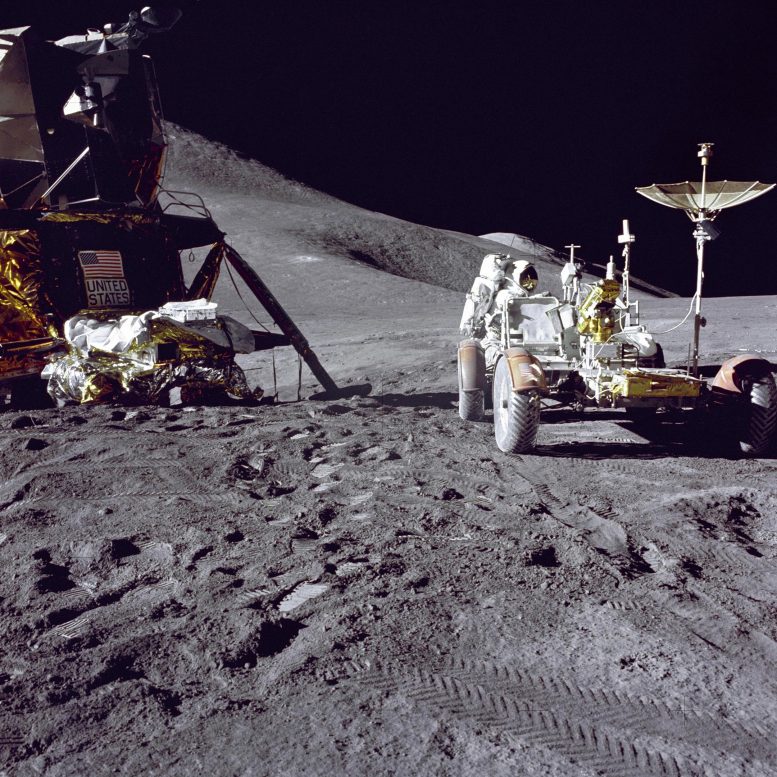
Our first wheels on the Moon. On the Apollo 15 mission, the Lunar Roving Vehicle allowed the astronauts to cover a much greater distance on the Moon than the previous three flights had accomplished. This year marks the 50th anniversary of the Apollo 15 mission. On July 26, 1971, David R. Scott (Commander), James B. Irwin (Lunar Module Pilot) and Alfred M. Worden (Command Module Pilot) launched from Kennedy Space Center’s Launch Complex 39A.
Apollo 15 set several new records for crewed spaceflight: heaviest payload in a lunar orbit of approximately 107,000 pounds, maximum radial distance traveled on the lunar surface away from the spacecraft of about 17.5 miles, most lunar surface moonwalks (three) and longest total of duration for lunar surface moonwalk (18 hours, 37 minutes), longest time in lunar orbit (about 145 hours), longest crewed lunar mission (295 hours), longest Apollo mission, the first satellite placed in lunar orbit by a crewed spacecraft, and first deep space and operational spacewalk.
Video Transcript:
[Man] Guidance, internal.
13
12
11
10
9
8
Ignition sequence start.
Engines on.
5
4
3
2
1
(orchestral music)
Apollo 15 was launched 50 years ago on July the 26th, 1971.
It was a relatively big step from the previous three missions. As President Nixon stated, it would be the most ambitious scientific exploration in space at that time.
The three astronauts were Commander David Scott, Command Module Pilot, Al Worden, and Lunar Module Pilot, Jim Irwin.
The Lunar Rover was an electrically driven, bare-bones car to allow the astronauts to cover much greater distance on the moon than the previous three flights could accomplish.
[Man 2] This is really a rock and roll ride, isn’t it?
Never been on a ride like this before.
Boy, oh boy.
[John] It had a top speed of about eight miles an hour, although I think in later flights, they actually cranked that up to about 11 miles an hour.
Scott and Irwin spent three days exploring the Apennine Hadley region in the Lunar Rover.
There’s actually a plaque on the Lunar Rover vehicle that was left on the moon that says “Man’s first wheels on the moon.”
The heavy focus on science for Apollo 15 was its primary feature. It was achieved two ways. One, of course, with the Lunar Rover vehicle on the moon to gather more lunar data. And secondly, the command service module carried a SIM bay of scientific instruments that allowed Al Worden to gather many photographs and much data as he circled the moon for his three days in orbit.
One of the interesting experiments that Scott performed on the moon was to demonstrate Galileo’s theory that two objects will always drop at the same rate in an airless environment.
[Man 2] Well I’ll drop it.
And I’ll drop the two of them here and hopefully they’ll hit the ground at the same time.
How about that?
[John] Scott and Irwin, while they were doing their lunar rock studies on the moon, came across a single rock that was determined to be over 4 billion years old. It was called the Genesis Rock.
Scott and Irwin spent over 18 hours on the moon, the longest time of any of the Apollo missions at that time. And they gathered 170 pounds of lunar material to bring back. They also set out the Apollo lunar experiments package.
In a private moment, Commander David Scott made a small aluminum statue of an astronaut on the moon to memorialize the 14 astronauts that died in the U.S. and Soviet programs.
The Lunar Rover had a TV camera on it, and for the first time we were privileged to see the asset stage take off from the moon.
After Scott and Irwin were back in the command module, they continued to orbit the moon for two days, and during that time deployed the Particles and Fields satellite.
During the flight back to earth, one of the most important tasks required of the crew was for Al Worden to EVA from the command module and to capture the cassettes that recorded all the data that he’d accumulated during his orbits with the moon.
That was the first time at 197,000 miles from the earth that man has ever done a deep space EVA.
(orchestral music)
During re-entry the burning reaction control system fuel burned through the risers of one of the shoots, and that shoot streamed and effectively became about one fifth of its normal capacity.
Apollo 15 landed on two chutes. It was designed to do that, but it did mean a hard landing, but a safe landing.
Apollo 15 broke several records. The first use of the Lunar Rover, the first deep spacewalk by Al Worden, the heaviest payload in lunar orbit it as 107,000 pounds, and the longest crewed lunar mission of 295 hours.
Apollo 15 achieved all of its objectives and accumulated a wealth of scientific information.
(orchestral music)
Never miss a breakthrough: Join the SciTechDaily newsletter.
Follow us on Google and Google News.
4 Comments
According to the Guinness Book Of Records, the edition of which containing this information I read so long ago that I can’t remember which one, Apollo 15 also set the record for the most payload into low Earth orbit, of 142.5 tons. That was the Apollo, Lunar Lander and Saturn 5 third stage.
I think you need a reality check
what a load of bulldust
http://moonfaker.com/home.html
Never read so much BS in all my life. Do NASA seriously think the general public believe this crap after 50 odd years? If they do then the people who write this stuff must be more delusional than those idiots who believe the Moon landings.
nasascam.atspace.co.uk
View it, take note of what it says, and get back to reality.