
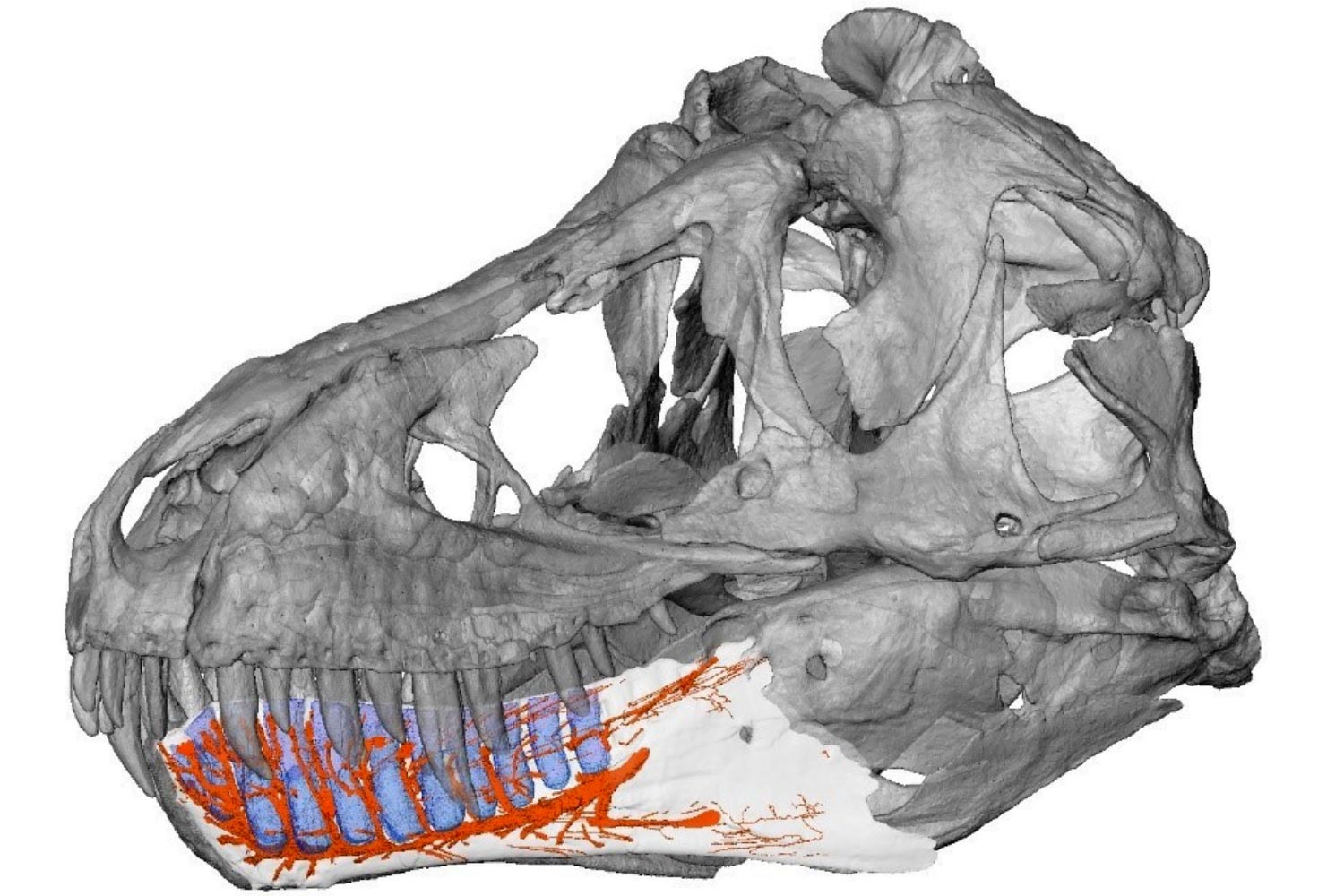
Tyrannosaurus rex’s ‘bite detectors’ better than any other dinosaur studied yet.
Tyrannosaurus rex was not just a huge beast with a big bite, it had nerve sensors in the very tips of its jaw enabling it to better detect – and eat – its prey, a new study published in the peer-reviewed journal Historical Biology today finds.
“T. rex was an even more fearsome predator than previously believed,” explains lead author Dr. Soichiro Kawabe, from the Institute of Dinosaur Research at Fukui Prefectural University, in Japan.
“Our findings show the nerves in the mandible (an area of the jaw) of Tyrannosaurus rex is more complexly distributed than those of any other dinosaurs studied to date, and comparable to those of modern-day crocodiles and tactile-foraging birds, which have extremely keen senses.
“What this means is that T. rex was sensitive to slight differences in material and movement; it indicates the possibility that it was able to recognize the different parts of their prey and eat them differently depending on the situation.
Shattering the Myth of a Bone-Crushing Brute
“This completely changes our perception of T. rex as a dinosaur that was insensitive around its mouth, putting everything and anything in biting at anything and everything, including bones.”
Whilst the morphology of vessels and nerves in the jaw have been analyzed in several fossil reptiles, this study is the very first investigation of the internal structure of the mandible of T. rex.
Dr. Kawabe, who was joined by Dr. Soki Hattori Assistant Professor at the Institute of Dinosaur Research, used computed tomography (CT) to analyze and reconstruct the distribution neurovascular canal of a fossil mandible of T. rex, which was originally found in the Hell Creek Formation, Montana.
They then compared their reconstruction to other dinosaurs such as Triceratops, as well as living crocodiles and birds.
This enabled the researchers to describe the well-preserved canals that houses the vessels and nerves in dentary of Tyrannosaurus rex.
Findings Suggest Enhanced Facial Sensitivity
“The present study reveals the presence of neurovascular canals with complex branching in the lower jaw of Tyrannosaurus, especially in the anterior region of the dentary, and it is assumed that a similarly complex branching neurovascular canal would also be present in its upper jaw,” says Dr. Kawabe.
He added: “The neurovascular canal with branching pattern as complex as that of the extant crocodilians and ducks, suggests that the trigeminal nervous system in Tyrannosaurus probably functioned as a sensitive sensor in the snout.
“It must be noted that the sensitivity of the snout in Tyrannosaurus may not have been as enhanced as that of the crocodilians because Tyrannosaurus lacks the thick neural tissue occupying the neurovascular canal unlike extant crocodiles.
“Nevertheless, the sensitivity of the snout of Tyrannosaurus was considerably greater than that of the ornithischian dinosaurs compared in this study.”
The results of the paper are consistent with analyses of the skull surface of another tyrannosaurid, Daspletosaurus, and the neurovascular canal morphology within the maxilla of allosaurid Neovenator, which indicate that the facial area of theropods may have been highly sensitive.
Broader Implications for T. rex Behavior
“These inferences also suggest that, in addition to predation, tyrannosaurids’ jaw tips were adapted to perform a series of behaviors with fine movements including nest construction, parental care, and intraspecific communication,” Dr. Hattori adds.
Limitations of the study include the team not analyzing the full mandible area of T. rex and other dinosaurs used for comparison, however as the proportion not researched is insignificant, the trend shown “should be a reasonable estimate.”
Reference: “Complex neurovascular system in the dentary of Tyrannosaurus” by Soichiro Kawabe and Soki Hattori, 22 August 2021, Historical Biology.
DOI: 10.1080/08912963.2021.1965137
Never miss a breakthrough: Join the SciTechDaily newsletter.
Follow us on Google and Google News.