
Two newly described dinosaurs from ancient Appalachia reveal distinct evolutionary traits from western species.
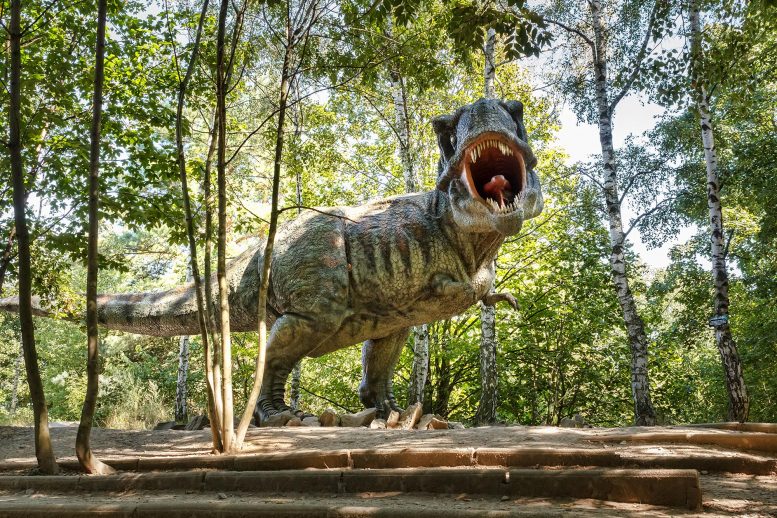
Tyrannosaurus rex, the fearsome predator that once roamed what is now western North America, appears to have had an East Coast cousin.
A new study by Yale undergraduate Chase Doran Brownstein describes two dinosaurs that inhabited Appalachia — a once isolated land mass that today composes much of the eastern United States — about 85 million years ago: an herbivorous duck-billed hadrosaur and a carnivorous tyrannosaur. The findings were published on August 25, 2021, in the journal Royal Society Open Science.
The two dinosaurs, which Brownstein described from specimens housed at Yale’s Peabody Museum of Natural History, help fill a major gap in the North American fossil record from the Late Cretaceous and provide evidence that dinosaurs in the eastern portion of the continent evolved distinctly from their counterparts in western North America and Asia, Brownstein said.
Geographic Isolation and Distinct Dinosaur Evolution
“These specimens illuminate certain mysteries in the fossil record of eastern North America and help us better understand how geographic isolation— large water bodies separated Appalachia from other landmasses — affected the evolution of dinosaurs,” said Brownstein, who is entering his junior year at Yale College. “They’re also a good reminder that while the western United States has long been the source of exciting fossil discoveries, the eastern part of the country contains its share of treasures.”
For most of the second half of the Cretaceous, which ended 66 million years ago, North America was divided into two land masses, Laramidia in the West and Appalachia in the East, with the Western Interior Seaway separating them. While famous dinosaur species like T. rex and Triceratops lived throughout Laramidia, much less is known about the animals that inhabited Appalachia. One reason is that Laramidia’s geographic conditions were more conducive to the formation of sediment-rich fossil beds than Appalachia’s, Brownstein explained.
The specimens described in the new study were discovered largely during the 1970s at the Merchantville Formation in present day New Jersey and Delaware. They constitute one of the only known dinosaur assemblages from the late Santonian to early Campanian stages of the Late Cretaceous in North America. This fossil record period, dating from about 85 to 72 million years ago, is limited, Brownstein noted.
Tyrannosaur Skeleton Reveals Unique Traits
Brownstein examined a partial skeleton of a large predatory therapod, concluding that it is probably a tyrannosaur. He noted that the fossil shares several features in its hind limbs with Dryptosaurus, a tyrannosaur that lived about 67 million years ago in what is now New Jersey. The dinosaur has different hands and feet than T. rex, including massive claws on its forelimbs, suggesting that it represents a distinct family of the predators that evolved solely in Appalachia.
“Many people believe that all tyrannosaurs must have evolved a specific set of features to become apex predators,” Brownstein said. “Our fossil suggests they evolved into giant predators in a variety of ways as it lacks key foot or hand features that one would associate with western North American or Asian tyrannosaurs.”
New Clues to Hadrosaur Evolution and Growth
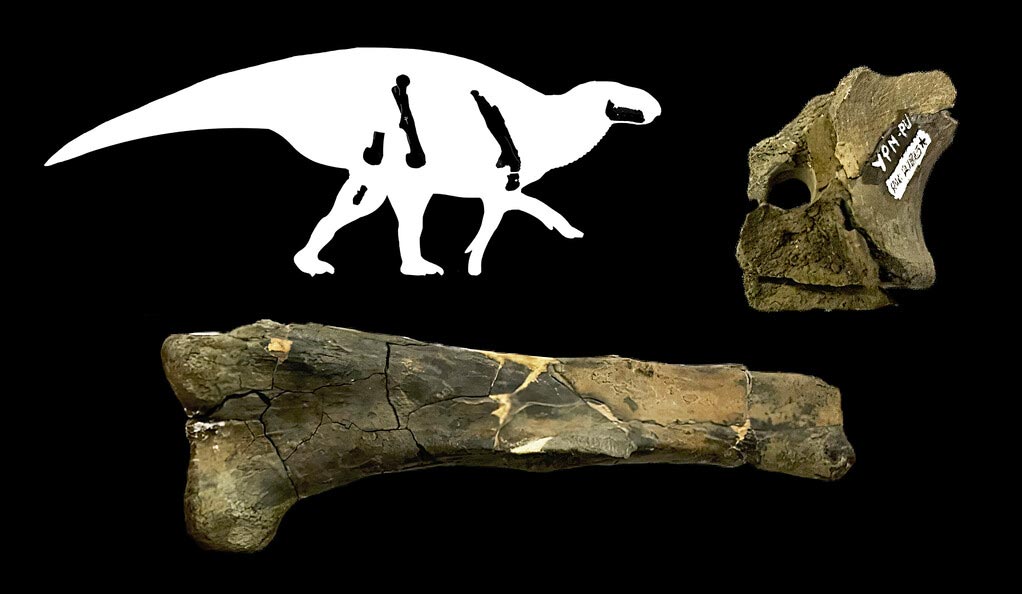
The partial skeleton of the hadrosaur provided important new information on the evolution of the shoulder girdle in that group of dinosaurs, Brownstein found. The hadrosaur fossils also provide one of the best records of this group from east of the Mississippi and include some of the only infant/perinate (very young) dinosaur fossils found in this region.
“Chase’s latest work is a worthy achievement for a researcher at any career stage,” said Peabody Director David Skelly, the Frank R. Oastler Professor of Ecology. “The fact that he’s an undergraduate just illustrates the remarkable potential created when you connect motivated, talented students with the university’s collections. Chase embodies the Peabody’s mission and we’re thrilled to be part of his Yale experience.”
Brownstein, who works as a research associate at the Stamford Museum and Nature Center in Stamford, Connecticut, has previously published his paleontological research in several peer-journals, including Scientific Reports, the Journal of Paleontology, and the Zoological Journal of the Linnaean Society. In addition to eastern North American fossils, he currently focuses his research on the evolution of fishes, lizards, and birds. He is particularly interested in how geographic change and other factors contribute to how fast different types of living things evolve.
He currently works in the lab of Thomas J. Near, curator of the Peabody Museum’s ichthyology collections and professor and chair of the Department of Ecology and Evolutionary Biology at Yale. Brownstein also collaborates with Yale paleontologists Jacques Gauthier and Bhart-Anjan Bhullar in the Department of Earth and Planetary Sciences.
While Brownstein is considering pursuing an academic career in evolutionary biology, he says his research is driven by enjoyment.
“Doing research and thinking about these things makes me happy,” he said. “Like biking, it’s something I love to do.”
Reference: “Dinosaurs from the Santonian–Campanian Atlantic coastline substantiate phylogenetic signatures of vicariance in Cretaceous North America” by Chase Doran Brownstein, 25 August 2021, Royal Society Open Science.
DOI: 10.1098/rsos.210127
Never miss a breakthrough: Join the SciTechDaily newsletter.
Follow us on Google and Google News.