
Close Menu
    Facebook X (Twitter) Instagram
    SciTechDaily
    • Biology
    • Chemistry
    • Earth
    • Health
    • Physics
    • Science
    • Space
    • Technology
    Facebook X (Twitter) Pinterest YouTube RSS
    SciTechDaily
    Home»Space»Lucy Is Going to Space – To Explore Time Capsules From the Birth of Our Solar System
    Space

    Lucy Is Going to Space – To Explore Time Capsules From the Birth of Our Solar System

    By NASASeptember 26, 2021No Comments3 Mins Read
    Facebook Twitter Pinterest Telegram LinkedIn WhatsApp Email Reddit
    Share
    Facebook Twitter LinkedIn Pinterest Telegram Email Reddit
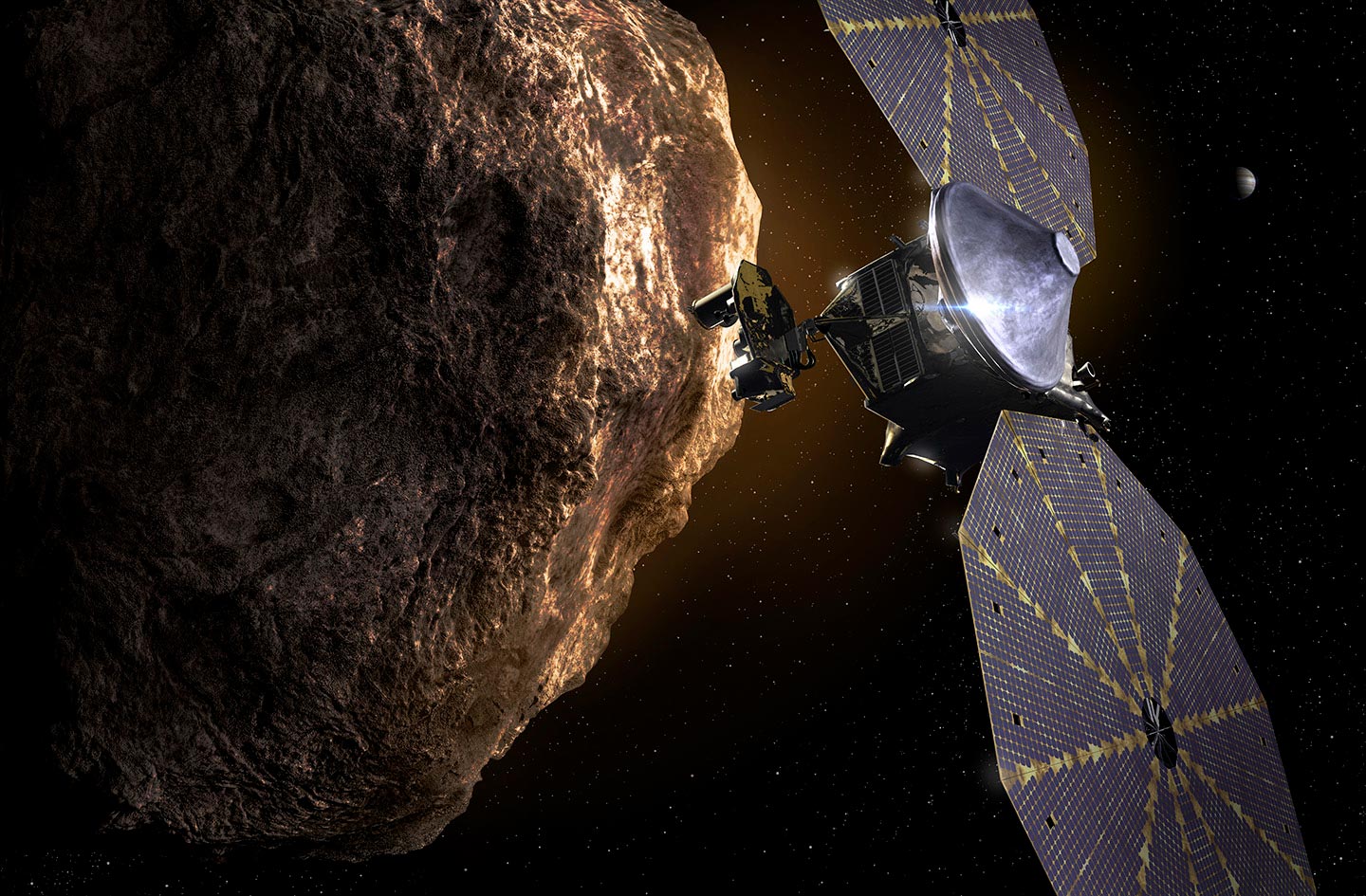
    Lucy Spacecraft at Trojan Asteroid
    Artist’s concept of Lucy spacecraft at Trojan asteroid. Credit: NASA

    NASA’s Lucy will visit eight asteroids, including Trojans locked in Jupiter’s orbit, on a 12-year quest to uncover secrets of the Solar System’s formation and evolution.

    Time capsules from the birth of our Solar System more than 4 billion years ago, the swarms of Trojan asteroids associated with Jupiter are thought to be remnants of the primordial material that formed the outer planets. The Trojans orbit the Sun in two loose groups, with one group leading ahead of Jupiter in its path, the other trailing behind. Clustered around the two Lagrange points equidistant from the Sun and Jupiter, the Trojans are stabilized by the Sun and its largest planet in a gravitational balancing act. These primitive bodies hold vital clues to deciphering the history of the solar system, and perhaps even the origins of organic material on Earth.

    NASA’s Lucy will be the first space mission to study the Trojans. The mission takes its name from the fossilized human ancestor (called “Lucy” by her discoverers) whose skeleton provided unique insight into humanity’s evolution. Likewise, the Lucy mission will revolutionize our knowledge of planetary origins and the formation of the solar system.
    Lucy's Orbital Path
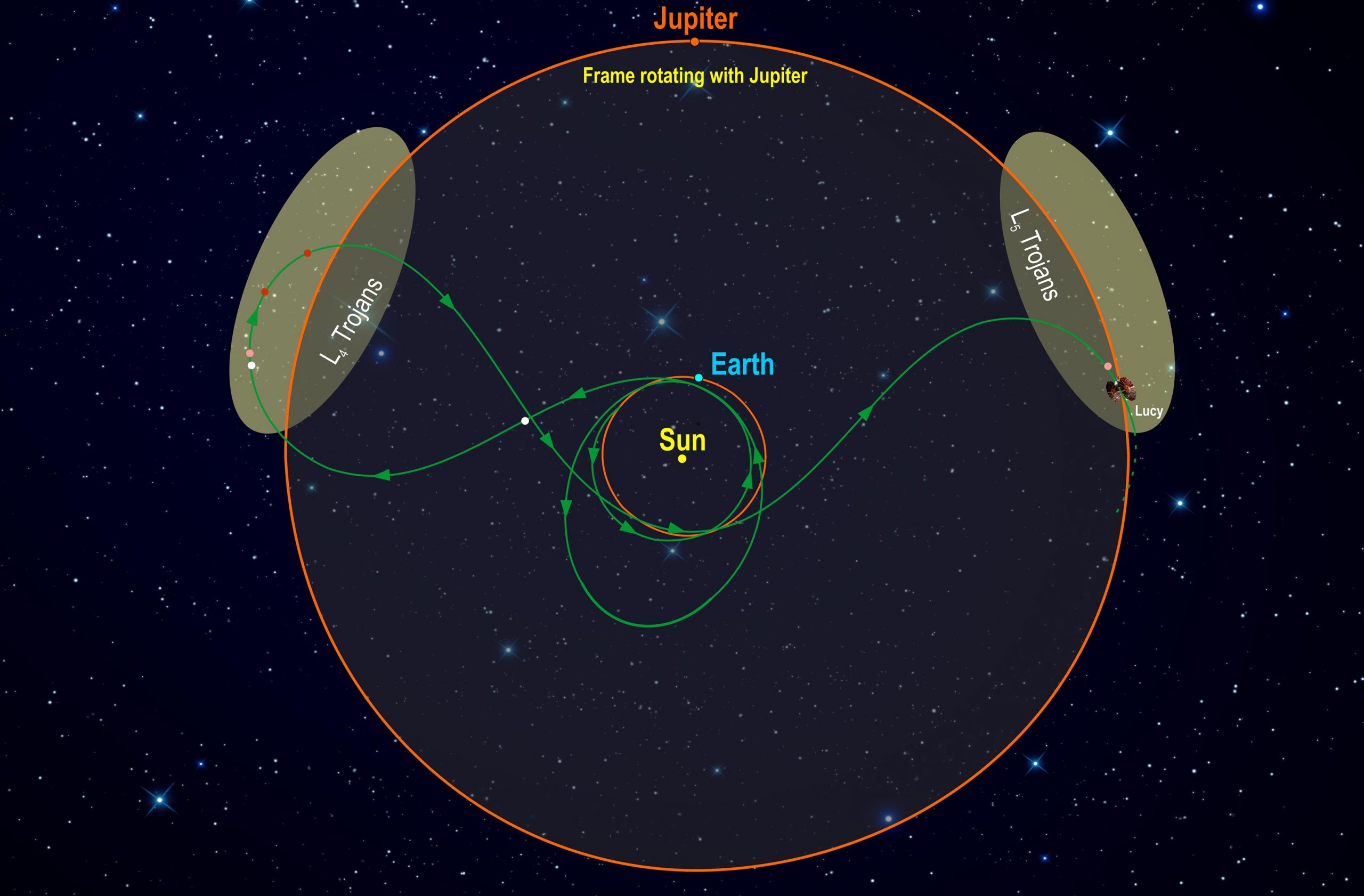
    This diagram illustrates Lucy’s orbital path. Credit: Southwest Research Institute

    Lucy is slated to launch in October 2021 and, with boosts from Earth’s gravity, will complete a 12-year journey to eight different asteroids — a Main Belt asteroid and seven Trojans, four of which are members of “two-for-the-price-of-one” binary systems. Lucy’s complex path will take it to both clusters of Trojans and give us our first close-up view of all three major types of bodies in the swarms (so-called C-, P- and D-types).

    This diagram illustrates Lucy’s orbital path. The spacecraft’s path (green) is shown in a frame of reference where Jupiter remains stationary, giving the trajectory its pretzel-like shape. After launch in October 2021, Lucy has two close Earth flybys before encountering its Trojan targets. In the L4 cloud Lucy will fly by (3548) Eurybates (white) and its satellite, (15094) Polymele (pink), (11351) Leucus (red), and (21900) Orus (red) from 2027-2028. After diving past Earth again Lucy will visit the L5 cloud and encounter the (617) Patroclus-Menoetius binary (pink) in 2033. As a bonus, in 2025 on the way to the L4, Lucy flies by a small Main Belt asteroid, (52246) Donaldjohanson (white), named for the discoverer of the Lucy fossil. After flying by the Patroclus-Menoetius binary in 2033, Lucy will continue cycling between the two Trojan clouds every six years.

    Never miss a breakthrough: Join the SciTechDaily newsletter.
    Follow us on Google and Google News.

    Asteroid Lucy Mission NASA
    Share. Facebook Twitter Pinterest LinkedIn Email Reddit

    Related Articles

    NASA’s Lucy Captures Ice Cream Cone–Shaped Asteroid That Defies Expectations

    NASA’s Lucy Gears Up for a Thrilling Close Encounter With a Mysterious Space Relic

    NASA’s Lucy Mission Gears Up to Meet a 150-Million-Year-Old Space Relic

    NASA’s Lucy Captures First Images of Asteroid Donaldjohanson Ahead of Close Flyby

    Launch Preparations Underway for NASA’s First Mission to the Trojan Asteroids

    The Fascinating Story of How the Trojan Asteroids – Target of NASA’s Lucy Mission – Were Discovered and Named

    NASA’s Big Plans to Explore Small Bodies: DART, Lucy, and Psyche Missions

    NASA’s First Mission to Explore the Trojan Asteroids Passes Critical Milestone

    NASA’s Mission to Jupiter’s Trojan Asteroids Confirms Discovery of “Bonus” Exploration Opportunity

    Leave A Reply Cancel Reply

    • Facebook
    • Twitter
    • Pinterest
    • YouTube

    Don't Miss a Discovery

    Subscribe for the Latest in Science & Tech!

    Trending News

    Could Low Vitamin D Be Making Your Pain Worse?

    Scientists Discover Once-Weekly Workout That Melts Belly Fat Surprisingly Effectively

    Scientists Just Tested a Thruster Powerful Enough for Human Missions to Mars

    Doctors Say Your Ice Pack Might Be Making Injuries Worse

    Scientists Discover 43-Foot Sea Reptile Twice the Size of a Great White Shark

    Bees and Birds Are Drinking Alcohol From Flowers

    Scientists Discover How Obesity May Trigger Alzheimer’s Disease

    Scientists Confirm Alcohol Causes Widespread Health Damage

    Follow SciTechDaily
    • Facebook
    • Twitter
    • YouTube
    • Pinterest
    • Newsletter
    • RSS
    SciTech News
    • Biology News
    • Chemistry News
    • Earth News
    • Health News
    • Physics News
    • Science News
    • Space News
    • Technology News
    Recent Posts
    • Ancient Goose Fossil Challenges Long-Held Theories About New Zealand Birds
    • A Tiny Bright-Blue Octopus Found in the Galápagos Is Completely New to Science
    • Scientists Stop Pancreatic Cancer Before It Starts in Landmark Preclinical Study
    • Scientists Discover Surprising Anti-Aging Power Hidden in Aged Garlic
    • Just Minutes of Intense Exercise Could Slash Disease Risk by 50%
    Copyright © 1998 - 2026 SciTechDaily. All Rights Reserved.
    • Science News
    • About
    • Contact
    • Editorial Board
    • Privacy Policy
    • Terms of Use

    Type above and press Enter to search. Press Esc to cancel.