
An international research team with participation from Mainz and Darmstadt measures neutron form factors with previously unattained precision.
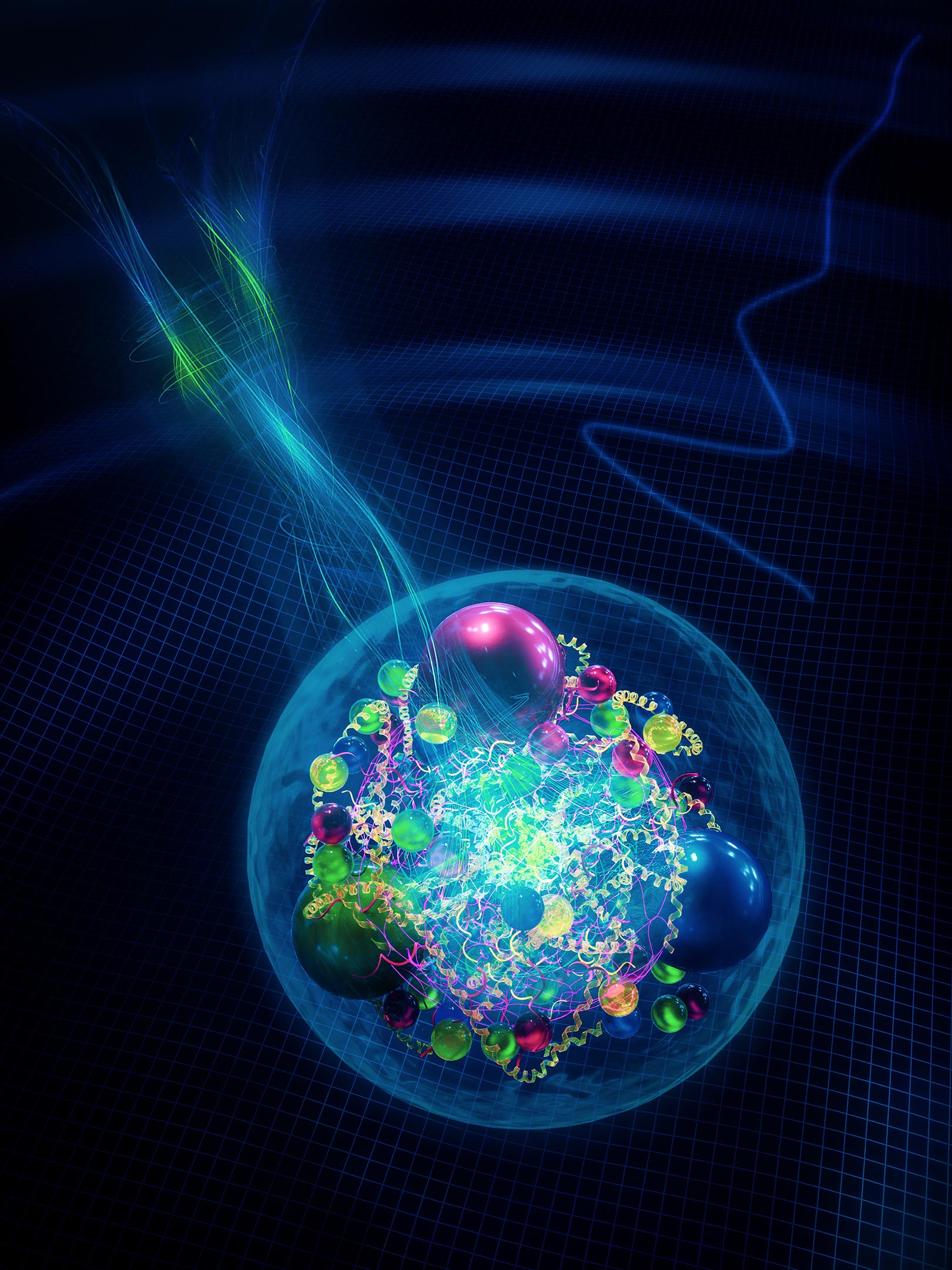
All known atomic nuclei and therefore almost all visible matter consist of protons and neutrons, yet many of the properties of these omnipresent natural building blocks remain unknown. As an uncharged particle, the neutron, in particular, resists many types of measurement and 90 years after its discovery there are still many unanswered questions regarding its size and lifetime, among other things. The neutron consists of three quarks that whirl around inside it, held together by gluons. Physicists use electromagnetic form factors to describe this dynamic inner structure of the neutron. These form factors represent an average distribution of electric charge and magnetization within the neutron and can be determined by means of experimentation.
Blank Space on the Form Factor Map Filled With Precise Data
“A single form factor, measured at a certain energy level, does not say much at first,” explains Professor Frank Maas, a researcher at the PRISMA+ Cluster of Excellence in Mainz, the Helmholtz Institute Mainz (HIM), and the GSI Helmholtzzentrum für Schwerionenforschung Darmstadt. “Measurements of the form factors at various energies are needed in order to draw conclusions on the structure of the neutron.” In certain energy ranges, which are accessible using standard electron-proton scattering experiments, form factors can be determined fairly accurately. However, so far this has not been the case with other ranges for which so-called annihilation techniques are needed that involve matter and antimatter mutually destroying each other.
In the BESIII experiment being undertaken in China, it has recently proved possible to precisely determine the corresponding data in the energy range 2 to 3.8 gigaelectronvolts; as pointed out in the article published in the current issue of Nature Physics by the partnership, this is over 60 times more accurate compared to previous measurements. “With this new data, we have, so to speak, filled a blank space on the neutron form factor ‘map’, which until now was unknown territory,” points out Frank Maas. “This data is now as precise as that obtained in corresponding scattering experiments. As a result, our knowledge of the form factors of the neutron will change dramatically, and as such we will get a far more comprehensive picture of this important building block of nature.”
Truly Pioneering Work in a Difficult Field of Research
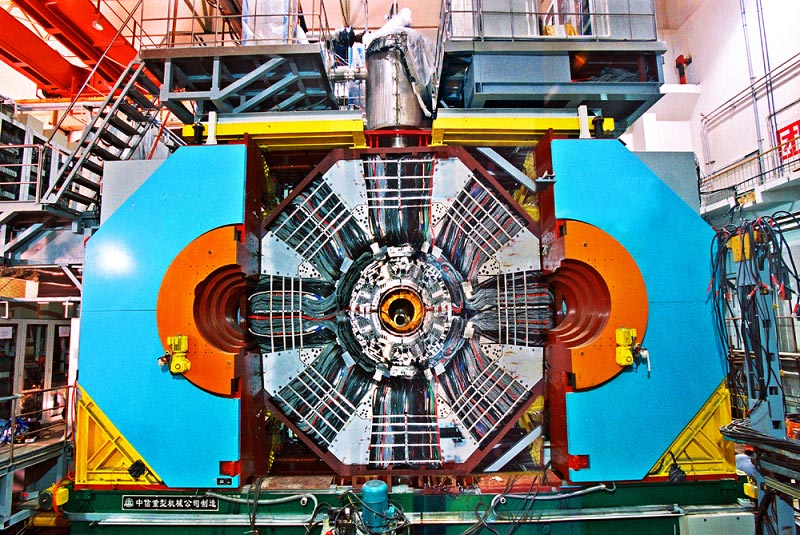
To make inroads into completing the required fields of the form factor ‘map’, the physicists needed antiparticles. The international partnership therefore used the Beijing Electron-Positron Collider II for its measurements. Here, electrons and their positive antiparticles, positrons, are allowed to collide in an accelerator and destroy each other, creating new, other particle pairs – a process known as ‘annihilation’ in physics. Using the BESIII detector, the researchers observed and analyzed the outcome, in which the electrons and positrons form neutrons and anti-neutrons. “Annihilation experiments like these are nowhere near as well-established as the standard scattering experiments,” adds Frank Maas. “Substantial development work was needed to carry out the current experiment – the intensity of the accelerator had to be improved and the detection method for the elusive neutron had to be practically reinvented in the analysis of the experimental data. This was by no means straightforward. Our partnership has done truly pioneering work here.”
Other Interesting Phenomena
As if this were not enough, the measurements showed the physicists that the results for the form factor do not produce a consistent slope relative to the energy level, but rather an oscillating pattern in which fluctuations become smaller as the energy level increases. They observed similar surprising behavior in the case of the proton – here however, the fluctuations were mirrored, i.e., phase-shifted. “This new finding indicates first and foremost that nucleons do not have a simple structure,” explains Frank Maas. “Now our colleagues on the theoretical side have been asked to develop models to account for this extraordinary behavior.”
Finally, on the basis of their measurements, the BESIII partnership has modified how the relative ratio of the neutron to proton form factors needs to be viewed. Many years ago, the result produced in the FENICE experiment was a ratio greater than one, which means that the neutron must have a consistently larger form factor than the proton. “But as the proton is charged, you would expect it to be completely the other way round,” asserts Frank Maas. “And that’s just what we see when we compare our neutron data with the proton data we’ve recently acquired through BESIII. So here we’ve rectified how we need to perceive the very smallest particles.”
From the Micro- to the Macrocosm
According to Maas, the new findings are especially important because they are so fundamental. “They provide new perspectives on the basic properties of the neutron. What’s more, by looking at the smallest building blocks of matter, we can also understand phenomena that occur in the largest dimensions – such as the fusion of two neutron stars. This physics of extremes is already very fascinating.”
Reference: “Oscillating features in the electromagnetic structure of the neutron” by The BESIII Collaboration, 8 November 2021, Nature Physics.
DOI: 10.1038/s41567-021-01345-6
Never miss a breakthrough: Join the SciTechDaily newsletter.
Follow us on Google and Google News.
4 Comments
This is a possible fact,that as indicated by the phase shift in case of proton from neutron has a real base in the electŕon-positron
collider experiments in China.
The energy level is quantized;as the experiment is operated between certain energy boundries.Again oscillating pattern is obtained for energy fluctuation in the çolliding experiments.
So fixed relationships are present for electron,proton and neùtron ìn structure ìncluding their
antiparticĺes.
This is a possible fact,that as indicated by the phase shift in case of proton from neutron has a real base in the electŕon-positron
collider experiments in China.
The energy level is quantized;as the experiment is operated between certain energy boundries.Again oscillating pattern is obtained for energy fluctuation in the çolliding experiments.
So fixed relationships are present for electron,proton and neùtron ìn structure ìncluding their
antiparticĺes.
This can even tell the fact that charge is a product of mass.Considering article conservation,there is no sign of sterile neùtrino.Number and types of particles are fixed.Structure and domain of matter/energy is simply fixèd or static and conserved.The change of particĺes are inter suffle among them governed by certain rigid ĺaws.
This is a possible fact,that as indicated by the phase shift in case of proton from neutron has a real base in the electŕon-positron
collider experiments in China.
The energy level is quantized;as the experiment is operated between certain energy boundries.Again oscillating pattern is obtained for energy fluctuation in the çolliding experiments.
So fixed relationships are present for electron,proton and neùtron ìn structure ìncluding their
antiparticĺes.
This can even tell the fact that charge is a product of mass.Considering article conservation,there is no sign of sterile neùtrino.Number and types of particles are fixed.Structure and domain of matter/energy is simply fixèd or static and conserved.The change of particĺes are inter suffle among them governed by certain rigid ĺaws.
So Physics needs more observations,more experiments and some more Laws.
Years ago, I found out that the structure of all elementary particles would oscillate, and therefore that of the neutron as well. In fact, the neutron oscillates in two ways, that of its core proton and that of its shell.
The neutron structure is physically defined by its core proton and its shell and is mathematically defined by two structural wave functions. One comes up from its proton core and the other one from its shell, formed by a negative charge.
Since the proton has a mass of 938.27 MeV it waves at a high frequency, but the shell waves at a much lower frequency since it has a mass of only 1.29 MeV. In the neutron free state its shell drops out of its proton core and then decays into the quantum state of an electron.
The neutron fine-structure. https://www.researchgate.net/publication/355483381_The_neutron_fine-structure